Introduction
Search engine optimization (SEO) is evolving faster than ever. With artificial intelligence reshaping how people discover information, the rules of visibility are changing. In 2026, SEO is no longer just about ranking on Google—it’s about being present, trusted, and cited across multiple platforms. To help you prepare, here’s a comprehensive look at what leading SEO experts believe will define success in the coming year.
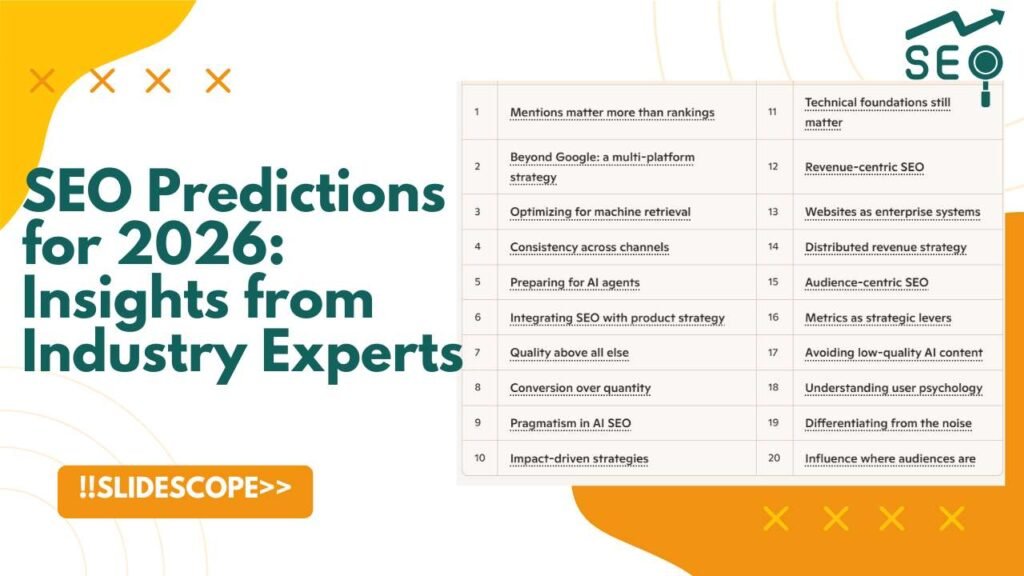
1. Mentions Matter More Than Rankings
Experts emphasize that visibility now depends on being mentioned in the right places. Long-tail, research-driven content and citations from authoritative sources like Reddit, LinkedIn, and niche forums are becoming critical. AI systems rely heavily on these mentions when generating answers.
2. Beyond Google: A Multi-Platform Strategy
SEO professionals must expand their focus beyond Google. AI-driven search utilities pull information from across the web, meaning consistent messaging across platforms is essential. Your brand should be discoverable on TikTok, YouTube, Quora, and other ecosystems.
3. Optimizing for Machine Retrieval
Content must be structured for machines as much as humans. Clear citations, structured data, and semantic clarity ensure that AI systems can retrieve and trust your information. Think of your content as data designed for both people and algorithms.
4. Consistency Across Channels
Every touchpoint—your website, feeds, and listings—should tell the same story. Hidden information should be surfaced in visible text, and pages must be fast, crawlable, and semantically clear. Consistency builds trust with both users and AI systems.
5. Preparing for AI Agents
We’re entering the era of agentic SEO, where AI agents act on behalf of users. Brands must expose products and services through APIs, feeds, and structured data so agents can execute tasks directly. This requires thinking of your website as a machine-operable system.
6. Integrating SEO with Product Strategy
Search and product are now inseparable. Accurate data pipelines and feeds are essential for monitoring performance and ensuring your offerings are visible in AI-driven environments. SEO must align closely with product development.
7. Quality Above All Else
Experts warn against chasing hype. Instead, focus relentlessly on quality. Suboptimal sites—whether technically or editorially—will fail. Success requires being the best in your niche and delivering uncompromising value.
8. Conversion Over Quantity
E-E-A-T (Experience, Expertise, Authoritativeness, Trustworthiness) remains vital. AI favors reputable brands with authentic voices. As AI-generated content floods the web, human creators offering genuine insights will stand out. Focus on conversion potential, not just traffic.
9. Pragmatism in AI SEO
With new tools claiming to optimize for AI answers, professionals must remain pragmatic. The science is still evolving. Stick to fundamentals: branding, technical SEO, and consistent content. Avoid vanity metrics and overpromised solutions.
10. Impact-Driven Strategies
SEO must integrate AI platform knowledge with user behavior insights. Cultural nuances, local search habits, and personalized experiences matter. Embedding this research into content planning ensures strategies drive measurable impact.
11. Technical Foundations Still Matter
Site speed, UX, and information architecture remain critical. Schema markup and internal linking enhance discoverability. Offsite strategies should emphasize brand sentiment and digital PR rather than traditional link building.
12. Revenue-Centric SEO
Traffic alone is insufficient. SEO strategies must be evaluated based on revenue impact. Prioritize projects with clear commercial potential, avoiding fads that don’t contribute to business outcomes.
13. Websites as Enterprise Systems
AI-driven search evaluates entities and synthesizes answers. Visibility requires authoritative data and retrievable content. Websites must function as enterprise systems with durable architecture and reliable data.
14. Distributed Revenue Strategy
Brand authority is replacing traffic volume as the key metric. SEOs need dual strategies: short-term optimization for Google and long-term preparation for fragmented traffic ecosystems. Monetizing attention off-site will become increasingly important.
15. Audience-Centric SEO
SEO must align with broader marketing strategies. Multi-touch attribution reveals the true value of SEO compared to PPC and social. Building owned channels and solving real business problems ensures SEO contributes meaningfully to acquisition strategies.
16. Metrics as Strategic Levers
Organizations must evolve their measurement frameworks. Granular tracking of SERP features and AI mentions reveals competitive gaps. Metrics should connect directly to revenue outcomes, transforming data into actionable levers.
17. Avoiding Low-Quality AI Content
AI-generated content risks degenerating into low-quality “slop.” SEOs must prioritize authentic value, reputation, and authority. Falsehoods will continue to circulate, so professionals must remain vigilant.
18. Understanding User Psychology
SEO must go beyond tactics to understand user psychology. Decisions are often subconscious and shaped by expectations, experiences, and perceptions. Social listening and behavioral metrics can reveal hidden motivations that drive engagement.
19. Differentiating from the Noise
Digital PR and brand mentions from influential sources will outweigh self-promotion. Unique content angles—customer stories, primary research—are essential to stand out in an AI-saturated environment.
20. Influence Where Audiences Are
Ultimately, SEOs must know where audiences seek trusted information and establish influence there. Agentic SEO is developing rapidly, and brands must adapt without being distracted by hype. Focus on fundamentals: user needs and consistent brand presence.
Key Takeaways
- SEO is now search everywhere optimization.
- Trust and authority matter more than keyword rankings.
- Revenue alignment is essential.
- Agentic AI readiness requires structured data and APIs.
- Quality over quantity will differentiate winners from the noise.
Conclusion
SEO in 2026 is less about manipulating rankings and more about ensuring visibility across diverse, AI-driven ecosystems. Success requires adaptability, authenticity, and alignment with business goals. Brands that embrace omnichannel presence, prioritize trust, and deliver genuine value will thrive in the new era of search.
Here’s a 500-word executive summary of the SEO experts’ predictions for 2026, crafted in a concise, professional style suitable for leadership audiences:
Executive Summary: SEO Predictions for 2026
Search engine optimization (SEO) is entering a transformative era shaped by artificial intelligence, evolving user behavior, and fragmented digital ecosystems. Twenty leading SEO experts have outlined how professionals should adapt in 2026. Their collective insights emphasize trust, authority, omnichannel presence, and business alignment as the cornerstones of future success.
Key Shifts in SEO
- Mentions Over Rankings
Visibility now depends less on traditional keyword rankings and more on being cited in authoritative sources. AI-driven search systems prioritize mentions across platforms like Reddit, LinkedIn, and niche communities. - Beyond Google
SEO must expand to encompass multiple platforms. TikTok, YouTube, Quora, and AI interfaces are integral to discovery. Brands must ensure consistent messaging across all digital touchpoints. - Machine-Friendly Content
Content must be structured for retrieval by AI systems. Clear citations, schema markup, and semantic clarity are essential for trust and visibility in machine-generated answers. - Consistency Across Channels
Every brand presence—websites, feeds, listings—must align in language and structure. Fast, crawlable, and semantically clear pages are critical for both human and machine audiences. - Agentic SEO Readiness
AI agents increasingly act on behalf of users. Brands must expose products and services through APIs and structured data, enabling agents to execute tasks directly. - Integration with Product Strategy
Search and product are now inseparable. Accurate data pipelines and feeds ensure offerings are discoverable in AI-driven environments, requiring close collaboration between SEO and product teams. - Quality as a Differentiator
Experts caution against chasing hype. Success requires uncompromising quality in both technical and editorial execution. Suboptimal sites will fail in competitive ecosystems. - Conversion Over Traffic
E-E-A-T principles remain vital. AI favors reputable brands with authentic voices. Human-driven insights and conversion-focused strategies will outperform volume-based approaches. - Pragmatism in AI SEO
With new tools emerging, professionals must remain objective. Fundamentals—branding, technical SEO, and consistent content—remain the foundation of sustainable success. - Revenue Alignment
SEO strategies must be evaluated based on commercial outcomes. Traffic alone is insufficient; projects must demonstrate clear revenue impact.
Emerging Priorities
- Websites as Enterprise Systems: Durable architecture and reliable data are essential for AI-driven retrieval.
- Distributed Revenue Strategy: Brand authority is replacing traffic volume as the key metric.
- Audience-Centric SEO: Multi-touch attribution highlights SEO’s role in acquisition compared to PPC and social.
- Metrics as Strategic Levers: Granular tracking of SERP features and AI mentions connects directly to revenue outcomes.
- Differentiation from Noise: Unique content angles, digital PR, and primary research are vital in an AI-saturated environment.
- User Psychology: Understanding subconscious decision-making enhances engagement and conversion.

Ankit Srivastava is an IT trainer, technology educator, and digital skills mentor with expertise in programming, data analytics, AI, and software development. He has successfully trained thousands of learners, with more than 10,000 student enrollments on Udemy. His practical teaching approach empowers students and professionals to build in-demand technical skills. Colorstech channel where Ankit posts video tutorials has more than 8000 Subscribers.