Introduction to Data Types
Data plays a crucial role in research and analysis across various fields, including social sciences, healthcare, business, and education. Understanding the types of data is essential for researchers and analysts, as it influences the methodology and the interpretation of results. Two primary categories of data are qualitative and quantitative data. Each serves distinct purposes and offers unique insights, facilitating comprehensive understanding in diverse studies.
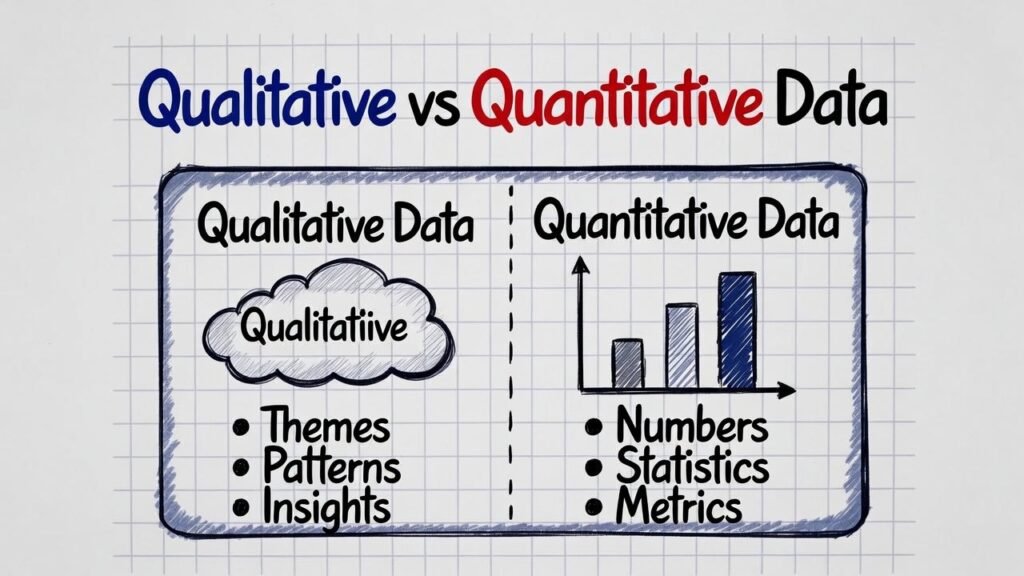
Qualitative data is descriptive in nature and often encompasses non-numerical information. It seeks to capture the essence of experiences, motivations, and behaviors through techniques such as interviews, open-ended surveys, and observations. This type of data allows researchers to delve into complexities, uncovering patterns and themes that quantitative data may overlook. Consequently, qualitative data is particularly valuable in exploring social phenomena, providing in-depth understanding that aids in hypothesis formation and theory development.
On the other hand, quantitative data is numerical and easily quantifiable, making it suitable for statistical analysis. This form of data can be gathered through structured surveys, experiments, or secondary data sources, enabling researchers to derive measurable outcomes. By employing statistical methods, analysts can identify trends, test hypotheses, and draw conclusions that are statistically significant. This quantitative approach is essential in fields such as epidemiology, market research, and economic analysis, where data-driven decisions are paramount.
Although qualitative and quantitative data are distinct, they are not mutually exclusive. Many research projects benefit from a mixed-method approach, integrating both types of data to provide a more holistic view of the subject under investigation. In essence, a thorough understanding of these data types is vital for researchers aiming to employ effective methodologies and achieve robust findings in their work.
Defining Qualitative Data
Qualitative data refers to non-numerical information that essentially captures qualities, characteristics, or descriptive attributes. This type of data is frequently used in fields such as social sciences, psychology, and market research to gain deeper insights into complex phenomena and human behavior. Unlike quantitative data which is expressed in numbers and is useful for statistical analysis, qualitative data provides a more nuanced view of subjects being studied.
Examples of qualitative data include interviews conducted with individuals, open-ended responses given in surveys, and notes taken during observations. Each of these methods allows researchers to explore the thoughts, feelings, and motivations that underlie behaviors and decisions. For instance, interviews can uncover individual experiences and perceptions that are often lost in numerical data. On the other hand, open-ended survey responses can provide rich, descriptive insights that illuminate the reasoning behind respondents’ choices.
Additionally, observational notes allow for detailed accounts of behaviors as they occur in a natural setting. This can be particularly valuable when examining cultural or contextual factors that influence an individual’s actions. By collecting qualitative data through these various methods, researchers can generate hypotheses that quantitative methods can later test, enhancing the overall research process. Ultimately, qualitative data plays a critical role in painting a comprehensive picture of intricate behavioral patterns and social dynamics.
Defining Quantitative Data
Quantitative data refers to information that is expressed in numerical form and can be measured and analyzed using statistical methods. This type of data is particularly valuable in research, as it allows for the precise measurement of variables and can help establish patterns, relationships, and causalities. Quantitative data is typically categorized into two main types: discrete data and continuous data.
Discrete data consists of distinct or separate values, often represented as whole numbers. Examples include the number of students in a class, the amount of cars in a dealership, or the number of correct responses on a test. Because discrete data involves countable quantities, it is instrumental in situations where specific values are needed.
On the other hand, continuous data encompasses measurements that can take on an infinite number of values within a given range. This type of data can include things like height, weight, temperature, and time. Continuous data is measured on a scale and can include decimal points, making it more versatile for detailed analysis.
Quantitative data is often collected through structured methods, such as surveys with closed-ended questions, experiments, and numerical databases. Surveys using fixed response options allow researchers to gather specific information that can be quantified easily. Experiments involve the manipulation of variables to observe outcomes and are fundamental in scientific studies, while numerical databases can house large amounts of quantitative data, facilitating advanced statistical analysis.
The relevance of quantitative data lies in its ability to draw conclusions and make predictions. By analyzing quantitative data, researchers can uncover trends and correlations that inform decision-making processes across various fields, including business, healthcare, and social sciences. Therefore, understanding the principles of quantitative data is essential for anyone engaging in data-driven research or analysis.
Key Differences Between Qualitative and Quantitative Data
Understanding the fundamental differences between qualitative and quantitative data is crucial for researchers and data analysts. Both types of data serve distinct purposes and follow different methodologies throughout the research process.
Firstly, the methods of data collection differ significantly. Qualitative data is typically collected through unstructured or semi-structured techniques such as interviews, focus groups, and open-ended surveys. This approach allows for elaborate, descriptive feedback that provides insights into people’s thoughts and experiences, therefore, illuminating the rationale behind behavior. Conversely, quantitative data relies on structured methods like surveys with closed-ended questions, tests, and numerical assessments. This enables the collection of measurable data that can be analyzed statistically to uncover patterns and trends.
Next, the data analysis techniques are also distinct. Qualitative data analysis focuses on identifying themes, patterns, and narratives within textual or visual data. It involves subjective interpretation and requires deep engagement with the context of the data. In contrast, quantitative analysis employs statistical methods to evaluate numerical data, often resulting in graphs and tables that represent the findings. This analysis leads to concrete conclusions drawn from correlations, averages, or other mathematical computations.
The nature of insights derived from qualitative data tends to be rich and descriptive, providing a deeper understanding of complex phenomena. It is particularly effective in exploratory research, where the goal is to uncover motivations or opinions. On the other hand, quantitative data offers generalizable results that enable researchers to make predictions and validate hypotheses, making it suitable for conclusive studies.
When considering contexts for usage, qualitative data is best utilized in scenarios requiring depth, such as understanding consumer behavior or societal trends, while quantitative data is ideal for situations demanding breadth and measurement, such as market analysis or polling.
Advantages and Limitations of Qualitative Data
Qualitative data offers numerous advantages that make it a valuable resource for researchers and practitioners alike. One of the primary strengths of qualitative data is its ability to provide in-depth insights into complex human behaviors and social phenomena. By employing methods such as interviews, focus groups, and observations, qualitative research allows for the exploration of participants’ feelings, motivations, and experiences, which may not be fully captured through quantitative measures. This richness of information can lead to a deeper understanding of the subject matter, uncovering nuances that are often overlooked.
Another advantage of qualitative data lies in its flexibility in data collection. Researchers can adapt their approaches based on the context of the study and the responses they receive, allowing for a more responsive and iterative research process. This adaptability can be particularly beneficial when exploring new or poorly understood phenomena, as it enables researchers to pursue emergent themes and insights that arise during the data collection phase.
However, while qualitative data provides significant benefits, it is not without its limitations. One major concern is the inherent subjectivity associated with qualitative research. The interpretation of qualitative data can vary significantly among researchers, introducing potential bias into the findings. This subjectivity makes it challenging to ensure reliability and validity, as different analysts may draw different conclusions from the same dataset.
Additionally, the generalizability of qualitative findings can be limited. Unlike quantitative data, which often relies on large sample sizes to infer conclusions about broader populations, qualitative research typically involves smaller, more homogenous samples. As a result, while qualitative data can provide deep insights into specific cases or contexts, the ability to generalize findings to a wider population may be constrained.
Advantages and Limitations of Quantitative Data
Quantitative data offers numerous advantages that make it a favored method among researchers, data analysts, and policymakers. One notable strength is its statistical rigor; quantitative data can be analyzed using a variety of statistical techniques, allowing for rigorous testing of hypotheses. This statistical foundation enhances the reliability and validity of results, making findings more universally applicable. Moreover, quantitative data can often be presented in a clear and concise manner, utilizing graphs, charts, and other visual aids that facilitate comprehension and communication of complex ideas.
Another advantage is the efficiency of data collection and analysis. Tools such as surveys, experiments, or software programs enable the gathering of large datasets quickly. This efficiency allows for the identification of patterns and trends over time, providing insights that are backed by numerical evidence. Consequently, quantitative methods lend themselves well to predicting future outcomes based on historical data.
However, quantitative data is not without its limitations. One significant drawback is the potential for oversimplification of complex issues. While quantitative metrics can provide insights, they often fail to capture the nuanced contexts that qualitative data might reveal. For instance, a survey response may quantify a sentiment but may not delve into the individual experiences or motivations that led to that sentiment. Additionally, reliance solely on numerical data can lead to an incomplete understanding of phenomena, as important qualitative aspects are overlooked.
Furthermore, the rigidity of quantitative research designs can restrict exploration of new or emerging issues. Adhering strictly to predefined variables can limit the scope of inquiry, leaving valuable insights unexplored. As such, while quantitative data serves as a powerful tool, its limitations should be considered in conjunction with qualitative data to facilitate a comprehensive understanding of research questions.
When to Use Qualitative vs. Quantitative Data
When determining the appropriate type of data to use in research, one must first consider the specific research goals and objectives. Qualitative data is often preferred when the aim is to explore complex behaviors, motivations, and perceptions. For instance, when researchers seek to understand why individuals hold certain beliefs or how they experience a particular phenomenon, qualitative methods such as interviews or focus groups are more suitable. These methods allow for deep, narrative insights that quantitative data cannot adequately capture.
In contrast, quantitative data is most beneficial when the research requires measurable or statistical analysis. This type of data is advantageous in studies aiming to establish patterns, test hypotheses, or analyze relationships between variables. For example, surveys with closed-ended questions can yield numerical data that researchers can then analyze using various statistical techniques to derive conclusions. This approach is essential when seeking to generalize findings across larger populations.
Another essential factor in choosing between qualitative and quantitative data is the nature of the subject matter. If the subject is relatively unexplored or complex, qualitative methods may provide richer, more nuanced insights that can inform subsequent quantitative research. On the other hand, when a well-defined issue exists, and the goal is to measure prevalence or impact, quantitative data will typically offer clearer answers.
Case studies demonstrate that the integration of both approaches can often address research questions more comprehensively. For example, a health study might use qualitative interviews to understand patient experiences and quantitative surveys to assess the overall effectiveness of a treatment. Thus, selecting the right type of data hinges on the specific questions being asked and the context in which the research is conducted.
Integrating Qualitative and Quantitative Data
The integration of qualitative and quantitative data in research, commonly referred to as the mixed-methods approach, offers numerous advantages that enhance the overall research outcomes. By combining the strengths of both data types, researchers can gain a more holistic understanding of complex research issues. Qualitative data offers rich, in-depth insights into the experiences and perceptions of individuals, while quantitative data provides the statistical backbone to verify patterns and correlations.
When these methodologies are employed together, they complement each other effectively. For instance, qualitative data can be utilized to formulate hypotheses that are later tested with quantitative data, thus ensuring that the research is grounded in real-world experiences. Alternatively, quantitative findings can guide qualitative research by identifying trends that merit further exploration. This reciprocal relationship enriches the analysis, enabling researchers to understand not only what is happening but also why it is occurring.
Several successful mixed-methods studies exemplify this integrative approach. For example, a research project assessing educational outcomes may first collect quantitative data through standardized test scores, followed by qualitative interviews with students and teachers. This combination can uncover underlying reasons for the observed performance trends and suggest tailored intervention strategies. Furthermore, public health studies often harness mixed methods to correlate numerical data on disease prevalence with qualitative insights from patient interviews, providing a more comprehensive view of health behaviours.
In sum, the integration of qualitative and quantitative data enhances research quality and depth, allowing researchers to address complex problems with greater nuance and practical relevance. The mixed-methods approach not only bridges the gaps between different forms of data but also leads to more informed decision-making and policy development.
Conclusion
In navigating the realms of research and data analysis, understanding the differences between qualitative and quantitative data is paramount. Each type of data offers unique perspectives and insights that can significantly influence the interpretation of results. Qualitative data, characterized by its descriptive nature, provides in-depth insights into human behavior, motivations, and feelings. On the other hand, quantitative data, with its numerical and statistical focus, facilitates the objective analysis of measurable phenomena.
Choosing the appropriate type of data involves careful consideration of the research objectives. In cases where understanding nuanced human experiences is essential, qualitative methods may prevail. Conversely, when the objective is to quantify behaviors or test hypotheses, quantitative approaches are more suitable. Researchers must strive to select the data type that aligns with their goals to achieve effective and meaningful results.
Furthermore, blending both qualitative and quantitative data can often yield richer findings, allowing for a more comprehensive approach to analysis. This mixed-methods strategy harnesses the strengths of both data types, fostering a more holistic understanding of the research question at hand. Thus, it is crucial for researchers to be adept in distinguishing between these methodologies and their respective applications.
In conclusion, a thorough grasp of qualitative and quantitative data is essential for anyone engaged in research. This knowledge not only informs the strategy for data collection but also enhances the overall quality of insights derived from the analysis. Thus, researchers are encouraged to remain mindful of their chosen approach and its implications in the context of their specific research objectives.

Ankit Srivastava is an IT trainer, technology educator, and digital skills mentor with expertise in programming, data analytics, AI, and software development. He has successfully trained thousands of learners, with more than 10,000 student enrollments on Udemy. His practical teaching approach empowers students and professionals to build in-demand technical skills. Colorstech channel where Ankit posts video tutorials has more than 8000 Subscribers.