Introduction
Hi, I’m Ankit, and if you’re reading this in 2026 with the goal of becoming a Software Developer or Software Engineer, let me start by saying one honest thing — this is still one of the best careers in the world, but only if you approach it the right way.
The software industry has changed dramatically over the last few years. Coding is no longer a “special skill” that only a few people possess. AI can now generate code, fix bugs, and even suggest architecture. Tutorials are everywhere. Bootcamps promise jobs in months. And yet, companies continue to struggle to find good developers. This gap exists because learning how to code is easy — learning how to think like a software engineer is not.
In 2026, a software developer is expected to do much more than write syntactically correct programs. You are expected to understand how systems behave under load, how users interact with applications, how data flows securely, and how business requirements translate into technical decisions. The role demands problem-solving ability, clarity of thought, and the discipline to build maintainable systems — not just working demos.
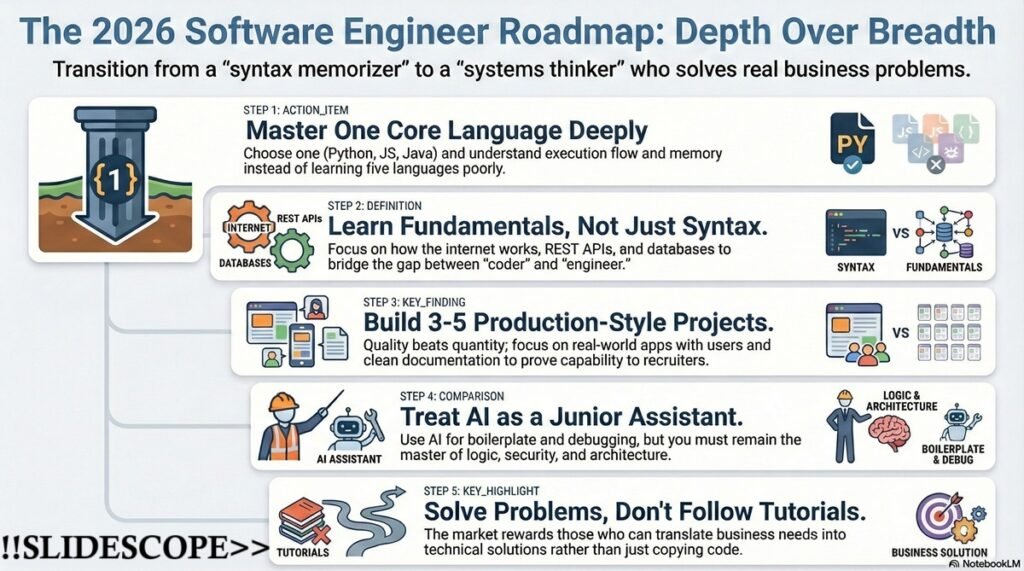
I’ve seen too many learners get stuck chasing trends: learning five programming languages without mastering one, jumping from framework to framework, or blindly following YouTube tutorials without understanding what’s happening behind the scenes. This roadmap is written to break that cycle. It is designed to help you build depth before breadth, confidence before complexity, and real-world capability before certifications.
This guide is not only for college students. It is equally relevant for working professionals trying to switch careers, freelancers who want stability, and engineers who feel left behind in an AI-driven market. Whether you come from a computer science background or not, what matters most in 2026 is your ability to learn continuously, adapt quickly, and build reliably.
Software engineering is a long-term profession. There are no shortcuts that last. The developers who grow consistently are those who respect fundamentals, write clean and readable code, understand trade-offs, and communicate clearly with both technical and non-technical stakeholders. This roadmap reflects that reality.
If you follow this roadmap with honesty and discipline, you won’t just become “job-ready.” You’ll become someone teams can rely on — an engineer who understands the bigger picture, not just the next line of code. And in 2026 and beyond, that is exactly the kind of software developer the industry rewards.
1. Understand What “Software Developer” Really Means in 2026
Before touching a single line of code, you must fix one dangerous misconception.
In 2026, a software developer is not someone who just writes code.
A modern software developer is expected to:
- Solve business problems
- Work with AI tools
- Read other people’s code
- Debug complex systems
- Collaborate with designers, managers, and data teams
- Understand performance, security, and scalability
The market no longer rewards syntax memorization.
It rewards thinking in systems.
Key reality shifts in 2026:
- AI can write boilerplate code
- Juniors are expected to deliver faster
- Companies want problem solvers, not tutorial followers
- One good full-stack developer beats three average ones
You must decide early:
- Web Developer?
- Backend Engineer?
- Mobile App Developer?
- Data / AI Engineer?
- Cloud / DevOps Engineer?
👉 Clarity here saves 2–3 years of confusion later.
2. Choose ONE Core Programming Language (Go Deep, Not Wide)
In 2026, learning 5 languages badly is useless.
You must master one primary language, understand its ecosystem, and use AI to support others.
Best core language choices (2026-safe):
- Python – Web, AI, automation, data, backend
- JavaScript / TypeScript – Frontend + Backend (Node.js)
- Java – Enterprise, fintech, large systems
- C# – Microsoft stack, enterprise, game dev
- Go – Cloud, DevOps, high-performance backend
What “mastery” actually means:
- You understand memory, execution flow, errors
- You can debug without Googling every error
- You know common design patterns
- You can read unfamiliar code confidently
What NOT to do:
❌ Jump languages every month
❌ Chase “trending” tech without fundamentals
❌ Copy-paste without understanding
👉 One language + strong fundamentals beats everything.
3. Learn Data Structures & Algorithms (But Do It the Right Way)
DSA is not about cracking FAANG only.
It trains your brain to think like an engineer.
In 2026:
- AI helps write code
- You are hired for thinking, not typing
What to focus on:
- Arrays, Strings, HashMaps
- Linked Lists, Stacks, Queues
- Recursion and Iteration
- Trees & Graphs (basic level)
- Time & Space Complexity
How to learn DSA correctly:
- Solve fewer problems deeply
- Visualize solutions
- Write brute force → optimize
- Explain solutions in plain English
Use platforms like LeetCode and HackerRank, but don’t turn it into a rat race.
👉 DSA gives you confidence, not just interview prep.
4. Master Software Engineering Fundamentals (This Is Where Most Fail)
Most “developers” fail not because of coding — but because they don’t understand how software works.
You must learn:
Core engineering concepts:
- How the internet works (HTTP, HTTPS, DNS)
- Client-server architecture
- REST APIs
- Authentication & authorization
- Databases (SQL + NoSQL basics)
- Caching
- Logging and monitoring
Version control:
- Git (branches, merges, pull requests)
- Collaboration workflows on GitHub
Why this matters:
In interviews, companies ask:
“How would you design this system?”
Not:
“What is the syntax of for loop?”
👉 This is the difference between a coder and an engineer.
5. Build Real Projects That Solve Real Problems
Certificates don’t get jobs.
Projects do.
In 2026, your GitHub profile is more important than your resume.
What makes a strong project:
- Solves a real-world problem
- Has users (even 10 users matter)
- Uses APIs
- Handles errors properly
- Has clean README documentation
Project ideas:
- Expense tracker with authentication
- Job portal with filters and admin panel
- AI-powered content analyzer
- Chat application
- SaaS dashboard with analytics
Key rule:
❌ Don’t build 20 tiny projects
✅ Build 3–5 solid, production-style projects
Deploy them live using cloud platforms.
👉 Recruiters check your projects before your degree now.
6. Learn Databases, APIs, and Backend Logic Properly
Frontend alone is not enough in 2026 unless you’re a specialist UI engineer.
You must understand backend fundamentals:
- CRUD operations
- API design
- Database relationships
- Transactions
- Indexing
- Security basics
Databases to learn:
- SQL (PostgreSQL / MySQL)
- One NoSQL (MongoDB / Redis)
API skills:
- RESTful API design
- Authentication tokens (JWT)
- Rate limiting
- Error handling standards
Backend knowledge gives you:
- Higher salary
- More roles
- Faster career growth
👉 Full-stack understanding = job security.
7. Understand Cloud, DevOps & Deployment (Non-Negotiable in 2026)
If you can’t deploy your app, you’re not production-ready.
Minimum cloud skills:
- Linux basics
- Hosting applications
- Environment variables
- CI/CD basics
- Docker fundamentals
Why companies care:
- Everyone deploys software
- Cloud reduces costs
- Engineers must own their deployments
You don’t need to master everything — but you must understand the flow.
👉 A developer who deploys is always preferred over one who can’t.
8. Learn to Work With AI (Not Compete Against It)
AI is not replacing developers.
Developers using AI are replacing those who don’t.
How AI fits your workflow:
- Code generation
- Debugging assistance
- Test case creation
- Documentation
- Refactoring
Your responsibility:
- Verify logic
- Optimize performance
- Ensure security
- Make architectural decisions
If you blindly trust AI output, you will fail interviews and jobs.
👉 Treat AI as a junior assistant, not a senior engineer.
9. Prepare for Interviews Like a Professional (Not a Student)
Interview preparation is a skill.
What companies test:
- Problem-solving approach
- Communication
- Trade-off analysis
- Code readability
- Debugging skills
What to practice:
- Explaining code aloud
- Whiteboard thinking
- System design basics
- Behavioral questions
Resume truth:
- One strong project > 10 weak skills
- Clear explanations matter
- Fake experience is easily caught
👉 Interviewers hire confidence + clarity, not perfection.
10. Build a Long-Term Career Mindset (This Is the Final Secret)
Software development is not a 6-month shortcut career anymore.
To survive and grow:
- Keep learning continuously
- Read other people’s code
- Follow engineering blogs
- Improve communication skills
- Understand business impact
Career progression path:
- Junior Developer
- Software Engineer
- Senior Engineer
- Tech Lead / Architect / Manager
Each step requires thinking evolution, not just better code.
👉 The best developers are calm problem solvers, not ego coders.
Final Words: The 2026 Reality Check
If you:
- Learn fundamentals deeply
- Build real projects
- Use AI wisely
- Understand systems
- Communicate clearly
👉 You will get hired.
There is no shortage of software jobs.
There is a shortage of good software engineers.

Ankit Srivastava is an IT trainer, technology educator, and digital skills mentor with expertise in programming, data analytics, AI, and software development. He has successfully trained thousands of learners, with more than 10,000 student enrollments on Udemy. His practical teaching approach empowers students and professionals to build in-demand technical skills. Colorstech channel where Ankit posts video tutorials has more than 8000 Subscribers.