Introduction
Job hunting is not just a professional journey — it’s an emotional rollercoaster. I have worked with students, corporate professionals, career switchers, and even senior managers who all faced the same invisible challenge during their job search: motivation fatigue.
With years of experience in IT training, digital transformation, and career mentoring, I can confidently say this — the job hunt tests your mindset more than your skillset. You may have the right qualifications, certifications, experience, and technical expertise. Yet, rejection emails, unanswered applications, and delayed responses can slowly impact your confidence.
The modern job market is highly competitive. AI screening tools filter resumes before human eyes even see them. Recruiters receive hundreds of applications within hours. LinkedIn is filled with “I’m excited to announce…” posts while you are still refreshing your inbox.
And that’s where the mental battle begins.
Motivation during a job hunt is not about blind positivity. It is about structure, clarity, emotional control, and strategic action. It’s about creating a system that protects your confidence while you navigate uncertainty.
In this article, I will share practical, real-world strategies that I personally recommend to professionals who are actively searching for jobs. These are not theoretical tips. These are structured methods that help you maintain focus, productivity, and self-belief.
Let’s begin.
1. Redefine the Job Hunt as a Project, Not a Problem
The first shift you must make is mental.
Stop treating your job hunt as a crisis. Start treating it as a project.
When you treat unemployment or career transition as a problem, your mind goes into fear mode. When you treat it as a project, your mind goes into execution mode.
In project management, we define:
- Clear objectives
- Defined timelines
- Measurable milestones
- Weekly progress tracking
Apply the same to your job hunt.
Instead of saying:
“I need a job urgently.”
Define:
- Target role
- Target industry
- Expected salary range
- 30-day, 60-day, 90-day strategy
For example:
Week 1–2: Resume optimization + LinkedIn branding
Week 3–4: Targeted applications + networking outreach
Week 5–8: Skill enhancement + interview preparation
Once you structure your search like this, your anxiety reduces. You stop reacting emotionally and start acting strategically.
Motivation improves when clarity improves.
2. Set Process Goals, Not Outcome Goals
Most job seekers say:
- “I want a job in 30 days.”
- “I want a 10 LPA package.”
- “I want to get selected in this company.”
These are outcome goals. They depend on external decisions.
Instead, focus on process goals:
- Apply to 5 quality roles per day
- Send 3 networking messages daily
- Improve 1 skill every week
- Practice 30 minutes of interview Q&A daily
Outcome is uncertain. Process is controllable.
When you focus on daily actions, you feel productive. And productivity builds confidence.
Even if you don’t get interview calls immediately, you still feel progress because you executed your plan.
Motivation dies when effort feels wasted.
Motivation survives when effort feels measurable.
Track your daily activities in a simple Excel sheet or Notion dashboard. At the end of the week, review your consistency, not your rejection count.
3. Create a Fixed Daily Routine
One of the biggest motivation killers during job hunting is lack of structure.
When you don’t have an office to go to, your brain slowly slips into irregular sleep patterns, inconsistent productivity, and overthinking cycles.
Create a disciplined routine:
Morning (8 AM – 11 AM)
High-focus tasks:
- Resume customization
- Applications
- Networking
Afternoon (12 PM – 3 PM)
Skill development:
- Certifications
- Online learning
- Practice projects
Evening (4 PM – 6 PM)
Interview prep + Follow-ups
After 6 PM, disconnect from job search.
If you keep checking job portals at midnight, your anxiety increases. Set boundaries.
A structured day reduces emotional volatility.
When your routine is strong, your motivation doesn’t depend on mood.
4. Limit Social Media Comparison
LinkedIn can inspire you — but it can also drain you.
When you see others announcing promotions or new jobs, your mind starts questioning your progress.
Remember this:
You are seeing their highlights, not their struggle timeline.
Behind every “Excited to share…” post, there were likely dozens of rejections.
If LinkedIn affects your mindset:
- Log in only during application hours
- Avoid scrolling the feed
- Use it as a tool, not entertainment
Comparison destroys motivation faster than rejection.
Focus on your path.
5. Upgrade Skills During the Waiting Period
Waiting without growth feels like stagnation.
Waiting with improvement feels like preparation.
Use this time wisely.
Ask yourself:
- Is my industry evolving?
- Are new tools in demand?
- Can I add one certification in 30 days?
For IT professionals:
- Learn a new dashboard tool
- Build a portfolio project
- Improve automation skills
For marketing professionals:
- Learn performance ads
- Practice SEO audit
- Improve analytics understanding
For freshers:
- Create real projects
- Build GitHub profile
- Improve communication
Every new skill adds psychological strength.
When you know you’re becoming better daily, rejection hurts less.
6. Separate Identity from Employment
This is critical.
Your job is not your identity.
Your designation is not your worth.
When people lose jobs, they feel they lost value. That is incorrect thinking.
You are:
- Your skills
- Your experience
- Your adaptability
- Your resilience
Employment is temporary.
Capability is permanent.
The moment you detach self-worth from employment status, emotional pressure reduces dramatically.
Motivation improves when self-esteem is protected.
7. Build a Support System
Isolation magnifies negativity.
Talk to:
- Mentors
- Friends in the industry
- Family members
- Professional communities
Join job search groups where people share interview experiences.
Sometimes, just knowing that others are also in the same phase reduces mental stress.
Do not suffer silently.
Job hunting is mentally demanding. Community reduces burnout.
8. Celebrate Small Wins
Did you:
- Update your resume professionally?
- Complete a certification?
- Get a recruiter reply?
- Clear one interview round?
Celebrate it.
Don’t wait for the final offer letter to feel proud.
Motivation is sustained by recognizing progress.
Small wins compound into big breakthroughs.
9. Manage Rejection Rationally
Rejection is data, not judgment.
If you didn’t get selected:
- Was it skill mismatch?
- Salary expectation mismatch?
- Cultural fit?
- Internal referral candidate?
Often, rejection has nothing to do with your capability.
Create a feedback journal:
- Which interviews went well?
- Where did you struggle?
- Which questions confused you?
Treat rejection like performance analytics.
Improve, refine, repeat.
That’s how professionals grow.
10. Maintain Physical Health
Energy affects mindset.
Simple habits:
- 30-minute walk daily
- Proper sleep
- Balanced diet
- Limited caffeine
When the body is weak, motivation collapses faster.
A strong body supports a strong mind.
Job hunting is not a test of luck. It is a test of consistency, emotional intelligence, and structured execution.
If you stay disciplined, improve continuously, and protect your mindset, results will come.
In Part 2, I will discuss:
- Handling long job gaps confidently
- Staying motivated after multiple rejections
- Financial stress management during job search
- Interview psychology
- Long-term career resilience
Stay consistent. Your breakthrough may be closer than you think.
Conclusion
Job hunting is one of the most misunderstood phases of a professional career. People think it is about sending resumes and waiting for interview calls. In reality, it is a deep test of patience, emotional strength, discipline, and belief in yourself.
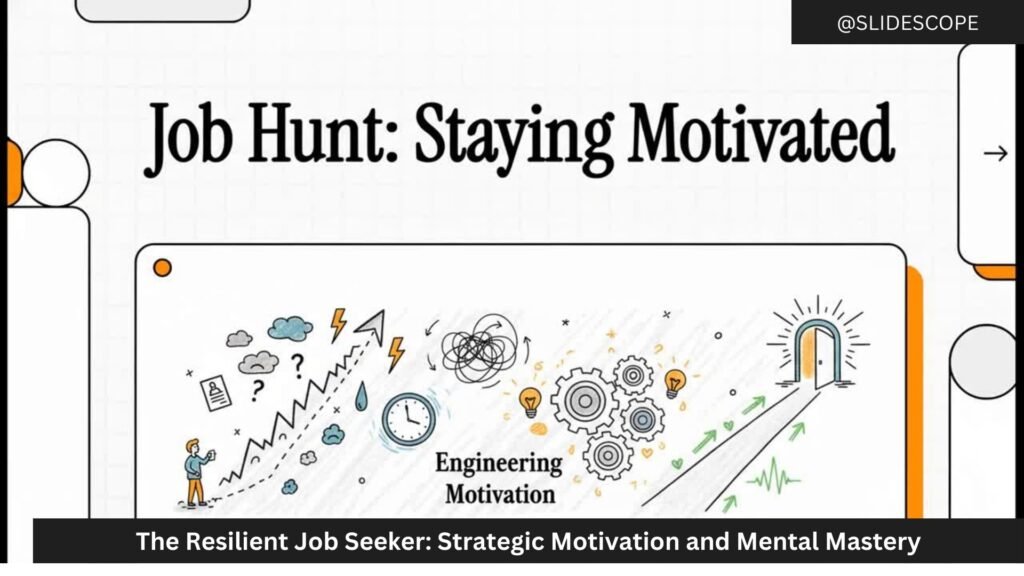
Throughout this article, I have emphasized one core idea — motivation during a job hunt is not automatic. It is engineered.
You build it through structure.
You protect it through routine.
You strengthen it through growth.
You sustain it through mindset.
The biggest mistake job seekers make is tying their emotional stability to external validation. One rejection email and confidence drops. One week without calls and self-doubt increases. But if you understand this clearly — hiring decisions depend on many variables beyond your control — you will stop personalizing rejection.
Remember, companies hire based on timing, budget, internal politics, referrals, project requirements, and role clarity. Sometimes the position itself gets closed. Sometimes they choose someone internally. Sometimes they want a slightly different profile. None of this defines your worth.
What defines you is how you respond.
If you respond by improving your resume, upgrading your skills, refining your interview communication, and staying consistent — you are growing. Growth never goes to waste.
I want you to think about this phase differently.
Instead of saying, “I am unemployed,” say, “I am in a transition period.”
Instead of saying, “Nothing is working,” say, “I am refining my strategy.”
Instead of saying, “I am behind,” say, “I am preparing for a better opportunity.”
Language shapes psychology. Psychology shapes action. Action shapes results.
Also understand this deeply: many successful professionals faced long job searches at some point in their careers. What separates those who succeed from those who quit is persistence with intelligent adjustment.
Discipline beats motivation.
On days when you don’t feel inspired, follow your routine anyway.
On days when rejection hurts, review your process anyway.
On days when comparison triggers doubt, disconnect and focus anyway.
Consistency creates momentum. Momentum creates confidence. Confidence attracts opportunities.
Another important lesson: never stop learning during your job search. When you keep improving your skills, you are increasing your market value daily. Even if one opportunity rejects you, the next one may require exactly the new skill you just learned.
Think long term.
Your career is not built in one hiring cycle. It is built over decades. A few months of struggle does not define a 30-year professional journey.
Financial pressure, family expectations, peer comparison — all of these are real. I understand that. But emotional panic never improves decision-making. Structured action does.
Track your efforts.
Review weekly.
Improve strategically.
Rest when needed.
Resume with clarity.
And most importantly, protect your self-respect.
You are more than a designation.
You are more than a salary package.
You are more than a LinkedIn update.
This phase will pass. What will remain is the resilience you build during it.
If you stay patient, disciplined, and growth-oriented, the right opportunity will align — not just any job, but one that fits your capability and long-term direction.
Trust your preparation.
Trust your progress.
Trust your timing.
Your breakthrough is not a matter of “if.” It is a matter of “when.”
Keep moving forward.

Ankit Srivastava is an IT trainer, technology educator, and digital skills mentor with expertise in programming, data analytics, AI, and software development. He has successfully trained thousands of learners, with more than 10,000 student enrollments on Udemy. His practical teaching approach empowers students and professionals to build in-demand technical skills. Colorstech channel where Ankit posts video tutorials has more than 8000 Subscribers.