By Ankit Srivastava
In today’s digital economy, marketing without data is gambling.
Every click, scroll, impression, lead, conversion, abandonment, and repeat purchase leaves behind a signal. A Marketing Data Analyst is the professional who turns those signals into revenue-driving decisions.
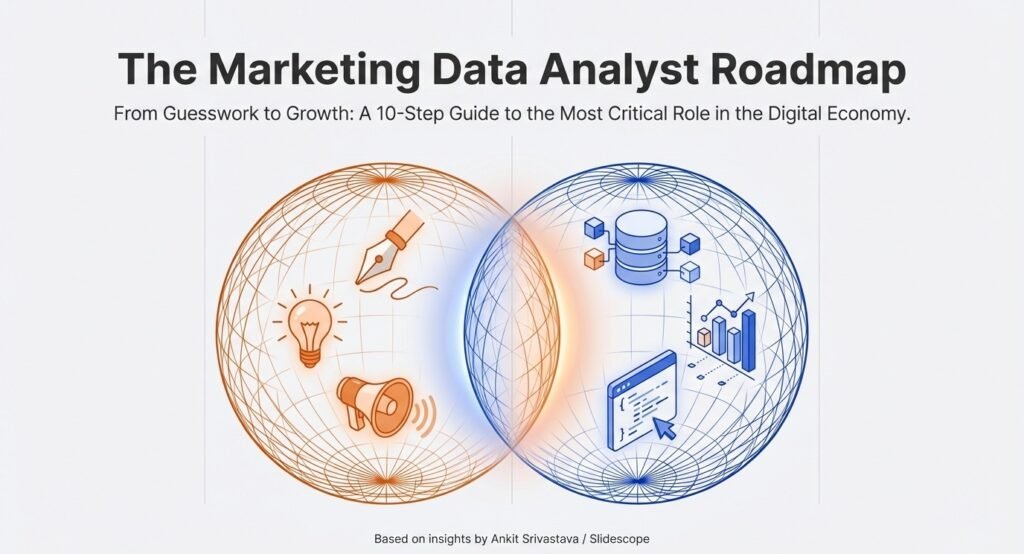
This role sits at the intersection of:
- Digital Marketing
- Data Analytics
- Business Strategy
- Customer Psychology
- Performance Optimization
Unlike a general Data Analyst, a Marketing Data Analyst focuses on:
- Customer acquisition
- Campaign performance
- Funnel optimization
- Attribution modeling
- ROI measurement
- Customer segmentation
- Retention analytics
If you want to become a serious Marketing Data Analyst, you must build a layered skill stack — not just learn tools.
Here is the complete roadmap.
1️⃣ Build Strong Foundations in Marketing Concepts
Before analytics, you must understand marketing itself.
If you don’t understand:
- Customer journey
- Marketing funnel
- Awareness vs consideration vs conversion
- Paid vs organic traffic
- Brand vs performance marketing
Then your analysis will lack context.
Core Marketing Concepts You Must Learn
- AIDA model
- TOFU, MOFU, BOFU funnel
- CAC (Customer Acquisition Cost)
- LTV (Lifetime Value)
- Conversion Rate
- CPL (Cost Per Lead)
- ROAS (Return on Ad Spend)
- Marketing attribution
- Buyer persona
Without marketing knowledge, you’ll just be running reports — not driving strategy.
Understanding the Core Role of a Marketing Data Analyst
Before tools, before SQL, before dashboards — you must understand the job.
A Marketing Data Analyst answers five primary questions:
1. Where are customers coming from?
(Channel analysis)
2. How much does it cost to acquire them?
(CAC analysis)
3. Which campaigns drive the highest quality users?
(LTV comparison)
4. Where are we losing users in the funnel?
(Funnel drop-off analysis)
5. How can we increase revenue efficiently?
(Optimization modeling)
If you don’t deeply understand these five areas, you will never become strategic.
2️⃣ Master Excel & Spreadsheet Analytics
Excel is still the backbone of marketing analytics.
You must master:
- Pivot Tables
- VLOOKUP / XLOOKUP
- INDEX MATCH
- Conditional formatting
- Advanced formulas
- Data cleaning
- Basic forecasting
Why Excel?
Because most marketing data initially comes in CSV exports:
- Google Ads data
- Meta Ads reports
- CRM exports
- Email campaign lists
If you cannot manipulate data in Excel efficiently, you’ll always depend on others.
3️⃣ Learn SQL – The Core Data Skill
Marketing data lives in:
- CRM databases
- Website event tables
- Lead tables
- Transaction tables
You must know SQL to:
- Calculate campaign ROI
- Track multi-touch attribution
- Analyze user journeys
- Build cohort retention
- Segment high-value users
Focus on:
- JOINS
- GROUP BY
- CASE statements
- Date functions
- Window functions
SQL transforms you from a report viewer to a real analyst.
4️⃣ Master Web & Digital Analytics Tools
A Marketing Data Analyst must deeply understand:
- Google Analytics 4
- Google Ads
- Meta Ads Manager
- Google Tag Manager
You Must Learn:
- Event tracking
- UTM parameters
- Conversion tracking
- Enhanced ecommerce tracking
- Attribution reports
- Funnel exploration
- Traffic source analysis
A strong Marketing Data Analyst understands tracking implementation — not just dashboards.
5️⃣ Understand Paid Marketing Metrics Deeply
You must know how to interpret:
- CTR (Click Through Rate)
- CPC (Cost Per Click)
- CPM (Cost Per 1000 impressions)
- CPA (Cost Per Acquisition)
- ROAS
- Quality Score
- Impression share
But more importantly:
You must know what to optimize and when.
Example:
High CTR but low conversion?
→ Landing page issue.
Low CTR?
→ Creative or targeting issue.
High CPA?
→ Funnel inefficiency or wrong audience.
6️⃣ Learn Data Visualization & Dashboarding
Marketing leaders don’t want spreadsheets.
They want:
- Clear dashboards
- Executive summaries
- ROI insights
Learn:
- Power BI
- Tableau
- Looker Studio
Build dashboards that show:
- Campaign performance
- Channel comparison
- Conversion funnels
- Revenue attribution
- Monthly trends
Remember:
Good dashboards answer business questions.
Bad dashboards show too many charts.
7️⃣ Learn Attribution Modeling
This is where Marketing Data Analysts become valuable.
Understand:
- First-click attribution
- Last-click attribution
- Linear attribution
- Time-decay attribution
- Data-driven attribution
Marketing teams often misinterpret results because of attribution misunderstanding.
If you master attribution, you become strategic.
8️⃣ Develop Customer Segmentation Skills
Segmentation increases ROI dramatically.
Learn to segment by:
- Demographics
- Behavior
- Purchase frequency
- Engagement level
- Recency, Frequency, Monetary (RFM)
Segmentation helps:
- Reduce CAC
- Increase LTV
- Improve retention
Advanced analysts also use clustering techniques.
9️⃣ Learn Basic Python for Marketing Analytics
Python helps in:
- Predictive modeling
- Churn prediction
- Customer lifetime modeling
- Automated reporting
- Large dataset processing
Focus on:
- pandas
- numpy
- matplotlib
- seaborn
You don’t need deep ML initially.
But predictive marketing analytics gives you edge.
🔟 Develop Business & Strategic Thinking
This is the biggest differentiator.
A beginner analyst says:
“Campaign A has 3% conversion rate.”
A strong Marketing Data Analyst says:
“Campaign A generates 20% higher LTV customers, so even with lower CTR, it is more profitable long-term.”
You must:
- Think in revenue
- Think in margin
- Think in growth
- Think in scalability
Marketing analytics is not about reducing cost.
It is about increasing profitable growth.
Career Path of a Marketing Data Analyst
Entry-Level
- Marketing Analyst
- Performance Analyst
- Digital Marketing Analyst
Mid-Level
- Marketing Data Analyst
- Growth Analyst
- Paid Media Analyst
Advanced
- Senior Marketing Analytics Manager
- Head of Growth
- Director of Marketing Intelligence
Real-World Skill Stack Summary
| Layer | Skill |
|---|---|
| Foundation | Marketing Concepts |
| Data Basics | Excel |
| Core | SQL |
| Tracking | GA4 & Tag Manager |
| Ads | Google & Meta Analytics |
| Visualization | BI Tools |
| Advanced | Python |
| Strategy | Attribution & Segmentation |
My Practical 12-Month Plan (If Starting Today)
Month 1–2:
Marketing fundamentals + Excel
Month 3–4:
SQL + GA4
Month 5–6:
Google Ads + Meta Ads analytics
Month 7–8:
Dashboarding + attribution
Month 9–10:
Segmentation + cohort analysis
Month 11–12:
Projects + internship + portfolio
Final Thoughts
Marketing Data Analysts are the growth engines of modern companies.
In a world driven by paid ads, digital funnels, automation, and AI — companies cannot afford guesswork.
If you combine:
- Technical skill
- Marketing understanding
- Business thinking
- Communication ability
You become irreplaceable.
Tools will evolve.
Platforms will change.
AI will automate reports.
But strategic analytical thinking will always be in demand.
And that is where your focus should be.
—
Ankit Srivastava
Future and Scope of a Marketing Data Analyst
The future of a Marketing Data Analyst is not just promising — it is strategically critical to how businesses will operate in the next decade.
We are living in a time where marketing budgets are increasing, but so is accountability. Companies are no longer satisfied with vanity metrics like impressions or engagement. Leadership teams want measurable impact:
- How much revenue did this campaign generate?
- What is our true customer acquisition cost?
- Which channel brings the highest lifetime value customers?
- Where should we increase or cut marketing spend?
This shift toward performance-driven marketing makes Marketing Data Analysts indispensable.
1️⃣ Data-Driven Decision Culture Is Growing
Organizations across industries — SaaS, eCommerce, EdTech, FinTech, Healthcare, Real Estate — are moving toward data-first strategies. Marketing teams are expected to justify every rupee or dollar spent.
As AI automates campaign execution, human expertise will focus more on:
- Strategic interpretation
- Experiment design
- Budget allocation modeling
- Customer behavior understanding
This elevates the Marketing Data Analyst from a reporting role to a strategic growth advisor.
2️⃣ AI Will Increase Demand, Not Reduce It
There is a misconception that AI will replace analytics roles.
The reality is different.
Tools powered by AI can:
- Generate dashboards
- Suggest optimization
- Predict trends
But they cannot fully:
- Understand brand positioning
- Interpret business context
- Align insights with long-term strategy
- Communicate impact to leadership
In fact, AI increases data volume. More data means greater need for skilled analysts who can translate complexity into business clarity.
The role will evolve from:
“Report creator”
to
“Revenue strategist.”
3️⃣ Expansion Into Advanced Analytics
The scope of a Marketing Data Analyst is expanding into areas like:
- Attribution modeling
- Predictive LTV modeling
- Marketing mix modeling
- Cohort retention analytics
- Growth experimentation frameworks
- Personalization strategy
Companies are investing in marketing intelligence teams, and Marketing Data Analysts are at the center of these functions.
4️⃣ Strong Salary & Career Progression
This role has a clear growth path:
- Marketing Analyst
- Marketing Data Analyst
- Senior Marketing Analyst
- Growth Analytics Lead
- Director of Marketing Intelligence
- Head of Growth / Chief Marketing Officer
Professionals who combine technical skills with strategic thinking often move into leadership roles faster than traditional marketers.
5️⃣ Global & Remote Opportunities
Marketing analytics is location-independent.
Remote roles are common because:
- Data is cloud-based
- Reporting tools are online
- Collaboration happens digitally
This opens global career opportunities.
Conclusion
The future of a Marketing Data Analyst is strong, scalable, and strategically important.
As businesses become more competitive and customer acquisition costs rise, companies cannot afford inefficient marketing. They need professionals who can:
- Optimize spend
- Improve conversion
- Increase retention
- Drive sustainable revenue growth
If you build strong analytical skills, marketing understanding, and business thinking, this position offers long-term stability, high earning potential, and leadership opportunities.
In the next decade, Marketing Data Analysts won’t just support marketing teams — they will shape growth strategy.

Ankit Srivastava is an IT trainer, technology educator, and digital skills mentor with expertise in programming, data analytics, AI, and software development. He has successfully trained thousands of learners, with more than 10,000 student enrollments on Udemy. His practical teaching approach empowers students and professionals to build in-demand technical skills. Colorstech channel where Ankit posts video tutorials has more than 8000 Subscribers.