Introduction
As someone deeply involved in IT training, digital transformation, and data-driven decision-making, I’ve seen firsthand how Machine Learning (ML) is reshaping industries. From marketing automation to predictive analytics and AI-powered applications, ML is no longer a futuristic concept—it’s a core skill for modern tech professionals.
If you’re planning to become a Machine Learning Engineer, you’re stepping into one of the most rewarding and high-growth career paths today. However, the journey can feel overwhelming because it combines programming, mathematics, data science, and real-world problem-solving.
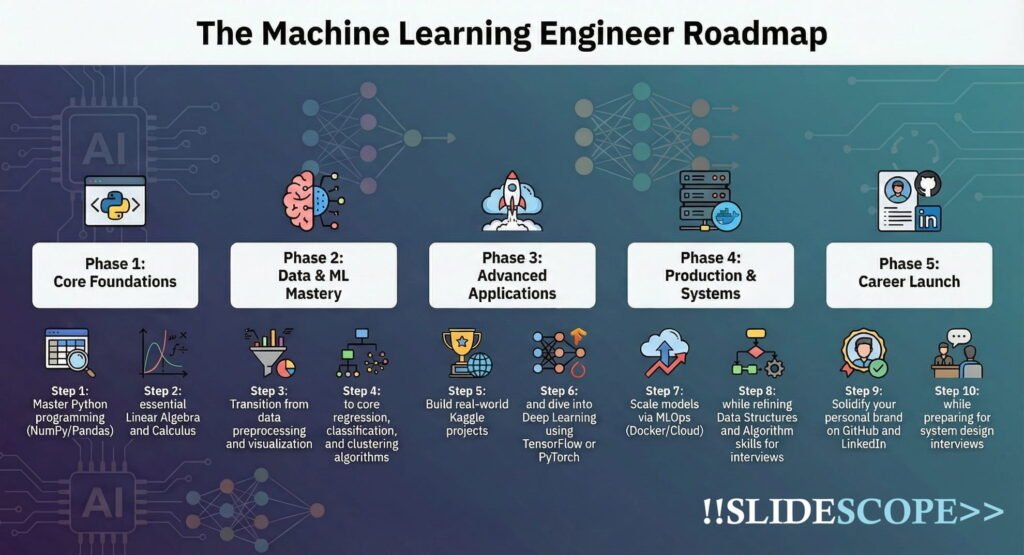
The key is to follow a structured roadmap—building fundamentals first, then gradually moving toward advanced concepts and practical implementation. In this guide, I’ll walk you through a step-by-step roadmap based on industry expectations and real project experience. Whether you’re a beginner or transitioning from another tech domain, this roadmap will give you clarity and direction.
1. Build Strong Programming Foundations
The first and most essential step toward becoming a Machine Learning Engineer is mastering programming. Without strong coding skills, implementing ML models becomes extremely difficult.
Start with Python, as it is the most widely used language in machine learning due to its simplicity and vast ecosystem. Focus on core concepts such as variables, loops, functions, data structures (lists, dictionaries, sets), and object-oriented programming. You should also learn how to write clean, efficient, and modular code.
Beyond basics, get comfortable with libraries like NumPy and Pandas. NumPy helps with numerical computations and matrix operations, while Pandas is essential for data manipulation and analysis. Understanding these libraries will help you handle datasets effectively.
Additionally, learn version control using Git. Machine learning projects often involve collaboration, and Git helps track changes and manage code efficiently. Familiarity with GitHub or GitLab is also important for showcasing your projects.
Practice is crucial—solve coding problems, build small scripts, and automate tasks. Platforms like LeetCode and HackerRank can help improve your logic-building skills.
By the end of this stage, you should be able to write efficient Python programs, manipulate data, and understand how code translates into real-world applications. This foundation will support everything you learn in machine learning.
2. Understand Mathematics and Statistics
Machine learning is not just about coding—it’s deeply rooted in mathematics and statistics. To truly understand how algorithms work, you must develop a strong mathematical foundation.
Focus on Linear Algebra, which includes vectors, matrices, eigenvalues, and eigenvectors. These concepts are essential because most ML algorithms rely on matrix operations.
Next, learn Probability and Statistics. Concepts such as mean, median, variance, standard deviation, probability distributions, and Bayes’ theorem are crucial for understanding data behavior and model predictions.
Calculus is also important, especially derivatives and gradients. These are used in optimization techniques like gradient descent, which is fundamental in training machine learning models.
You don’t need to become a mathematician, but you should understand the intuition behind these concepts. Use visual learning tools and practical examples to make learning easier.
Apply math concepts in Python using libraries like NumPy. For example, implement basic matrix operations or probability simulations.
A solid grasp of mathematics will give you an edge—it allows you to debug models, optimize performance, and understand advanced algorithms more deeply rather than just using them as black boxes.
3. Learn Data Handling and Preprocessing
Data is the backbone of machine learning. Before building any model, you need to understand how to collect, clean, and preprocess data.
Start by learning how to work with different data formats such as CSV, JSON, and Excel. Use Pandas to load, explore, and manipulate datasets. Learn techniques like filtering, grouping, and aggregating data.
Data cleaning is a critical step. You’ll often encounter missing values, duplicates, and inconsistent data. Learn how to handle these issues using techniques like imputation, normalization, and scaling.
Feature engineering is another important aspect. It involves selecting and transforming variables to improve model performance. For example, converting categorical data into numerical format using encoding techniques.
Understand data visualization using libraries like Matplotlib and Seaborn. Visualizing data helps identify patterns, trends, and anomalies.
Also, learn about train-test splitting and why it’s important to evaluate models properly.
By mastering data preprocessing, you ensure that your machine learning models are built on high-quality data, which directly impacts accuracy and performance.
4. Master Core Machine Learning Algorithms
Once your foundation is strong, move on to learning core machine learning algorithms. These are the building blocks of ML systems.
Start with supervised learning algorithms like Linear Regression and Logistic Regression. These help you understand how models learn relationships between inputs and outputs.
Then explore decision trees and ensemble methods like Random Forest and Gradient Boosting. These are widely used in real-world applications due to their high accuracy and interpretability.
Next, learn unsupervised learning techniques such as K-Means clustering and Principal Component Analysis (PCA). These help in discovering hidden patterns in data.
Understand evaluation metrics such as accuracy, precision, recall, F1-score, and ROC-AUC. These metrics help measure model performance.
Use libraries like Scikit-learn to implement these algorithms. Start with small datasets and gradually move to complex ones.
The goal is not just to use algorithms but to understand when and why to use each one. This knowledge is crucial for solving real-world problems effectively.
5. Work on Real-World Projects
Practical experience is what differentiates a beginner from a professional. Start working on real-world projects as early as possible.
Begin with simple projects like predicting house prices, spam detection, or customer churn analysis. These projects help you understand the end-to-end ML pipeline.
As you progress, take on more complex projects such as recommendation systems, sentiment analysis, or fraud detection.
Use publicly available datasets from platforms like Kaggle. Participate in competitions to challenge yourself and learn from others.
Focus on solving real problems rather than just building models. Understand business requirements, define objectives, and evaluate results accordingly.
Document your projects properly. Create GitHub repositories with clear explanations, code, and results.
Projects not only enhance your skills but also act as proof of your capabilities when applying for jobs.
6. Learn Deep Learning Fundamentals
Deep learning is a subset of machine learning that focuses on neural networks. It is widely used in areas like image recognition, natural language processing, and speech recognition.
Start with the basics of neural networks—understand neurons, layers, activation functions, and forward/backward propagation.
Learn frameworks like TensorFlow and PyTorch. These tools simplify the process of building and training deep learning models.
Work on projects such as image classification using convolutional neural networks (CNNs) or text analysis using recurrent neural networks (RNNs).
Understand concepts like overfitting, regularization, and dropout. These help improve model performance.
Deep learning requires more computational power, so also explore tools like Google Colab for training models.
Having deep learning skills will open opportunities in advanced AI domains and give you a competitive advantage.
7. Understand Model Deployment and MLOps
Building a model is only half the job—deploying it into production is equally important.
Learn how to convert ML models into APIs using frameworks like Flask or FastAPI. This allows applications to use your models in real time.
Understand containerization using Docker. It helps package your application and ensures consistency across environments.
Explore cloud platforms like AWS, Google Cloud, or Azure for deploying ML models. Learn services like AWS SageMaker or Google AI Platform.
MLOps (Machine Learning Operations) focuses on automating and managing ML workflows. Learn concepts like CI/CD pipelines, monitoring, and model versioning.
Understanding deployment ensures that your models are not just theoretical but actually used in real-world applications.
8. Master Data Structures and Algorithms (DSA)
While machine learning focuses on data and models, strong problem-solving skills are equally important.
Learn core data structures such as arrays, linked lists, stacks, queues, trees, and graphs.
Understand algorithms like sorting, searching, and recursion.
Practice coding problems regularly to improve logical thinking and efficiency.
DSA is especially important for technical interviews, where companies test your ability to solve complex problems.
It also helps optimize ML pipelines and improve performance.
Balancing DSA with ML ensures you are both a strong programmer and a capable engineer.
9. Build a Strong Portfolio and Personal Brand
To stand out in the competitive job market, you need more than just skills—you need visibility.
Create a portfolio showcasing your projects, case studies, and achievements. Use platforms like GitHub and build a personal website if possible.
Write blogs explaining your projects and concepts. This demonstrates your understanding and communication skills.
Stay active on LinkedIn—share insights, projects, and learning experiences.
Contribute to open-source projects or collaborate with others.
A strong personal brand increases your chances of getting noticed by recruiters and companies.
10. Prepare for Jobs and Continuous Learning
Finally, focus on job preparation and continuous improvement.
Understand the job roles and expectations of a Machine Learning Engineer. Prepare for interviews by practicing coding, ML concepts, and system design.
Revise important topics such as algorithms, statistics, and ML workflows.
Stay updated with industry trends—AI is evolving rapidly, and continuous learning is essential.
Take advanced courses, attend webinars, and follow industry experts.
Apply for internships, freelance projects, or entry-level roles to gain experience.
Remember, becoming a Machine Learning Engineer is a journey. Stay consistent, keep learning, and focus on building real-world solutions.
Conclusion
Becoming a Machine Learning Engineer requires a combination of programming, mathematics, data handling, and real-world problem-solving skills. By following this structured roadmap, you can systematically build your expertise and transition into this high-demand field.
The key is consistency—learn step by step, apply your knowledge through projects, and continuously improve. With the right approach, dedication, and practical exposure, you can successfully build a strong career in machine learning.

Ankit Srivastava is an IT trainer, technology educator, and digital skills mentor with expertise in programming, data analytics, AI, and software development. He has successfully trained thousands of learners, with more than 10,000 student enrollments on Udemy. His practical teaching approach empowers students and professionals to build in-demand technical skills. Colorstech channel where Ankit posts video tutorials has more than 8000 Subscribers.