Introduction
Reinforcement Learning (RL) is one of the most exciting and rapidly evolving domains within Artificial Intelligence. From training robots to enabling autonomous vehicles and optimizing business decisions, RL is transforming how machines learn from experience. As someone deeply involved in digital transformation and AI-driven systems, I believe Reinforcement Learning offers immense career potential for those willing to dive into its complexity.
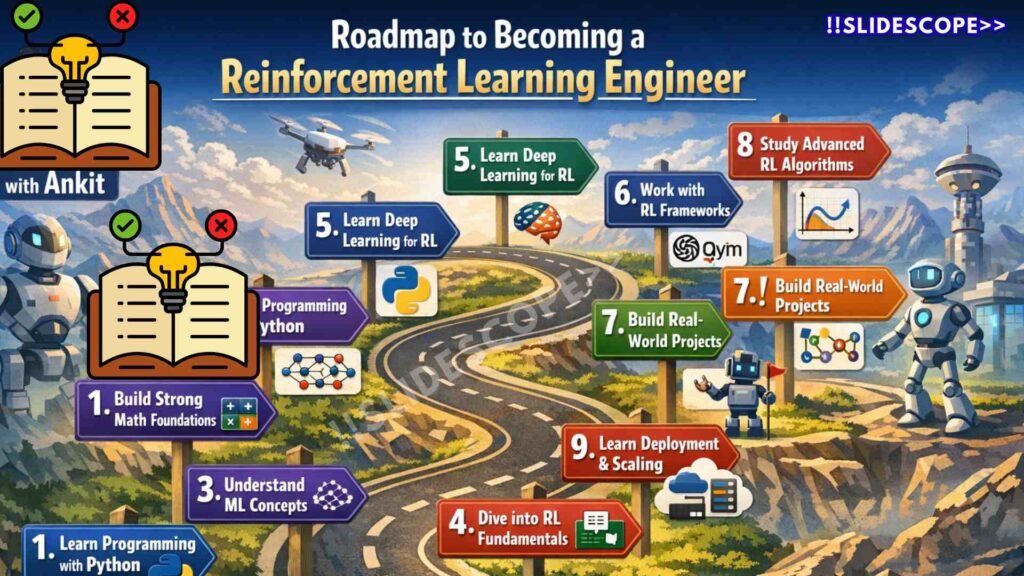
However, RL is not an entry-level field—it requires a strong foundation in mathematics, programming, and machine learning concepts. The journey can feel overwhelming, but with a structured roadmap, you can systematically build the skills required to become a successful Reinforcement Learning Engineer. In this guide, I’ll walk you through 10 essential steps that will take you from fundamentals to advanced RL applications, helping you build both theoretical understanding and practical expertise.
1. Build Strong Mathematical Foundations
Reinforcement Learning is deeply rooted in mathematics, and without a solid foundation, it becomes difficult to understand core algorithms. Focus on linear algebra, probability, statistics, and calculus. Concepts like vectors, matrices, eigenvalues, gradients, and distributions are frequently used in RL models.
Probability theory plays a critical role because RL agents operate under uncertainty. You must understand concepts such as expected value, Markov processes, and stochastic systems. Calculus, especially differentiation, is important for optimization techniques like gradient descent.
Additionally, understanding optimization methods helps you grasp how RL models learn and improve policies over time. Spend time solving mathematical problems rather than just reading theory. Use tools like NumPy to visualize concepts programmatically.
A strong math base not only helps in understanding RL algorithms but also enables you to innovate and tweak models for better performance in real-world applications.
2. Learn Programming with Python
Python is the primary language used in Reinforcement Learning due to its simplicity and powerful ecosystem. Begin by mastering Python fundamentals such as data structures, loops, functions, and object-oriented programming.
After the basics, move toward libraries like NumPy, Pandas, and Matplotlib for data manipulation and visualization. These tools are essential when analyzing RL environments and results.
You should also learn how to write clean, modular, and efficient code. Reinforcement Learning experiments often require multiple iterations, and structured code helps in debugging and scaling projects.
Understanding Python frameworks like TensorFlow and PyTorch is critical, as they are widely used for building neural networks in Deep Reinforcement Learning.
Practice by building small projects such as simulations or simple games. The goal is to become comfortable translating theoretical RL concepts into working code.
3. Understand Core Machine Learning Concepts
Before diving into Reinforcement Learning, you need a strong grasp of Machine Learning fundamentals. Learn about supervised and unsupervised learning, regression, classification, clustering, and evaluation metrics.
Understanding bias-variance tradeoff, overfitting, and model generalization is crucial because RL models also face similar challenges.
You should also be familiar with feature engineering, model training, and validation techniques. These concepts help in understanding how learning systems adapt and improve.
Study algorithms like decision trees, support vector machines, and neural networks. Even though RL is different, these models provide foundational insights into learning behavior.
Additionally, explore optimization techniques such as gradient descent and loss functions, as they are heavily used in RL training processes.
Having a solid ML background ensures that you can transition smoothly into RL and understand how agents learn from interactions rather than labeled data.
4. Dive into Reinforcement Learning Fundamentals
Now it’s time to step into Reinforcement Learning itself. Start with the core concepts: agents, environments, states, actions, and rewards.
Learn about Markov Decision Processes (MDPs), which form the backbone of RL. Understand how policies define agent behavior and how value functions estimate future rewards.
Study basic algorithms like Q-Learning and SARSA. These help you understand how agents learn optimal actions over time through trial and error.
You should also explore exploration vs. exploitation trade-offs—one of the most important challenges in RL.
Focus on understanding how rewards influence behavior and how agents improve through feedback loops.
Implement simple environments like grid worlds or basic games to see how these concepts work in practice.
This step is crucial because it lays the groundwork for advanced RL techniques and real-world applications.
5. Learn Deep Learning for RL
Deep Learning plays a major role in modern Reinforcement Learning. It allows agents to handle complex environments with high-dimensional data like images and videos.
Start by understanding neural networks, activation functions, and backpropagation. Then move to advanced architectures like CNNs and RNNs.
Learn how Deep Q-Networks (DQN) combine neural networks with Q-learning to solve complex problems. Study concepts like experience replay and target networks.
Frameworks like PyTorch and TensorFlow are essential here. Practice building neural networks and training them on datasets.
Deep Reinforcement Learning enables applications like game playing (e.g., AlphaGo) and robotics.
Mastering this step allows you to move beyond simple RL problems and work on real-world, high-impact projects.
6. Work with RL Libraries and Frameworks
To accelerate your learning, start using RL-specific libraries. Tools like OpenAI Gym provide pre-built environments where you can test RL algorithms.
Stable Baselines and RLlib offer implementations of popular algorithms, helping you focus on understanding rather than coding everything from scratch.
These frameworks allow you to experiment with different policies, reward structures, and environments quickly.
You should also learn how to customize environments and integrate your own datasets.
Using these tools helps you gain practical experience and understand how RL systems behave under different conditions.
It also prepares you for industry-level projects where efficiency and scalability are important.
7. Build Real-World RL Projects
Practical experience is what sets you apart. Start building projects such as game-playing agents, recommendation systems, or trading bots.
You can create agents that learn to play games like CartPole or MountainCar using OpenAI Gym.
Move on to more complex problems like autonomous navigation or resource optimization.
Document your projects on GitHub and explain your approach, challenges, and results.
Real-world projects demonstrate your ability to apply RL concepts and solve practical problems.
They also help you understand limitations, such as slow convergence or unstable training.
Employers value hands-on experience, so focus on building a strong portfolio.
8. Study Advanced RL Algorithms
Once you’re comfortable with basics, move to advanced algorithms. Learn about Policy Gradient methods, Actor-Critic models, and Proximal Policy Optimization (PPO).
These algorithms are more stable and efficient than basic methods.
Study concepts like reward shaping, multi-agent systems, and hierarchical RL.
You should also explore model-based RL, where agents learn environment dynamics.
Advanced RL techniques are used in robotics, finance, and large-scale AI systems.
Understanding these methods helps you tackle complex, real-world challenges.
It also prepares you for research roles or high-level engineering positions.
9. Learn Deployment and Scaling
Building models is only part of the job—deploying them is equally important. Learn how to integrate RL models into real-world systems.
Understand APIs, cloud platforms, and containerization tools like Docker.
Learn how to monitor model performance and update policies over time.
Scaling RL systems requires handling large datasets and distributed computing.
You should also understand latency, reliability, and system design principles.
Deployment skills make you industry-ready and capable of delivering production-grade solutions.
10. Stay Updated and Contribute to the Community
Reinforcement Learning is a rapidly evolving field. Stay updated with research papers, blogs, and industry trends.
Follow conferences like NeurIPS and ICML. Read research papers and try to implement them.
Join communities on GitHub, Reddit, or LinkedIn to learn from others.
Contribute to open-source projects or publish your own work.
Continuous learning is essential because RL techniques are constantly improving.
Building a network and staying informed helps you grow faster and stay competitive.
Conclusion
Reinforcement Learning is not just another specialization in Artificial Intelligence—it is a paradigm shift in how machines learn, adapt, and make decisions in dynamic environments. As we move deeper into an era driven by automation, intelligent systems, and data-driven optimization, the demand for skilled Reinforcement Learning Engineers is only going to accelerate. From robotics and gaming to finance, healthcare, and autonomous systems, RL is unlocking possibilities that were once considered science fiction.
However, it’s important to approach this field with the right mindset. Reinforcement Learning is inherently complex and often requires patience, experimentation, and resilience. Unlike traditional machine learning, where results can be more predictable, RL involves uncertainty, delayed rewards, and iterative improvements. You will face challenges like unstable training, reward design issues, and computational limitations. But these challenges are exactly what make the field intellectually rewarding and professionally valuable.
Throughout this roadmap, one thing should be clear—there is no shortcut to becoming an expert in Reinforcement Learning. It demands a combination of strong mathematical intuition, programming expertise, and a deep understanding of machine learning principles. But beyond technical skills, what truly differentiates a great RL Engineer is curiosity and persistence. The willingness to experiment, fail, analyze, and improve is what drives real mastery.
In my experience working with technology and digital ecosystems, I’ve seen that the most successful professionals are those who bridge theory with practical implementation. Reinforcement Learning is no different. Building projects, testing models in real-world scenarios, and continuously refining your approach will give you an edge that theoretical knowledge alone cannot provide. Treat every project as a learning opportunity, and don’t hesitate to explore unconventional solutions.
Another key aspect is staying connected with the evolving landscape. RL is advancing rapidly, with new algorithms, frameworks, and research breakthroughs emerging frequently. Keeping yourself updated through research papers, industry blogs, and communities will ensure that your skills remain relevant and competitive. More importantly, contributing back—whether through open-source projects, blogs, or teaching—can significantly enhance your understanding and visibility in the field.
Finally, remember that becoming a Reinforcement Learning Engineer is not just about landing a job—it’s about becoming a problem solver who can design intelligent systems that learn from experience. The journey may take time, but every step you take builds a foundation for a highly impactful and future-proof career. If you stay consistent, keep learning, and focus on real-world applications, you will not only master Reinforcement Learning but also position yourself at the forefront of AI innovation.

Ankit Srivastava is an IT trainer, technology educator, and digital skills mentor with expertise in programming, data analytics, AI, and software development. He has successfully trained thousands of learners, with more than 10,000 student enrollments on Udemy. His practical teaching approach empowers students and professionals to build in-demand technical skills. Colorstech channel where Ankit posts video tutorials has more than 8000 Subscribers.