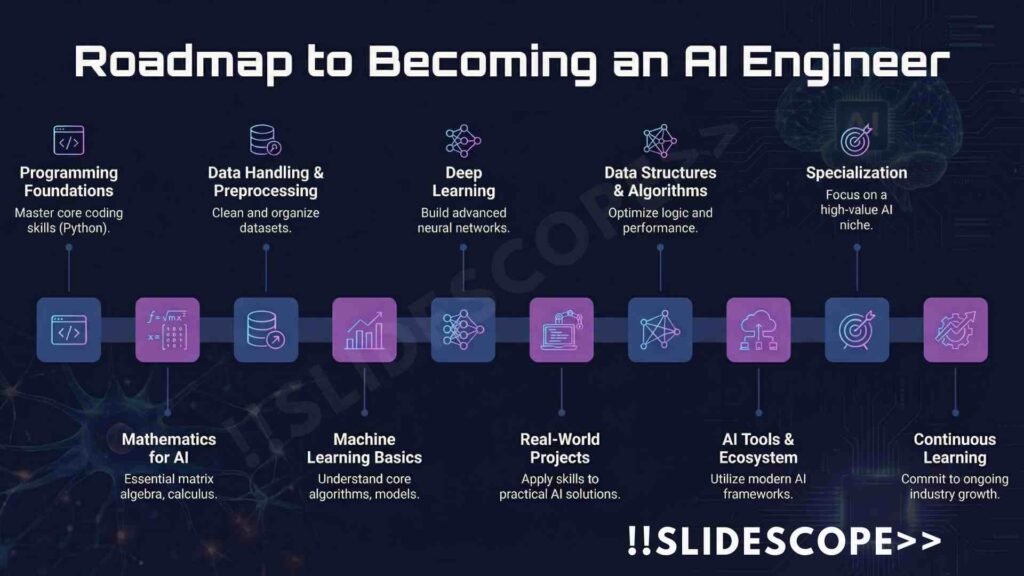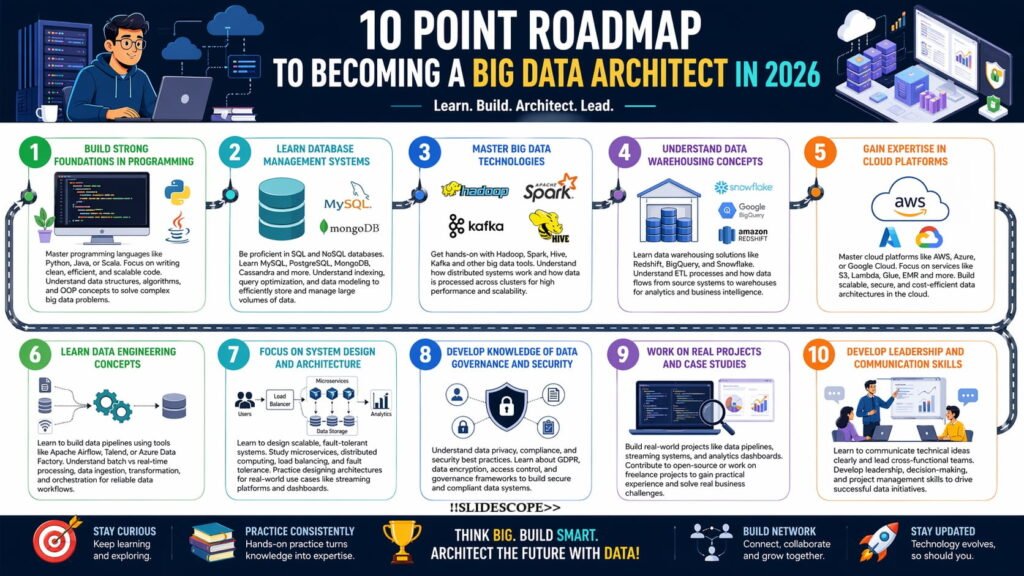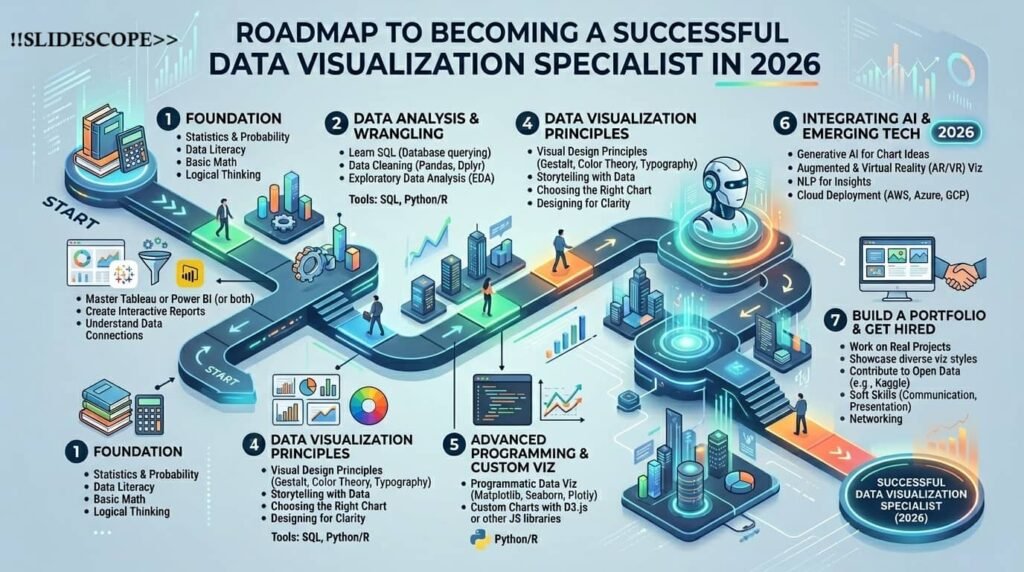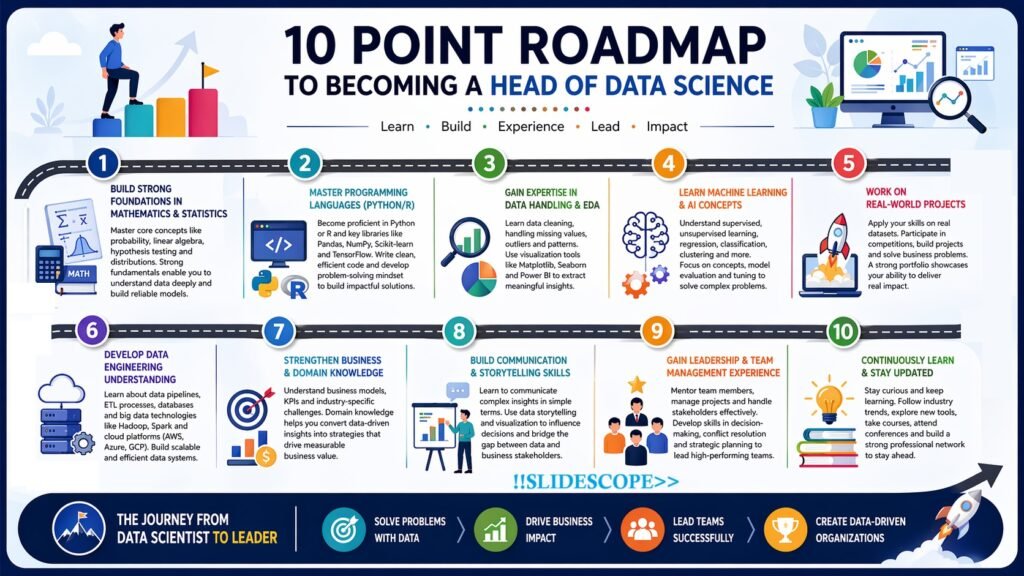
Data Science has become the backbone of modern digital decision-making. However, becoming a Head of Data Science is not just about mastering algorithms or tools—it’s about combining technical expertise with business strategy and leadership. From my experience, professionals who approach their growth with a structured roadmap and long-term vision are the ones who reach leadership roles. This roadmap will guide you step-by-step from foundational skills to executive-level thinking.
1. Build Strong Foundations in Mathematics & Statistics
Mathematics and statistics form the core of data science. Concepts like probability, linear algebra, and hypothesis testing are essential for understanding models. Without a strong foundation, advanced machine learning becomes difficult. Focus on clarity in fundamentals, as they help you interpret data logically and make accurate decisions in complex scenarios.
2. Master Programming Languages (Python/R)
Python or R are essential tools for data scientists. Libraries like Pandas, NumPy, and Scikit-learn enable efficient data manipulation and modeling. Beyond syntax, focus on writing clean, optimized, and scalable code. Strong programming skills allow you to translate business problems into technical solutions effectively.
3. Gain Expertise in Data Handling & EDA
Data cleaning and exploratory data analysis (EDA) are critical steps in any project. Handling missing values, identifying outliers, and uncovering patterns are daily tasks. Visualization tools help communicate insights clearly. Mastering EDA ensures that your models are built on reliable and well-understood data.
4. Learn Machine Learning & AI Concepts
Understanding machine learning algorithms is essential. Focus on both supervised and unsupervised learning methods. Learn how models work, when to use them, and how to evaluate them. Conceptual clarity is more important than just implementation, especially as you move toward senior roles.
5. Work on Real-World Projects
Practical experience is key to growth. Work on real datasets, participate in competitions, or take freelance projects. Building a strong portfolio demonstrates your ability to solve real business problems. It also helps you gain confidence and industry exposure.
6. Develop Data Engineering Understanding
A Head of Data Science must understand data pipelines, ETL processes, and big data tools. Knowledge of platforms like Spark and cloud systems (AWS, Azure) is crucial. This helps in designing scalable and efficient data solutions for organizations.
7. Strengthen Business & Domain Knowledge
Technical skills alone are not enough. You must understand business problems and industry domains. Whether it’s finance, healthcare, or e-commerce, domain knowledge helps you translate data insights into actionable business strategies.
8. Build Communication & Storytelling Skills
Being able to communicate insights is critical. You must present complex data in a simple and understandable way to stakeholders. Data storytelling bridges the gap between technical analysis and business decisions, making your work impactful.
9. Gain Leadership & Team Management Experience
Leadership roles require more than individual contribution. You need to manage teams, mentor juniors, and handle projects effectively. Skills like decision-making, conflict resolution, and strategic planning become essential as you grow.
10. Continuously Learn & Stay Updated
Data Science is constantly evolving. New tools, frameworks, and techniques emerge regularly. Continuous learning through courses, certifications, and industry updates ensures you stay relevant and competitive in your field.
Conclusion
Becoming a Head of Data Science is not a short-term achievement—it is a long-term journey that requires consistent effort, strategic thinking, and continuous evolution. Many professionals enter the field of data science with enthusiasm, but only a few reach leadership positions. The difference lies in how systematically they build their skills and how well they align their growth with business impact.
The journey begins with building a strong foundation. Mathematics and statistics are not just academic subjects; they are the language through which data speaks. Without a clear understanding of these fundamentals, it becomes difficult to interpret complex models or validate insights. Investing time in strengthening these basics pays off in the long run and sets you apart from those who rely only on tools.
Programming is the next essential pillar. Tools like Python and R are not just technical requirements—they are enablers of innovation. The ability to write efficient, scalable, and clean code directly impacts your productivity and effectiveness. However, coding alone is not enough. You must also understand the data you are working with. This is where data handling and exploratory data analysis play a crucial role. These steps ensure that your models are built on accurate and meaningful data, reducing errors and improving outcomes.
As you progress, machine learning and AI become central to your role. But it is important to avoid a common mistake—focusing only on implementation. True expertise lies in understanding the logic behind algorithms, knowing when to use them, and being able to interpret their results. This level of understanding is what differentiates senior professionals from beginners.
Real-world experience is what transforms knowledge into skill. Working on practical projects exposes you to real challenges, helping you develop problem-solving abilities and adaptability. It also builds your portfolio, which is critical for career advancement. Organizations value professionals who can demonstrate impact, not just theoretical knowledge.
At higher levels, your role expands beyond analysis. You need to understand how data flows within systems, how infrastructure is built, and how scalability is achieved. This is where data engineering knowledge becomes important. A Head of Data Science must be able to collaborate with engineering teams and ensure that data systems support business needs effectively.
Another major shift in this journey is the transition from a technical mindset to a business-oriented approach. At leadership levels, your primary goal is not just to build models but to drive business value. You need to understand organizational goals, identify opportunities, and use data to influence strategic decisions. This requires a deep understanding of business domains and the ability to think beyond technical boundaries.
Communication becomes a critical skill at this stage. No matter how advanced your analysis is, it has little value if it cannot be understood by stakeholders. The ability to present insights clearly, tell compelling stories with data, and influence decisions is what makes a leader effective. This is often the skill that differentiates good data scientists from great ones.
Leadership itself is a skill that develops over time. Managing teams, mentoring individuals, and handling complex projects require emotional intelligence, patience, and strategic thinking. As a Head of Data Science, you are responsible not only for delivering results but also for building and guiding a team that can achieve those results consistently.
Finally, continuous learning is non-negotiable. The field of data science is evolving rapidly, with new tools, techniques, and technologies emerging constantly. Staying updated is not just about maintaining relevance—it is about staying ahead. Professionals who embrace learning as a lifelong habit are the ones who continue to grow and lead.
In conclusion, becoming a Head of Data Science is about more than just technical mastery. It is about developing a holistic skill set that includes analytics, engineering, business understanding, communication, and leadership. It is a journey that requires dedication, patience, and a clear vision. If you follow this roadmap with consistency and intent, you can position yourself not just as a data scientist, but as a strategic leader who drives meaningful impact through data.

Ankit Srivastava is an IT trainer, technology educator, and digital skills mentor with expertise in programming, data analytics, AI, and software development. He has successfully trained thousands of learners, with more than 10,000 student enrollments on Udemy. His practical teaching approach empowers students and professionals to build in-demand technical skills. Colorstech channel where Ankit posts video tutorials has more than 8000 Subscribers.