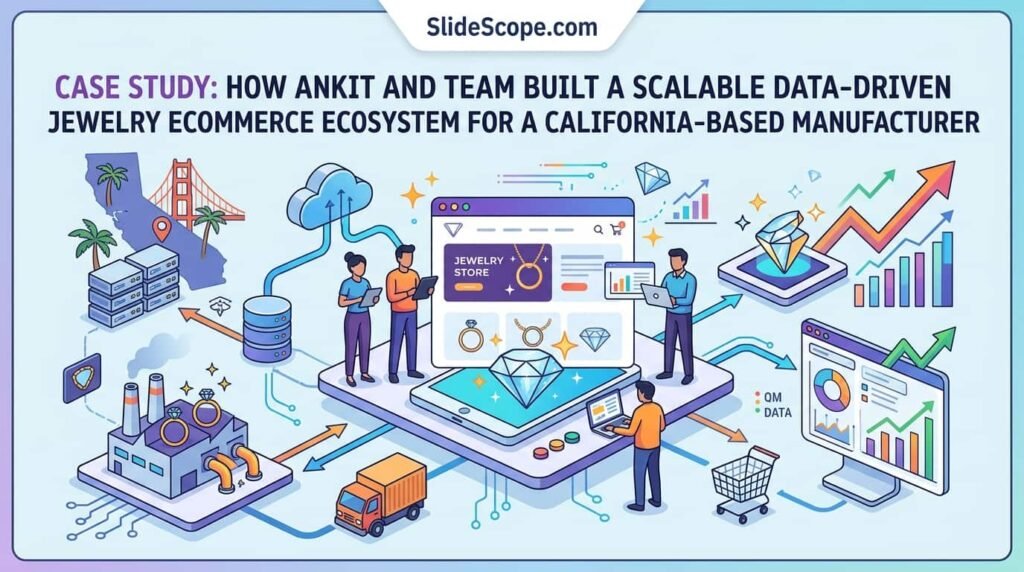
In today’s competitive digital commerce landscape, building an eCommerce website is no longer enough. Businesses require an integrated digital ecosystem that connects inventory, marketing, customer engagement, analytics, operations, and decision-making into one scalable framework. This becomes even more critical in industries like jewelry manufacturing, where products have thousands of customization combinations involving gemstones, metals, colors, sizes, and pricing structures.
A California-based jewelry manufacturing company approached Ankit and his team with a complex challenge. The company already operated a manufacturing unit, a physical retail store in California, and an ASP.NET ERP system managing inventory and financial operations. However, they wanted to expand aggressively into online commerce while maintaining synchronization across departments and delivering a premium digital experience to customers.
The objective was not just to create an online shopping website. The goal was to build a scalable eCommerce infrastructure capable of handling more than 20,000 products with multiple variations, support live shopping experiences on Facebook and YouTube, create high-performing marketing campaigns, integrate analytics from multiple platforms, and provide management with actionable business intelligence dashboards.
Ankit and his team designed and implemented a complete WooCommerce-based solution integrated with marketing automation, SEO optimization, ETL pipelines, customer engagement systems, and advanced reporting dashboards using Looker Studio and Tableau. The project evolved into a full-scale digital transformation initiative that connected ERP data, shopping behavior, advertising analytics, giveaway campaigns, and live shopping operations into one unified ecosystem.
This case study explores how the team transformed a traditional jewelry business into a scalable digital commerce operation using WordPress, WooCommerce, technical SEO, marketing strategy, data engineering, and business intelligence.
Understanding the Business Challenges
The jewelry industry presents unique technical and operational challenges for eCommerce implementation. Unlike standard retail catalogs, jewelry products involve numerous product attributes and combinations. A single product may exist in multiple gemstone variants, metal types, finishes, colors, and customization options.
The company already had an established ERP system built on ASP.NET with Microsoft SQL Server managing manufacturing inventory, store inventory, financial operations, and business processes. However, the system was not optimized for modern online commerce experiences.
The major challenges included:
Managing Large Product Catalogs
The business had over 20,000 products with extensive variation structures. Traditional eCommerce setups often become slow and difficult to manage when handling large datasets with complex attributes.
The platform needed to support:
- Gemstone combinations
- Metal options
- Color variations
- Product customization
- Dynamic pricing structures
- Product filtering systems
- High-resolution media assets
Delivering a Premium User Experience
Luxury buyers expect visually rich and interactive shopping experiences. The website needed to provide:
- Smooth navigation
- Interactive product selection
- Combination previews
- Advanced filtering
- Mobile responsiveness
- Fast loading speed
- Seamless checkout experience
Integrating Multiple Systems
The organization had data spread across multiple platforms:
- ASP.NET ERP with MSSQL
- WooCommerce with MySQL
- Facebook campaign data
- Google Analytics
- Facebook Pixel tracking
- Giveaway campaign entries
- Shopping show lead databases
- Winner selection systems
- Marketing performance reports
The absence of centralized reporting made strategic decision-making difficult.
Building Digital Visibility
The company wanted to compete in organic search results for jewelry-related keywords. This required:
- Technical SEO
- Structured product optimization
- Category hierarchy optimization
- Page speed enhancement
- Schema implementation
- Mobile optimization
- SEO-friendly URLs and metadata
Expanding Customer Acquisition
The business wanted aggressive digital growth through:
- Giveaway campaigns
- Live shopping shows
- Social media marketing
- Community engagement
- Lead generation systems
- Retargeting campaigns
WooCommerce eCommerce Architecture Implementation
After evaluating the requirements, Ankit and his team selected WordPress with WooCommerce as the foundation for the eCommerce platform. The decision was based on scalability, flexibility, SEO capabilities, and customization potential.
The implementation focused on creating a highly optimized architecture capable of managing enterprise-scale product operations.
Product Data Structuring
Managing 20,000+ products with multiple variations required careful database planning and taxonomy design.
The team created:
- Structured product categories
- Optimized attribute management systems
- Variation handling workflows
- Dynamic product filtering
- SEO-friendly product URLs
- Bulk import systems
- Product tagging strategies
The goal was to ensure both usability and search engine crawlability.
Interactive Product Experience
A major focus was placed on helping users visualize jewelry combinations. Customers could explore multiple gemstone and metal combinations interactively.
The interface was designed to:
- Improve engagement
- Increase time on site
- Enhance conversion rates
- Reduce customer confusion
- Support premium brand perception
The user experience strategy combined aesthetics with functionality, creating a modern luxury shopping environment.
Performance Optimization
Large WooCommerce websites often struggle with speed and database performance. The team implemented:
- Optimized database queries
- Caching systems
- Image compression workflows
- Lazy loading
- CDN optimization
- Performance-focused hosting configurations
These improvements helped maintain fast load speeds even with large product datasets.
Technical SEO and Organic Growth Strategy
A major component of the project involved building long-term organic visibility through technical SEO and on-page optimization.
Ankit and his team implemented a comprehensive SEO framework designed specifically for large-scale eCommerce operations.
On-Page SEO Optimization
The team optimized:
- Product titles
- Product descriptions
- Metadata
- Category pages
- Internal linking structures
- Image alt tags
- Structured data markup
Special attention was given to product variation indexing to prevent duplicate content issues.
Technical SEO Enhancements
The technical SEO process included:
- XML sitemap optimization
- Robots.txt configuration
- Canonical management
- Crawl budget optimization
- Mobile usability improvements
- Core Web Vitals enhancement
- Schema implementation
The website architecture was designed to support scalability without negatively affecting SEO performance.
Content and Search Intent Alignment
The product and category structures were aligned with customer search behavior. This helped improve keyword targeting and user engagement.
The SEO strategy focused on:
- Transactional intent keywords
- Long-tail product searches
- Jewelry customization searches
- Category-focused ranking opportunities
Giveaway Campaigns and Customer Acquisition
To increase brand visibility and customer acquisition, Ankit and his team conceptualized and executed giveaway campaigns that generated more than 50,000 entries.
These campaigns were designed not only for reach but also for lead generation and customer engagement.
Campaign Strategy
The giveaway campaigns integrated:
- Landing pages
- Social sharing systems
- Entry tracking
- Email collection
- Referral mechanics
- Facebook engagement
- Audience retargeting
The campaigns successfully created viral traction and expanded the brand’s digital audience.
Lead Generation and Audience Building
The campaigns helped the company:
- Build customer databases
- Increase email subscribers
- Generate social engagement
- Improve brand awareness
- Collect behavioral data for future marketing
The data collected during these campaigns later became part of advanced analytics pipelines.
Supporting Live Shopping Shows on Facebook and YouTube
The company actively conducted online shopping shows through Facebook and YouTube. These live commerce events became an important sales and customer engagement channel.
Ankit and his team supported the operational and technical aspects of these events.
Live Commerce Infrastructure
The team assisted in:
- Lead management workflows
- Product coordination systems
- Shopping show operations
- Audience interaction processes
- Campaign tracking
- Viewer engagement analytics
The live shopping ecosystem connected entertainment, sales, and customer interaction into one digital experience.
Presenter and Management Support
The presenters and management teams required operational coordination during live events.
The team developed workflows for:
- Product showcasing
- Lead tracking
- Order coordination
- Winner announcements
- Audience engagement monitoring
This helped streamline live commerce execution.
Data Engineering and ETL Ecosystem
One of the most technically advanced aspects of the project was the creation of ETL workflows and centralized business intelligence systems.
The organization had data spread across multiple platforms and databases.
Data Sources Included
The ETL architecture connected:
- MSSQL ERP databases
- WooCommerce MySQL databases
- Facebook Pixel data
- Google Analytics
- Giveaway systems
- Lead databases
- Winner tracking systems
- Shopping show performance data
Building Centralized Reporting
Ankit led the development of centralized dashboards using:
- Looker Studio
- Tableau
- ETL pipelines
- Automated data workflows
The dashboards helped management visualize:
- Sales performance
- Marketing ROI
- Product trends
- Customer acquisition metrics
- Conversion tracking
- Campaign effectiveness
- Inventory movement
- Revenue analytics
Data Transformation and Cleaning
The ETL systems transformed raw datasets into actionable business intelligence.
Processes included:
- Data normalization
- Data cleaning
- Data mapping
- Automated refresh systems
- Cross-platform integrations
The dashboards reduced manual reporting efforts and improved strategic decision-making.
Marketing Analytics and Attribution Tracking
Modern eCommerce growth depends heavily on analytics and attribution tracking.
The team integrated:
- Google Analytics
- Facebook Pixel
- Conversion tracking systems
- Event tracking
- Funnel analysis
- Campaign attribution
This enabled the business to measure:
- Customer journeys
- Ad performance
- Shopping behavior
- Traffic quality
- Conversion bottlenecks
The marketing analytics framework supported more efficient advertising decisions and budget allocation.
Scalability and Operational Efficiency
One of the key achievements of the project was scalability.
The infrastructure was designed to support:
- Large product catalogs
- High traffic volumes
- Marketing campaigns
- Live commerce operations
- Reporting automation
- Cross-platform integrations
The business gained the ability to expand digital operations without constantly rebuilding systems.
Business Impact and Outcomes
The digital transformation initiative delivered measurable operational and marketing benefits.
Improved Customer Experience
Customers gained:
- Faster browsing
- Interactive product exploration
- Better mobile experiences
- Easier product discovery
- Smooth online purchasing
Enhanced Marketing Performance
The company achieved:
- High giveaway participation
- Increased audience engagement
- Improved lead generation
- Better campaign tracking
- Enhanced social media visibility
Better Data-Driven Decisions
Management benefited from:
- Real-time dashboards
- Cross-platform reporting
- Simplified analytics
- Centralized business intelligence
- Faster strategic insights
Stronger Digital Infrastructure
The organization now had:
- A scalable WooCommerce ecosystem
- Integrated analytics systems
- Automated reporting workflows
- Enhanced SEO foundations
- Multi-channel commerce capabilities
Conclusion
This project demonstrated how a traditional jewelry manufacturing business could evolve into a sophisticated, data-driven digital commerce operation through the right combination of technology, strategy, analytics, and execution.
Ankit and his team successfully transformed a complex operational environment involving ERP systems, large-scale product management, marketing campaigns, live commerce operations, and multi-platform analytics into a unified digital ecosystem.
The implementation went far beyond website development. It included enterprise-level WooCommerce architecture, technical SEO optimization, marketing automation, ETL engineering, analytics integration, interactive customer experiences, and business intelligence reporting.
By handling over 20,000 products with complex variations, supporting large-scale giveaway campaigns with more than 50,000 entries, assisting live shopping show operations, and integrating data from MSSQL, MySQL, Google Analytics, Facebook Pixel, and multiple campaign systems, the team built a scalable framework capable of supporting long-term business growth.
This case study reflects the importance of combining eCommerce expertise, data engineering, marketing strategy, and analytics-driven decision-making in modern digital commerce environments. It also highlights how businesses can unlock operational efficiency and customer engagement when digital systems are properly integrated.
For organizations looking to modernize traditional operations and build scalable commerce ecosystems, this project serves as a practical example of how technology, analytics, and customer experience can work together to create sustainable digital growth.
Disclaimer
This case study is intended for educational, informational, and portfolio demonstration purposes only. Certain business details, workflows, operational structures, timelines, and technical implementations may have been generalized, modified, or partially anonymized to maintain client confidentiality and protect proprietary business information.
The project outcomes, campaign performance metrics, engagement figures, and operational improvements mentioned in this document are based on actual project experiences and implementation scenarios handled by Ankit and the associated team. However, individual business results may vary depending on market conditions, business strategies, operational execution, competition, advertising budgets, customer behavior, and technology infrastructure.
All trademarks, platform names, technologies, and third-party tools referenced in this case study, including WordPress, WooCommerce, Facebook, YouTube, Google Analytics, Looker Studio, Tableau, ASP.NET, MSSQL, and MySQL, remain the property of their respective owners.
This document does not constitute financial, legal, investment, or business guarantee advice. Any strategies or methodologies discussed should be evaluated independently before implementation in other business environments.

Ankit Srivastava is an IT trainer, technology educator, and digital skills mentor with expertise in programming, data analytics, AI, and software development. He has successfully trained thousands of learners, with more than 10,000 student enrollments on Udemy. His practical teaching approach empowers students and professionals to build in-demand technical skills. Colorstech channel where Ankit posts video tutorials has more than 8000 Subscribers.