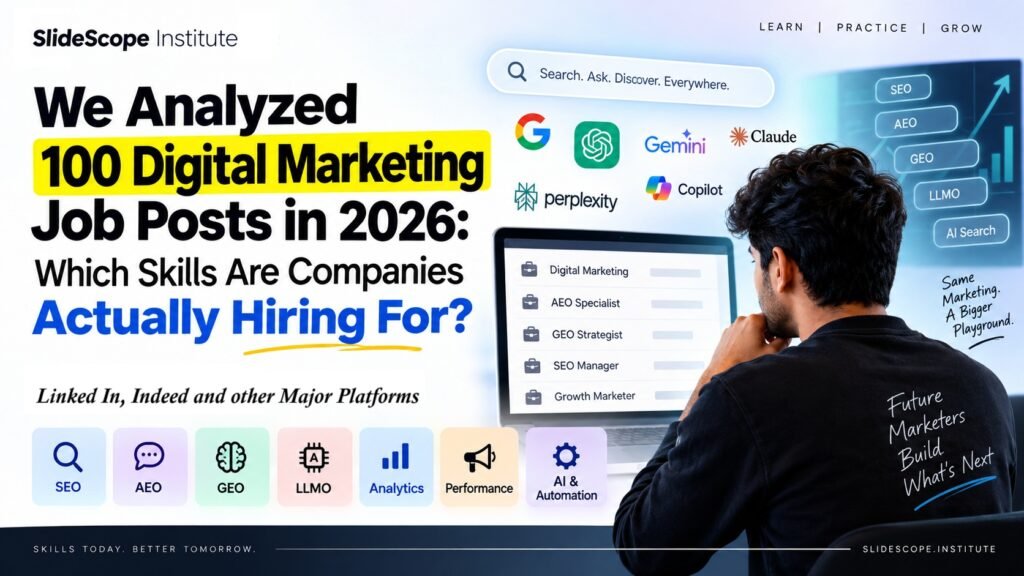
Digital marketing jobs have changed dramatically.
If you looked at a digital marketing job description five years ago, you would probably see SEO, Google Ads, social media, content marketing and email marketing.
Look at many job descriptions in 2026, and the vocabulary is different.
You now see terms such as AEO, GEO, LLMO, AI Search, AI Overviews, ChatGPT, Gemini, Perplexity, prompt engineering, automation, GA4, CRO and data-driven marketing appearing alongside traditional SEO and performance marketing requirements.
That raises an important question:
What are companies actually hiring digital marketers to do in 2026?
I reviewed a sample of 100 digital marketing and marketing-related job postings across LinkedIn, Indeed and other major recruitment platforms and compared the patterns with larger published hiring and skills datasets.
I want to make one thing clear: this is not a claim that the 100-post sample represents every digital marketing job globally. Job requirements vary by country, company size, seniority and industry. The purpose of the review was to identify recurring skill patterns and the direction in which digital marketing hiring is moving.
And the direction is very clear.
Companies are moving beyond the idea of a marketer who simply creates content, manages social media or optimizes pages for Google.
They increasingly want marketers who can make a brand discoverable across search engines, answer engines and AI platforms — and then measure whether that visibility produces business results.
Here are the five major skill groups I believe every digital marketer should understand in 2026.
1. SEO Is Still the Foundation — But SEO Has Expanded
Let’s start with the skill everyone thought AI would destroy.
SEO.
SEO is not disappearing.
In fact, SEO continues to appear heavily across marketing job descriptions. Large-scale job-posting research still shows SEO, Google Analytics, paid media, performance marketing and related search capabilities among the most frequently requested marketing skills.
But the job itself has changed.
Companies are no longer looking only for someone who can insert keywords into articles.
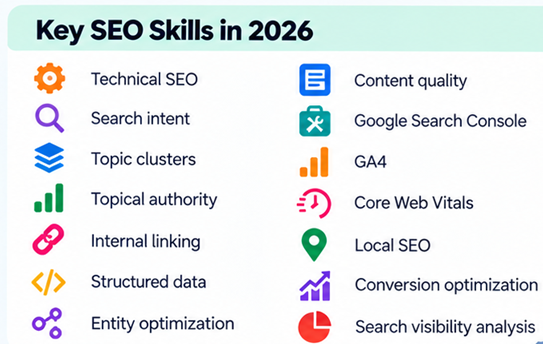
Modern SEO increasingly involves:
- Technical SEO
- Search intent
- Topic clusters
- Topical authority
- Internal linking
- Structured data
- Entity optimization
- Content quality
- Google Search Console
- GA4
- Core Web Vitals
- Local SEO
- Conversion optimization
- Search visibility analysis
And now there is another major consideration:
What happens when the user doesn’t click a traditional Google result?
This is where SEO starts connecting with AEO and GEO.
Google is increasingly presenting answers directly in the search experience, while users are also asking conversational questions through AI tools.
So the SEO professional of 2026 has to think beyond:
“How do I rank this page?”
The better question is:
“How does my brand become visible when someone searches for this topic — regardless of whether the result is a traditional link, an AI-generated answer or a conversational response?”
That is a much broader responsibility.
SEO remains the foundation.
But it is no longer the entire building.
2. AEO: The Marketer Who Helps Search Engines Answer Questions
The second major shift is AEO — Answer Engine Optimization.
AEO is about improving the likelihood that your content can be used to answer a user’s question.
This concept existed before generative AI.
Featured snippets, People Also Ask, knowledge panels and other direct-answer search features already pushed marketers toward answer-focused content.
But AI-powered search has accelerated the importance of this approach.
Today’s users increasingly ask questions like:
“What is the best digital marketing course for beginners?”
“Which SEO agency specializes in ecommerce?”
“How much does SEO cost?”
“What is the difference between SEO and GEO?”
The user doesn’t necessarily want ten blue links.
They want an answer.
That changes how content needs to be created.
An AEO-focused marketer thinks about:
- Question-based search
- Search intent
- FAQs
- Clear definitions
- Concise answers
- Structured content
- Semantic relationships
- Supporting evidence
- Schema markup
- Conversational queries
- Featured snippets
- AI-generated search experiences
And importantly, AEO is now appearing in actual hiring requirements.
Current job postings explicitly mention AEO alongside SEO, including requirements around conversational search, zero-click optimization, structured data and AI search visibility.
That is significant.
Because when AEO appears inside a job description, the company is effectively saying:
“We don’t only want traffic. We want our brand to become part of the answer.”
That is a major change in how marketers think about organic visibility.
3. GEO & LLMO: Welcome to the Era of AI Search Visibility
This is probably the biggest new skill category in digital marketing hiring.
GEO — Generative Engine Optimization.
And closely related to it:
LLMO — Large Language Model Optimization.
These terms are increasingly being used to describe the process of improving how brands, websites and information are represented and surfaced by generative AI systems.
Think about the platforms people now use for research:
- ChatGPT
- Google Gemini
- Google AI search experiences
- Microsoft Copilot
- Perplexity
- Claude
- Other AI-powered discovery platforms
The search journey is changing.
Previously, someone might search Google, click five websites and compare them.
Now someone may ask an AI system:
“Which companies provide international flight booking services in Australia?”
The AI may generate a response using information gathered from multiple sources.
The marketing challenge therefore becomes:
How does your company become visible, understood, mentioned and trusted within that answer?
This is where GEO comes in.
A GEO-oriented marketer may need to think about:
- Brand/entity clarity
- Authoritative content
- Structured information
- First-party information
- Third-party mentions
- Digital PR
- Citations
- Reviews
- Brand consistency
- Topical authority
- Content comprehensiveness
- AI crawler accessibility
- AI search visibility
- Monitoring brand mentions in AI responses
LinkedIn’s 2026 marketing skills research has already identified LLM Optimization as a rapidly growing marketing capability, alongside areas such as prompt engineering, performance analysis, data-driven decision-making and SEO.
And this isn’t limited to reports.
Actual job listings are beginning to use language such as GEO, AEO, AI Search and LLM optimization in their requirements.
That is an important signal for anyone building a career in marketing.
However, I would make one distinction very clear:
GEO and LLMO are not replacements for SEO.
They are emerging layers on top of a broader search and content strategy.
A company with poor technical SEO, weak content, unclear entities and little authority is unlikely to magically become highly visible in AI systems simply because someone added the words “GEO” to their job title.
The fundamentals still matter.
The discovery environment is simply getting bigger.
4. AI + Analytics + Automation: Marketing Is Becoming More Technical
The fourth major skill group is the combination of AI, data and automation.
This is where the modern digital marketer starts looking very different from the traditional marketer.
Indeed’s 2026 labor-market research reported a substantial increase in the share of marketing job postings mentioning AI, rising from 8.4% at the beginning of 2025 to 14.9% by the end of 2025.
That is a major signal.
But being “AI skilled” doesn’t mean simply knowing how to use ChatGPT.
Employers increasingly need people who can integrate AI into actual workflows.
For example:
Research → AI-assisted analysis → Content → SEO → Distribution → Measurement → Optimization
AI can help with:
- Keyword research
- Content research
- Competitor analysis
- Audience research
- Content briefs
- Copy variations
- Ad variations
- Data analysis
- Reporting
- Personalization
- Marketing automation
- Workflow automation
- Customer segmentation
- Campaign ideation
At the same time, marketers are increasingly expected to understand data.
That means skills such as:
- GA4
- Google Search Console
- Looker Studio
- Excel
- Conversion tracking
- Attribution
- CRO
- SQL
- Power BI
- Dashboard creation
can significantly strengthen a marketing profile.
Why?
Because companies don’t ultimately care about the number of blog posts you published.
They care about outcomes.
Did traffic increase?
Did qualified leads increase?
Did conversion improve?
Did customer acquisition costs decrease?
Did revenue increase?
This is why data-driven decision-making is becoming such an important marketing capability.
The marketer who can say:
“Organic traffic increased by 40%”
is useful.
The marketer who can say:
“Organic traffic increased, but qualified conversions didn’t. Here’s why, and here’s what we’re changing.”
is much more valuable.
5. The 2026 Digital Marketer Is a Hybrid Professional
After reviewing the job requirements, one thing becomes obvious.
The market is not necessarily looking for someone who knows everything.
It is looking for someone who can connect different marketing disciplines.
The old model looked something like this:
SEO
OR
Social Media
OR
Paid Ads
OR
Content
The emerging model looks more like:
SEO + AEO + GEO + LLMO + AI + Analytics + Performance
That doesn’t mean every job requires all of these skills.
A junior SEO role may still primarily require SEO.
A PPC specialist may focus almost entirely on paid acquisition.
A content marketer may focus on editorial and AI-assisted content production.
But at the broader digital marketing manager and strategist level, these disciplines increasingly overlap.
And this creates an interesting career opportunity.
Imagine two candidates.
Candidate A
- SEO
- Social media
- Content writing
- Google Ads
Candidate B
- SEO
- AEO
- GEO
- LLMO
- Google Ads
- GA4
- Looker Studio
- AI workflows
- CRO
- Content strategy
Candidate B doesn’t automatically get the job.
Experience, communication, portfolio quality and business understanding still matter.
But Candidate B is demonstrating something increasingly valuable:
The ability to understand the entire modern discovery and conversion ecosystem.
What Should Digital Marketers Learn in 2026?
If you are currently learning digital marketing, don’t panic when you see this list.
You don’t need to master everything simultaneously.
Build your skills in layers.
Layer 1 — Marketing Fundamentals
Learn:
- Marketing strategy
- Audience research
- Buyer journey
- Positioning
- Content
- Conversion
Layer 2 — Search
Learn:
- SEO
- Technical SEO
- On-page SEO
- Search intent
- Structured data
- Entity SEO
Layer 3 — Answer & AI Search
Then add:
- AEO
- GEO
- LLMO
- AI Overviews
- AI search visibility
- Citation analysis
- Conversational search
Layer 4 — Performance
Learn:
- Google Ads
- Meta Ads
- PPC
- Performance marketing
- CRO
- Conversion tracking
Layer 5 — Data
Learn:
- GA4
- Search Console
- Looker Studio
- Excel
- SQL
- Power BI
Layer 6 — AI & Automation
Finally:
- Prompt engineering
- AI research
- AI content workflows
- Marketing automation
- Workflow automation
- AI-assisted analytics
This creates a much stronger profile than simply collecting certificates.
Final Thoughts
The biggest lesson from reviewing digital marketing hiring in 2026 is that the digital marketer’s job is expanding.
SEO isn’t dead.
Content isn’t dead.
Paid advertising isn’t dead.
Social media isn’t dead.
Instead, they are becoming connected to a much larger ecosystem.
Search is becoming conversational.
Answers are increasingly generated instead of simply retrieved.
AI platforms are becoming discovery channels.
Analytics is becoming central to decision-making.
Automation is reducing repetitive marketing work.
And companies are increasingly looking for professionals who understand how all of these pieces fit together.
That is why I believe the digital marketing career path is moving from:
SEO → Digital Marketing → Performance Marketing → Growth Marketing → AI Search Marketing
The next generation of marketers will need to understand not only how to get a website found, but also how to get a brand understood, recommended and cited across the new AI-driven discovery ecosystem.
For me, the most important takeaway is simple:
Don’t learn AEO because it is trendy.
Don’t learn GEO because everyone is talking about it.
Don’t learn AI just because it is on job descriptions.
Learn how these technologies solve a real marketing problem.
Because the companies that are hiring in 2026 don’t simply need people who know the latest terminology.
They need marketers who can turn visibility into attention, attention into trust, and trust into measurable business results.
And that is what the digital marketing job of 2026 increasingly looks like.
— Ankit

Ankit Srivastava is an IT trainer, technology educator, and digital skills mentor with expertise in programming, data analytics, AI, and software development. He has successfully trained thousands of learners, with more than 10,000 student enrollments on Udemy. His practical teaching approach empowers students and professionals to build in-demand technical skills. Colorstech channel where Ankit posts video tutorials has more than 8000 Subscribers.