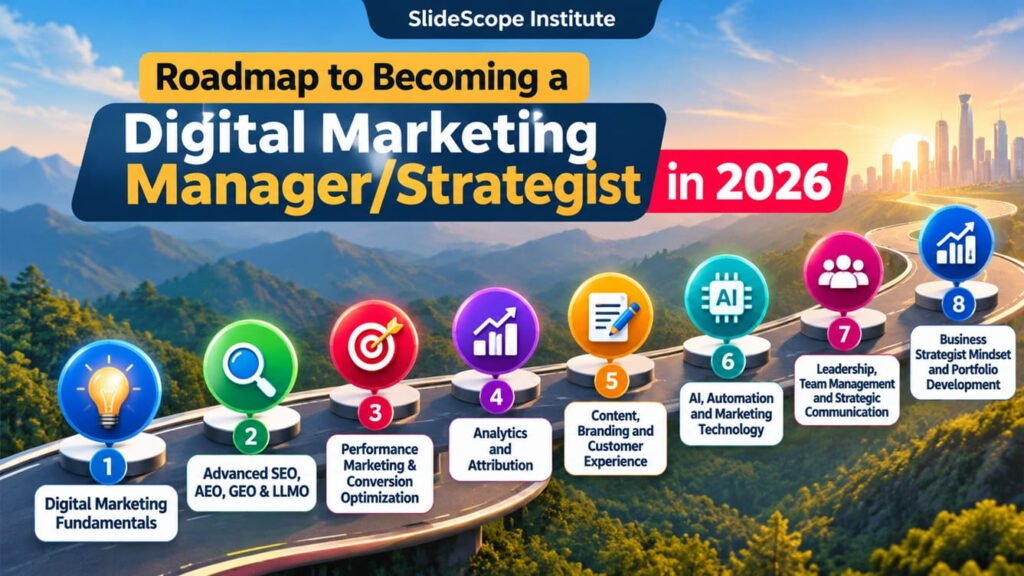
Digital marketing in 2026 is no longer limited to running social media campaigns, writing blogs, or managing Google Ads. A Digital Marketing Manager or Strategist is expected to understand the complete customer journey—from awareness and search visibility to conversion, retention, analytics, automation, and brand growth. The role increasingly combines marketing strategy, technology, data analysis, AI, team leadership, and business understanding.
For professionals who want to move from execution into leadership, having a structured roadmap is essential. You need to build strong foundations, develop channel expertise, learn to interpret data, understand emerging AI-driven search, manage people and budgets, and ultimately connect marketing activities with measurable business outcomes.
This roadmap is designed for professionals targeting Digital Marketing Manager, Digital Marketing Strategist, Growth Manager, Performance Marketing Manager, or Head of Digital Marketing roles in 2026. It focuses not just on what to learn, but on how to progress from doing individual tasks to making strategic decisions.
Digital Marketing Manager Roadmap 2026
Build the skills, strategic thinking, analytics expertise, AI knowledge, and leadership capabilities needed to progress from digital marketing execution into management and business-focused strategy.
1. Master the Digital Marketing Fundamentals
Before becoming a strategist, you need a strong understanding of how digital marketing works as a complete ecosystem. A manager cannot effectively lead SEO, paid advertising, social media, content, email, or analytics teams without understanding how these channels interact.
Start with the fundamentals of SEO, SEM/PPC, social media marketing, content marketing, email marketing, affiliate marketing, conversion rate optimization, online reputation management, and marketing analytics. Understand the purpose of every channel, its strengths, limitations, costs, and position within the customer journey.
You should also learn basic marketing concepts such as STP—segmentation, targeting and positioning—customer personas, buyer journeys, marketing funnels, customer acquisition cost, lifetime value, conversion rates, and return on investment.
The goal is not to become the world's best specialist in every channel. Instead, develop enough expertise to understand how specialists work and how channels contribute to broader business objectives.
At this stage, build small practical projects. Create an SEO campaign, launch a Google Ads test campaign, develop a content calendar, analyze website traffic, and create a basic marketing dashboard.
A strong foundation allows you to move from simply executing instructions to understanding why a marketing activity is being performed and what business outcome it should produce.
2. Develop Advanced SEO, AEO, GEO and LLMO Skills
Search has changed dramatically, making modern search strategy one of the most important capabilities for digital marketing leaders. Traditional SEO remains important, but marketers now need to understand how users discover information through Google, Bing, AI assistants, answer engines, generative search experiences, YouTube, social platforms, and other discovery channels.
Develop strong knowledge of technical SEO, keyword research, search intent, information architecture, internal linking, structured data, content optimization, backlinks, Core Web Vitals, international SEO, and local SEO.
Then expand beyond traditional SEO into AEO—Answer Engine Optimization—and GEO—Generative Engine Optimization. Understand how content can become useful sources for AI-generated answers. Learn about entity optimization, topical authority, structured information, citations, expert content, and conversational search.
LLMO, or optimization for large language model discovery and visibility, is also becoming relevant for brands that want their information represented accurately across AI-driven experiences.
As a future manager, your responsibility will not necessarily be writing every meta description or fixing every technical error. Instead, you should be able to develop an organic visibility strategy, establish KPIs, evaluate agency or team performance, and connect search visibility with qualified traffic and revenue.
The objective is to evolve from “ranking for keywords” to “being discoverable wherever customers search for answers.”
3. Learn Performance Marketing and Conversion Optimization
A Digital Marketing Manager needs to understand how paid campaigns generate measurable business results. Learn the fundamentals of Google Ads, Microsoft Ads, Meta Ads, LinkedIn Ads, YouTube advertising, display advertising, remarketing, lead generation, and campaign optimization.
Begin with campaign structure, audience targeting, keyword selection, bidding, budgets, creative testing, landing pages, tracking, attribution, and conversion measurement. You should understand metrics such as CTR, CPC, CPM, CPA, CPL, ROAS, conversion rate, customer acquisition cost, and lifetime value.
However, strategic marketing requires looking beyond campaign-level metrics. A campaign producing inexpensive leads is not necessarily successful if those leads do not become customers.
This is where conversion rate optimization becomes important. Learn how landing-page design, messaging, forms, calls-to-action, page speed, trust signals, offers, and user experience influence conversions.
Practice creating complete campaign funnels rather than isolated advertisements. For example:
Advertisement → Landing Page → Lead → Qualification → Sales → Customer → Retention
As you progress toward management, learn how to allocate budgets between channels based on objectives and performance. You should also understand experimentation and A/B testing rather than relying entirely on assumptions.
Your role eventually shifts from “How do I optimize this campaign?” to “Where should the company invest its marketing budget to achieve its business objectives?”
4. Become Data-Driven With Analytics and Attribution
One of the biggest differences between an execution-focused marketer and a strategic marketing manager is the ability to make decisions using data.
Develop strong knowledge of Google Analytics 4, Google Search Console, Google Tag Manager, Looker Studio, Excel, SQL, and business intelligence tools such as Power BI or Tableau. You do not necessarily need to become a full-time data analyst, but you should be comfortable working with marketing data.
Learn how to define KPIs before launching campaigns. Understand traffic sources, engagement, conversions, funnel performance, customer acquisition cost, revenue contribution, retention, and campaign profitability.
Tracking is equally important. Learn how tags, events, pixels, UTM parameters, conversion APIs, CRM integrations, and server-side tracking work. Without reliable data collection, even an impressive dashboard can produce misleading conclusions.
You should also understand attribution models and their limitations. Marketing rarely operates through a single touchpoint. A customer might discover a brand through search, interact with social media, read several articles, click an advertisement, and eventually convert through direct traffic.
As a manager, your responsibility is to turn large amounts of information into clear decisions.
Instead of saying, “Traffic increased by 30%,” you should be able to explain where the growth came from, whether it produced valuable users, what changed, and what the team should do next.
5. Master Content, Branding and Customer Experience
Modern digital marketing managers need to think beyond individual campaigns and understand how a brand communicates across the entire customer journey.
Develop the ability to build a content strategy covering websites, blogs, landing pages, social media, email, video, webinars, downloadable resources, case studies, and other formats. Learn how different content formats support awareness, consideration, conversion, and retention.
Content should be based on audience needs rather than simply publishing according to a calendar. Develop buyer personas, identify customer questions, analyze search intent, study competitors, and create content clusters around important topics.
At the same time, understand brand positioning, messaging, tone of voice, visual consistency, differentiation, and reputation management. A performance campaign may generate clicks, but long-term growth requires a recognizable and trusted brand.
Customer experience should also become part of your thinking. Examine what happens after someone clicks an advertisement or search result. Is the landing page relevant? Is the form simple? Does the follow-up happen quickly? Does the customer receive useful information?
A strong strategist connects content, brand, UX, SEO, advertising, email, and sales rather than treating them as isolated departments.
Your goal is to create a consistent customer experience from the first interaction through conversion and beyond.
6. Integrate AI, Automation and Marketing Technology
AI is becoming an important layer across almost every part of digital marketing. Future marketing managers need to understand how to use AI without allowing automation to replace strategic thinking.
Learn how AI can support market research, customer segmentation, content ideation, SEO analysis, advertising creatives, personalization, predictive analytics, reporting, customer support, and workflow automation.
Explore practical tools and technologies for marketing automation, including CRM platforms, email automation, workflow platforms, AI assistants, chatbots, analytics systems, and no-code/low-code automation.
The important skill is not simply knowing how to generate content with AI. A manager should understand where AI creates genuine efficiency and where human judgment remains essential.
For example, AI can help analyze thousands of keywords or customer interactions, generate initial creative variations, summarize reports, or identify patterns. But positioning, brand decisions, campaign priorities, ethical considerations, and business strategy still require human oversight.
Build automated workflows such as:
Lead Generation → CRM → Lead Scoring → Email Sequence → Sales Notification → Reporting
Also understand data privacy, consent, security, copyright, AI-generated content risks, and governance.
By 2026, marketers who understand both marketing strategy and marketing technology can coordinate teams more effectively and identify opportunities for automation that directly improve productivity.
7. Build Leadership, Team Management and Strategic Communication Skills
Moving into management requires a major shift in mindset. You are no longer measured only by what you personally produce. Your success increasingly depends on how effectively you help other people perform.
Learn how to build and manage teams across SEO, content, performance marketing, social media, design, development, analytics, email, and marketing operations.
Understand how to define roles, assign responsibilities, create SOPs, establish KPIs, conduct reviews, provide feedback, and manage deadlines.
You also need strong communication skills. A Digital Marketing Manager frequently communicates with founders, CEOs, sales teams, product managers, developers, designers, agencies, and external partners. Each stakeholder may care about different outcomes.
Learn to translate marketing activity into business language.
Instead of presenting a report containing hundreds of metrics, explain:
What happened → Why it happened → Business impact → What we recommend → What happens next
Budget management is another essential leadership skill. Learn to prepare marketing plans, forecast spending, evaluate agencies, negotiate with vendors, and justify investments.
You should also develop project management skills using frameworks, workflows, documentation, and tools that keep multiple campaigns moving simultaneously.
The transition from specialist to manager happens when you stop asking “How can I do everything myself?” and start asking “How can I build a system and team that consistently delivers results?”
8. Think Like a Business Strategist and Build a Portfolio
The final stage is connecting digital marketing directly to business strategy.
A Digital Marketing Strategist should understand the company's products, customers, competitors, revenue model, sales process, margins, growth opportunities, and strategic priorities.
Start creating complete marketing strategies rather than isolated campaigns. Build plans that include market research, audience segmentation, positioning, channel selection, budgets, content strategy, technology, KPIs, timelines, risks, and expected business outcomes.
Develop your ability to create quarterly and annual digital marketing roadmaps. Learn how to prioritize initiatives based on business impact, resources, cost, urgency, and feasibility.
Your portfolio should demonstrate this strategic thinking. Instead of showing only certificates, create case studies explaining:
- The business problem
- Target audience
- Research performed
- Strategy developed
- Channels selected
- Campaign execution
- Data and KPIs
- Optimization decisions
- Business results
- Lessons learned
Also build your professional visibility through LinkedIn, industry communities, speaking opportunities, webinars, articles, and practical projects.
Ultimately, the strongest evidence of leadership is not how many tools you know. It is your ability to identify a business problem, develop a digital strategy, lead execution, measure results, and continuously improve the system.
Conclusion
Becoming a Digital Marketing Manager or Strategist in 2026 requires much more than learning a collection of marketing tools. The career path moves from execution → specialization → analytics → strategy → leadership → business impact.
Start by mastering the fundamentals, then develop expertise across search, paid advertising, content, analytics, customer experience, AI, and automation. At the same time, build the management capabilities required to lead people, budgets, projects, agencies, and cross-functional teams.
The most important shift is your mindset. An executive-level digital marketer does not simply ask, “What should we post?”, “Which keyword should we target?”, or “Which advertisement should we run?”
They ask:
Who are we trying to reach? What business problem are we solving? Which channels can create the greatest impact? How will we measure it? What does the data tell us? And how can we build a repeatable growth system?
That is the transition from being a Digital Marketing Executive to becoming a Digital Marketing Manager and Strategist.
And in 2026, the professionals who combine marketing knowledge, data, AI, technology, creativity, and leadership will be positioned to take on increasingly strategic roles within modern organizations.

Ankit Srivastava is an IT trainer, technology educator, and digital skills mentor with expertise in programming, data analytics, AI, and software development. He has successfully trained thousands of learners, with more than 10,000 student enrollments on Udemy. His practical teaching approach empowers students and professionals to build in-demand technical skills. Colorstech channel where Ankit posts video tutorials has more than 8000 Subscribers.