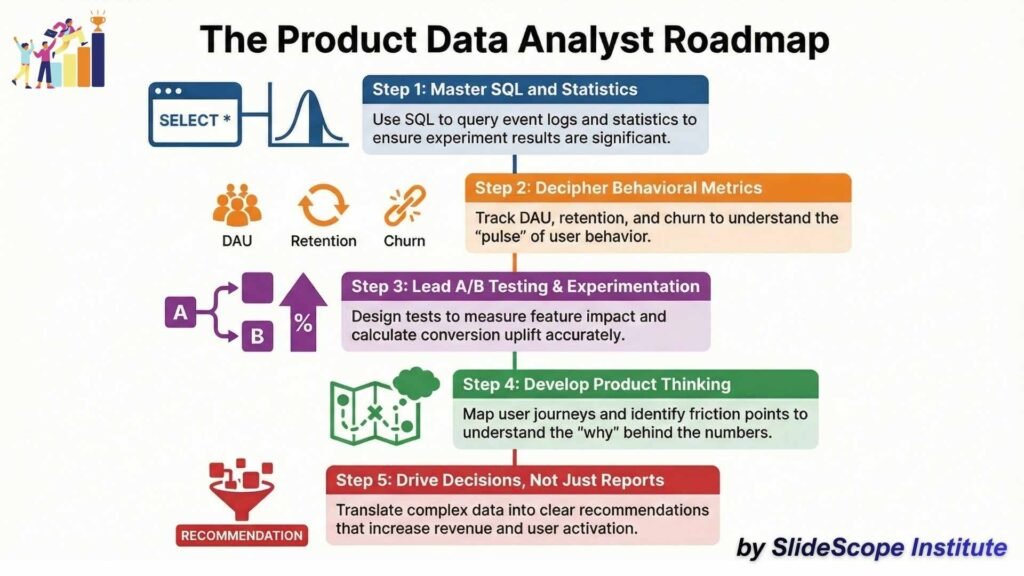
By Ankit Srivastava.
Becoming a Product Data Analyst is not about learning tools alone. It’s about developing the ability to connect user behavior, product performance, business goals, and data storytelling into measurable impact.
In today’s digital-first ecosystem — SaaS platforms, EdTech apps, FinTech tools, eCommerce systems, AI products — companies don’t just want dashboards. They want insights that drive:
- Product decisions
- Feature prioritization
- User retention
- Revenue growth
- Experimentation success
If you want to become a strong Product Data Analyst, you must build technical depth + product thinking + business understanding.
Below is a structured 10-step roadmap that I recommend.
1️⃣ Build Strong Foundations in Statistics & Analytical Thinking
Before touching tools, you must understand why analysis works.
As a Product Data Analyst, you will constantly deal with:
- User cohorts
- A/B testing
- Funnel drop-offs
- Retention curves
- Conversion optimization
- Experiment impact measurement
You must deeply understand:
Core Topics to Master:
- Mean, Median, Variance, Standard Deviation
- Probability Basics
- Hypothesis Testing
- p-value & statistical significance
- Confidence intervals
- Correlation vs Causation
- Regression basics
- Sampling bias
Why This Matters
When a product manager asks:
“Did this new onboarding feature improve retention?”
You must:
- Form hypothesis
- Define metrics
- Select appropriate test
- Interpret results correctly
If you don’t understand statistical reasoning, you’ll misinterpret product experiments — and that can cost companies millions.
2️⃣ Master SQL – Your Primary Weapon
If you ask me the most important skill for a Product Data Analyst, the answer is simple:
SQL.
Product data lives in databases.
You must be able to:
- Query event logs
- Analyze user journeys
- Segment customers
- Track feature usage
- Measure churn
What to Learn in SQL
- SELECT, WHERE, GROUP BY
- JOINS (INNER, LEFT, RIGHT)
- Subqueries
- CTEs (WITH statements)
- Window Functions
- Aggregations
- Date functions
- Case statements
Product-Specific SQL Use Cases
- DAU / MAU calculation
- Cohort retention analysis
- Funnel conversion
- User segmentation
- Lifetime value calculation
- Session-level analysis
A Product Analyst should not depend on Data Engineers for basic queries.
SQL gives you independence.
3️⃣ Understand Product Metrics Deeply
You cannot analyze what you don’t understand.
Every digital product revolves around certain core metrics.
Must-Know Product Metrics:
- DAU (Daily Active Users)
- MAU (Monthly Active Users)
- Stickiness Ratio
- Retention Rate
- Churn Rate
- Conversion Rate
- Average Revenue Per User (ARPU)
- Customer Lifetime Value (CLTV)
- Activation Rate
- Engagement Metrics
SaaS-Specific:
- MRR (Monthly Recurring Revenue)
- CAC (Customer Acquisition Cost)
- LTV:CAC Ratio
eCommerce:
- Cart Abandonment Rate
- Repeat Purchase Rate
EdTech:
- Course Completion Rate
- Learning Engagement
You must understand:
- How metrics are defined
- How they are calculated
- When they are misleading
- What drives them
A great Product Analyst knows:
Metrics are not numbers — they are behavioral signals.
4️⃣ Learn Product Analytics Tools
Modern product teams use event-tracking tools.
Some popular platforms:
- Google Analytics 4
- Mixpanel
- Amplitude
- Heap
- Hotjar
What You Must Learn:
- Event tracking
- User properties
- Funnel analysis
- Cohort analysis
- Retention analysis
- Path analysis
- Feature adoption tracking
If you’re in SaaS or app-based business, tools like Mixpanel and Amplitude are heavily used.
If you’re in website-heavy businesses, GA4 is critical.
You must understand event schema design — not just dashboard viewing.
5️⃣ Develop Strong Data Visualization Skills
Data without storytelling is noise.
Learn tools like:
- Power BI
- Tableau
- Looker Studio
You must know:
- When to use bar chart vs line chart
- How to build executive dashboards
- How to avoid misleading visuals
- KPI hierarchy structuring
- Drill-down design
- Cohort visualization
As a Product Analyst:
Your dashboards should answer:
- What changed?
- Why did it change?
- What should we do next?
Not just:
“Here is the data.”
6️⃣ Learn Experimentation & A/B Testing
Product teams experiment constantly.
You must understand:
- A/B testing design
- Control vs variant
- Sample size calculation
- Statistical power
- Uplift measurement
- Guardrail metrics
When a new feature is released:
- Does it increase activation?
- Does it reduce churn?
- Does it hurt performance elsewhere?
A Product Data Analyst must:
- Define primary metric
- Define secondary metrics
- Monitor test health
- Interpret impact
- Recommend rollout or rollback
Experimentation separates good analysts from great ones.
7️⃣ Build Product Thinking
This is where many analysts fail.
They know SQL.
They know dashboards.
But they don’t understand the product.
Product Thinking Means:
- Understanding user pain points
- Knowing user journey
- Mapping friction points
- Thinking in features
- Understanding product lifecycle
You must ask:
- Why are users dropping off here?
- Is this a UX issue or pricing issue?
- Is this acquisition quality or product-market fit issue?
Talk to:
- Product managers
- UX designers
- Marketing team
- Customer support
Data lives in numbers.
Product truth lives in conversations.
8️⃣ Learn Basic Python for Advanced Analysis
While SQL handles structured queries, Python helps in:
- Advanced statistical testing
- Predictive modeling
- Segmentation
- Automation
- Large data manipulation
Libraries to learn:
- pandas
- numpy
- matplotlib
- seaborn
- scipy
You don’t need to become a Data Scientist.
But Python gives you analytical depth when SQL isn’t enough.
9️⃣ Work on Real Product Projects
Theory won’t make you a Product Analyst.
You need practical exposure.
Build Projects Like:
- Analyze a SaaS onboarding funnel
- Calculate retention for an EdTech platform
- Create cohort analysis dashboard
- Build churn prediction dataset
- Perform A/B test simulation
- Analyze mobile app engagement
If possible:
- Use Kaggle datasets
- Simulate product database
- Use open SaaS datasets
Portfolio is critical.
Companies hire analysts who show thinking — not certificates.
🔟 Develop Business Communication & Stakeholder Influence
The most underrated skill.
As a Product Data Analyst, you will present insights to:
- Product managers
- Founders
- Marketing heads
- Engineering leads
Your job is not to present SQL output.
Your job is to say:
“If we optimize onboarding step 2, we can improve activation by 12%, leading to ₹X increase in monthly revenue.”
You must:
- Simplify complex analysis
- Avoid jargon
- Present insights with clarity
- Recommend action
Data alone does not create impact.
Decisions do.
Bonus: Career Path Strategy
Entry Roles:
- Data Analyst
- Business Analyst
- Growth Analyst
- Junior Product Analyst
Mid-Level:
- Product Data Analyst
- Growth Analytics Specialist
Advanced:
- Senior Product Analyst
- Analytics Lead
- Head of Product Analytics
Skills Stack Summary
| Layer | Skill |
|---|---|
| Foundation | Statistics |
| Core Tool | SQL |
| Product Layer | Metrics & Funnels |
| Visualization | BI Tools |
| Advanced | Python |
| Strategic | Product Thinking |
| Impact | Communication |
My Practical Advice (From Experience)
If I had to guide someone starting today:
Month 1–2
Statistics + SQL basics
Month 3–4
Advanced SQL + product metrics
Month 5–6
Dashboarding + funnel analysis
Month 7–8
A/B testing + cohort analysis
Month 9+
Real projects + portfolio + internship
Final Thoughts
A Product Data Analyst is not just a data professional.
He or she is:
- A product detective
- A behavioral scientist
- A business strategist
- A storyteller
In the AI era, dashboards are automated.
SQL can be generated.
Reports can be built with prompts.
But interpretation, product intuition, and business judgment — that is where real value lies.
If you focus only on tools, you will compete with automation.
If you focus on insight and impact, you will lead product strategy.
That is the difference.
And that is the roadmap.
—
Ankit