Introduction
As someone deeply involved in IT training and digital transformation, I’ve seen firsthand how Computer Vision is reshaping industries—from healthcare diagnostics to autonomous vehicles and smart surveillance. Becoming a Computer Vision Engineer isn’t just about learning to process images; it’s about teaching machines to interpret the visual world intelligently.
This field sits at the intersection of mathematics, programming, and artificial intelligence, making it both challenging and incredibly rewarding. If you’re someone who enjoys problem-solving, working with data, and building intelligent systems, this roadmap will guide you step-by-step. Whether you’re starting from scratch or transitioning from another tech role, following a structured path will help you build the right skills, tools, and mindset needed to succeed in this high-demand domain.
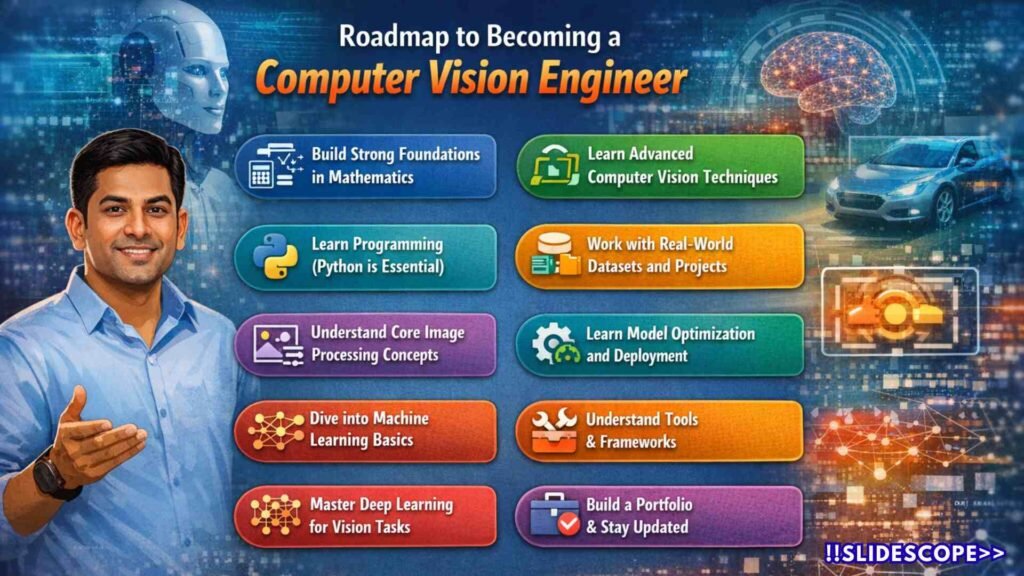
1. Build Strong Foundations in Mathematics
Computer Vision relies heavily on mathematical concepts, so your journey must begin here. Focus on linear algebra, calculus, probability, and statistics. Linear algebra helps in understanding image transformations and matrix operations, which are core to image processing. Calculus is essential for optimization techniques used in training models, especially neural networks. Probability and statistics allow you to interpret uncertainty, noise, and model predictions effectively.
Understanding vectors, eigenvalues, gradients, and distributions is not optional—it’s fundamental. These concepts power algorithms behind object detection, facial recognition, and image segmentation.
Instead of memorizing formulas, focus on intuition. Try implementing mathematical concepts in code using libraries like NumPy. Visualizing data and transformations will deepen your understanding.
A strong mathematical base ensures you can move beyond just using tools—you’ll understand how and why models work, enabling you to innovate and debug effectively in real-world scenarios.
2. Learn Programming (Python is Essential)
Programming is the backbone of Computer Vision, and Python is the most widely used language in this domain. Its simplicity and rich ecosystem make it ideal for beginners and professionals alike.
Start by mastering Python fundamentals such as data structures, loops, functions, and object-oriented programming. Then move on to libraries like NumPy for numerical computations and Pandas for data handling.
For Computer Vision specifically, you must learn OpenCV, which provides tools for image processing tasks like filtering, edge detection, and feature extraction. Writing efficient and clean code is crucial, as real-world applications often deal with large datasets and require optimization.
Practice by building small projects—such as detecting edges in images or creating filters. Gradually move to more complex implementations.
The goal is not just coding but writing scalable and maintainable solutions. As you grow, you’ll integrate Python with deep learning frameworks to build powerful vision systems.
3. Understand Core Image Processing Concepts
Before jumping into advanced AI models, you must understand traditional image processing techniques. These are the building blocks of Computer Vision.
Learn how images are represented digitally—pixels, color spaces (RGB, grayscale), and image formats. Study operations like thresholding, filtering, morphological transformations, and histogram equalization.
Edge detection algorithms like Canny and Sobel are essential for understanding how features are extracted from images. You should also explore contour detection and image segmentation basics.
These techniques help in preprocessing data before feeding it into machine learning models. They also remain relevant in lightweight or real-time systems where deep learning may not be feasible.
Hands-on practice is key. Use OpenCV to experiment with different transformations and observe their effects.
Mastering these fundamentals ensures you have a solid understanding of how visual data is manipulated and prepared, forming a strong base for advanced Computer Vision techniques.
4. Dive into Machine Learning Basics
Computer Vision heavily integrates with Machine Learning, so understanding ML concepts is critical. Start with supervised and unsupervised learning, regression, and classification techniques.
Learn algorithms like linear regression, decision trees, k-nearest neighbors, and support vector machines. These may seem basic, but they help you understand model behavior, bias-variance tradeoff, and evaluation metrics.
Study concepts such as training/testing splits, cross-validation, and performance metrics like accuracy, precision, recall, and F1-score.
Implement models using libraries like Scikit-learn. Work on small datasets to understand how features influence predictions.
This stage builds your intuition about how models learn from data. It prepares you for deep learning, where similar principles apply but at a larger scale.
A solid ML foundation ensures you can choose the right model, evaluate performance, and troubleshoot issues effectively in Computer Vision projects.
5. Master Deep Learning for Vision Tasks
Deep Learning is at the heart of modern Computer Vision. You need to understand neural networks, especially Convolutional Neural Networks (CNNs), which are specifically designed for image data.
Learn how CNNs work—convolution layers, pooling layers, activation functions, and backpropagation. Study architectures like LeNet, AlexNet, VGG, and ResNet.
Use frameworks like TensorFlow or PyTorch to build and train models. Start with image classification tasks and gradually move to more complex problems.
Understand overfitting, regularization, dropout, and hyperparameter tuning. These concepts are critical for building robust models.
Experiment with real datasets like CIFAR-10 or ImageNet subsets.
Deep learning enables machines to recognize patterns, objects, and features at scale. Mastering it will allow you to build state-of-the-art Computer Vision applications used in industries today.
6. Learn Advanced Computer Vision Techniques
Once you’re comfortable with deep learning, move to advanced Computer Vision tasks. These include object detection, image segmentation, and pose estimation.
Study popular models like YOLO (You Only Look Once), SSD (Single Shot Detector), and Mask R-CNN. Each has its own strengths depending on speed and accuracy requirements.
Learn about transfer learning—using pre-trained models to save time and resources. This is widely used in industry projects.
Explore feature extraction techniques like SIFT and SURF, even though they are traditional methods—they still provide valuable insights.
Understanding these advanced techniques enables you to work on real-world applications like surveillance systems, autonomous vehicles, and medical imaging solutions.
7. Work with Real-World Datasets and Projects
Theory alone won’t make you a Computer Vision Engineer—you must work on real-world problems.
Start with publicly available datasets such as COCO, Pascal VOC, or Kaggle datasets. These provide diverse challenges and help you understand real-world complexities like noise, imbalance, and labeling issues.
Build projects like face detection, object tracking, or license plate recognition. Deploy your models using simple web apps or APIs.
Participate in competitions on platforms like Kaggle to test your skills against others.
Projects help you understand the complete pipeline—from data collection and preprocessing to model training and deployment.
This hands-on experience is what employers value most. It demonstrates your ability to apply theoretical knowledge to practical scenarios.
8. Learn Model Optimization and Deployment
Building a model is only half the job—deploying it efficiently is equally important.
Learn techniques like model quantization, pruning, and optimization to make models faster and lighter. This is crucial for real-time applications like mobile apps or embedded systems.
Understand deployment tools like TensorFlow Lite, ONNX, and Docker. Learn how to serve models using APIs or integrate them into applications.
Explore edge computing and how models run on devices with limited resources.
Also, focus on performance monitoring and updating models based on real-world feedback.
Deployment skills differentiate beginners from professionals. They ensure your models are not just accurate but also usable in production environments.
9. Understand Tools, Frameworks, and Ecosystem
To succeed, you must be comfortable with the tools used in the industry.
Learn libraries like OpenCV, TensorFlow, PyTorch, and Keras. Understand how to use Jupyter notebooks for experimentation.
Get familiar with version control systems like Git and platforms like GitHub. Learn basic cloud platforms such as AWS or Google Cloud for model training and deployment.
Explore annotation tools for labeling datasets and experiment tracking tools like MLflow.
Understanding the ecosystem helps you work efficiently and collaborate with teams.
The right tools can significantly improve productivity and allow you to focus more on solving problems rather than managing infrastructure.
10. Build a Portfolio and Stay Updated
The field of Computer Vision evolves rapidly, so continuous learning is essential.
Create a strong portfolio showcasing your projects, code, and results. Use GitHub and personal websites to present your work professionally.
Write blogs or create content explaining your projects—it helps reinforce your knowledge and builds credibility.
Follow research papers, blogs, and communities. Platforms like arXiv and conferences like CVPR provide insights into the latest advancements.
Networking is also important—connect with professionals on LinkedIn and participate in tech communities.
Consistency and curiosity will keep you ahead in this fast-moving field. With the right mindset and continuous effort, you can build a successful career as a Computer Vision Engineer.
Conclusion
Becoming a Computer Vision Engineer is not a one-time achievement but a continuous journey of learning, experimentation, and adaptation. From building a strong mathematical foundation to mastering deep learning and deploying real-world solutions, every step in this roadmap contributes to shaping you into a well-rounded professional. The key is not to rush through topics but to truly understand them, apply them in practical scenarios, and refine your approach based on results.
In my experience as an IT trainer and digital project leader, I’ve seen many learners get overwhelmed by the complexity of this field. Computer Vision can seem intimidating at first because it combines multiple disciplines—mathematics, programming, and artificial intelligence. However, the moment you start breaking it down into structured steps, as we’ve done in this roadmap, it becomes far more approachable. The real transformation happens when you move from passive learning to active building—creating projects, solving problems, and experimenting with datasets.
One important aspect that often gets overlooked is consistency. You don’t need to master everything in a week or even a few months. What matters is showing up regularly, practicing coding, revisiting concepts, and gradually increasing the complexity of your projects. Even small wins, like successfully implementing an edge detection algorithm or training your first image classification model, build confidence and momentum. Over time, these small steps compound into significant expertise.
Another crucial factor is staying updated. The field of Computer Vision evolves rapidly, with new architectures, models, and optimization techniques being introduced frequently. What is considered state-of-the-art today may become outdated in a couple of years. This means you must cultivate a habit of continuous learning—reading research papers, following industry leaders, and experimenting with new tools and frameworks. This curiosity-driven mindset will ensure you remain relevant and competitive.
Equally important is building a strong portfolio. Your projects speak louder than your resume. Whether it’s a real-time object detection system, a facial recognition app, or a medical imaging solution, each project demonstrates your ability to solve real-world problems. Focus on quality over quantity—well-documented, impactful projects will always stand out. Sharing your work through GitHub, blogs, or LinkedIn also helps you build credibility and attract opportunities.
Finally, remember that Computer Vision is not just about technology—it’s about impact. From improving healthcare diagnostics to enabling autonomous driving and enhancing security systems, your work has the potential to solve meaningful problems. Approach this field with curiosity, discipline, and a problem-solving mindset.
If you stay committed to this roadmap, keep learning, and consistently apply your knowledge, you won’t just become a Computer Vision Engineer—you’ll become someone capable of building intelligent systems that truly understand the world visually.

Ankit Srivastava is an IT trainer, technology educator, and digital skills mentor with expertise in programming, data analytics, AI, and software development. He has successfully trained thousands of learners, with more than 10,000 student enrollments on Udemy. His practical teaching approach empowers students and professionals to build in-demand technical skills. Colorstech channel where Ankit posts video tutorials has more than 8000 Subscribers.