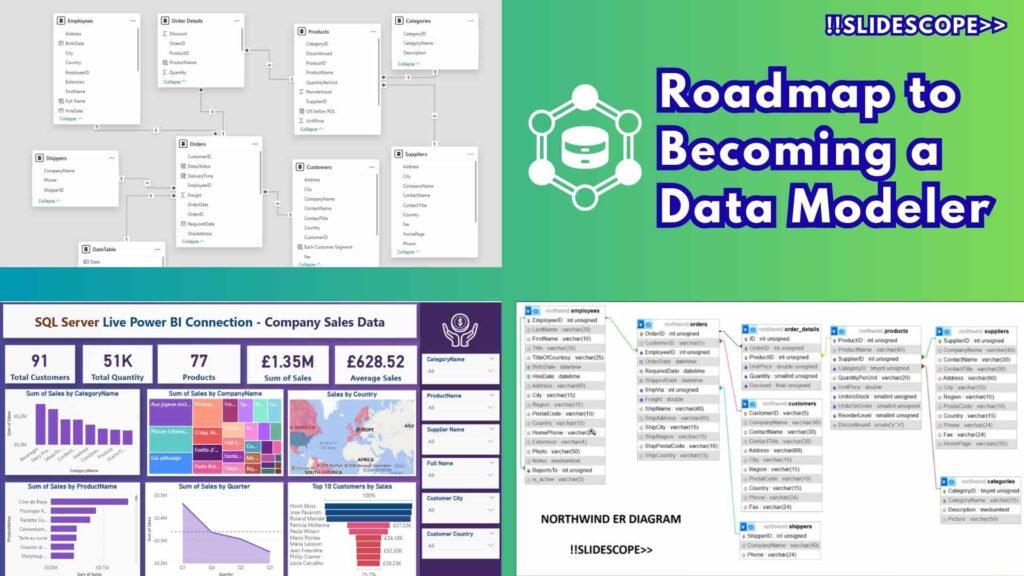
Lets start with an example of a trading company’s database:

As you can see this database has 8 Primary tables shown in the Entity Relationship diagram.
Now Lets see this Power BI Screenshot:
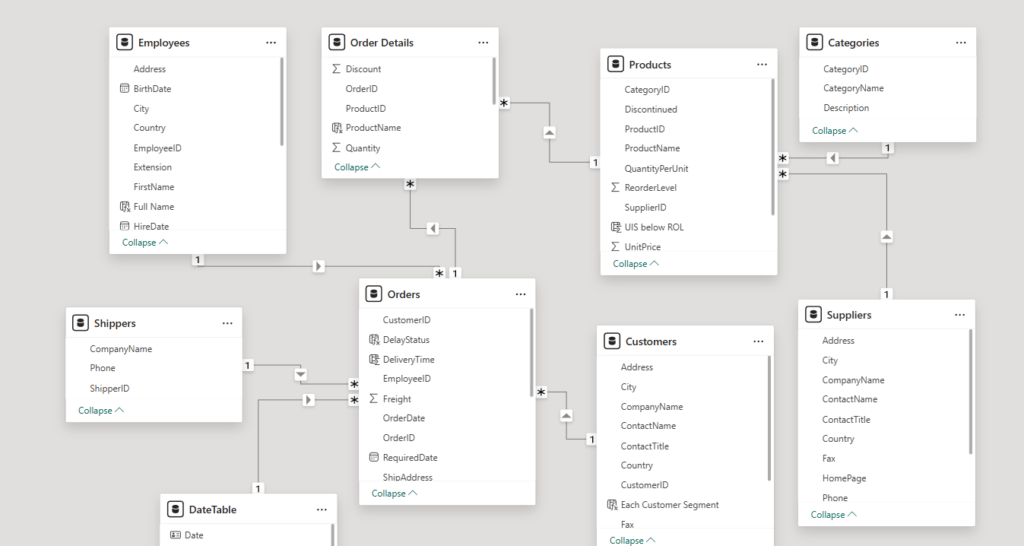
This is a Data Model of the same database in SQL server when connected with Power BI. After Creating this model our job of creating Interactive databases of this company became efficient. Here is a snapshot of the Power BI Dashboard:

Now that is one of many tasks that a Data Modeler would perform.
In this article we are discussing the Roadmap to becoming a Data Modeler
SlideScope Institute · Career Series
Roadmap to Becoming
a Data Modeler
A structured, ten-point guide to building the skills, credentials, and professional presence needed to launch and grow a career in data modeling.
Step 1 of 10
Real-Life Works of a Data Modeler
By Ankit
1. Understanding Business Requirements Deeply
As a data modeler, my first responsibility is to truly understand the business problem before jumping into tables and schemas. I work closely with stakeholders, business analysts, and domain experts to gather requirements. It’s not just about what data is needed, but why it is needed. I translate business language into data structures. This step ensures that the data model aligns with real-world use cases like reporting, analytics, or operations. A strong foundation here avoids rework later. I often ask multiple questions, validate assumptions, and document everything clearly. Without this clarity, even the most technically sound model can fail in delivering value.
2. Designing Conceptual Data Models
Once requirements are clear, I create conceptual models that represent high-level relationships between entities. This is like building a blueprint of the data ecosystem. At this stage, I don’t worry about technical constraints; I focus on business meaning. For example, defining entities like Customers, Orders, Products, and their relationships. This helps stakeholders visualize how data connects. It also ensures alignment across teams before diving deeper. Conceptual modeling is crucial because it bridges the gap between business thinking and technical implementation, making communication smoother and reducing misunderstandings in later stages.
3. Building Logical Data Models
After conceptual clarity, I move to logical modeling. Here, I define attributes, primary keys, foreign keys, and relationships in detail. I normalize the data to reduce redundancy and improve efficiency. Logical models are independent of any database system, making them flexible and scalable. I ensure that data integrity rules are properly defined. This step requires both analytical thinking and attention to detail. A well-designed logical model ensures consistency across systems and forms the backbone for scalable data architecture.
4. Creating Physical Data Models
In this stage, I translate logical models into physical structures specific to a database system like MySQL, SQL Server, or Snowflake. I define tables, columns, indexes, partitions, and storage details. Performance becomes a key focus here. I optimize queries, design indexes, and ensure efficient data retrieval. Physical modeling also involves handling constraints like storage limits and processing power. This is where theory meets real-world implementation, and decisions here directly impact system performance.
5. Data Normalization and Denormalization
Balancing normalization and denormalization is a critical part of my work. Normalization reduces redundancy and ensures data integrity, while denormalization improves query performance. Depending on the use case, such as transactional systems or data warehouses, I decide the right approach. For example, in analytics systems, denormalized tables can speed up reporting. I carefully evaluate trade-offs to ensure both performance and accuracy. This balance is essential for building efficient and scalable data systems.
6. Ensuring Data Quality and Integrity
A data modeler is responsible for maintaining data accuracy and consistency. I define constraints, validation rules, and relationships that enforce data integrity. This includes primary keys, foreign keys, and data validation rules. I also collaborate with data engineers to implement data quality checks. Poor data quality can lead to wrong business decisions, so this responsibility is critical. I ensure that the system prevents incorrect data entry and maintains reliability across all processes.
7. Supporting Data Warehousing and BI Systems
In modern organizations, data modeling plays a key role in building data warehouses and BI systems. I design star schemas, snowflake schemas, and fact-dimension models for analytics. This helps tools like Power BI or Tableau generate insights efficiently. I focus on query performance, aggregation, and scalability. My models ensure that business users can easily access and analyze data without technical complexity. This is where data modeling directly impacts decision-making and business growth.
8. Collaborating with Cross-Functional Teams
Data modeling is not a solo job. I work closely with developers, data engineers, analysts, and business stakeholders. Collaboration ensures that the data model meets both technical and business needs. I participate in meetings, reviews, and feedback sessions. Clear communication is key, as I often act as a bridge between technical and non-technical teams. This collaboration ensures smooth implementation and reduces errors during development.
9. Managing Data Governance and Documentation
Documentation is an essential part of my role. I maintain data dictionaries, metadata, and schema documentation. This ensures transparency and helps teams understand data structures easily. I also follow data governance policies to ensure compliance and security. Proper documentation reduces dependency on individuals and supports long-term scalability. It also helps new team members quickly understand the system.
10. Optimizing and Maintaining Data Models
Data modeling is not a one-time task. I continuously monitor and optimize models based on changing business needs. As data grows, performance issues can arise, and I work on tuning queries and redesigning structures if needed. I also update models when new features or requirements are introduced. Maintenance ensures that the system remains efficient, scalable, and aligned with business goals. Continuous improvement is key to long-term success in data modeling.

Ankit Srivastava is an IT trainer, technology educator, and digital skills mentor with expertise in programming, data analytics, AI, and software development. He has successfully trained thousands of learners, with more than 10,000 student enrollments on Udemy. His practical teaching approach empowers students and professionals to build in-demand technical skills. Colorstech channel where Ankit posts video tutorials has more than 8000 Subscribers.