Introduction
Artificial Intelligence is no longer a futuristic concept—it’s shaping industries, transforming businesses, and redefining how we solve problems. As someone deeply involved in IT training and digital transformation, I’ve seen firsthand how AI skills are becoming one of the most valuable assets in today’s job market.
If you’re aiming to become an AI Engineer, you’re stepping into a field that blends programming, mathematics, data science, and real-world problem-solving. The journey might seem overwhelming at first, but with the right roadmap and consistent effort, it becomes structured and achievable.
In this guide, I’ll walk you through a clear, step-by-step roadmap that will help you build strong foundations, develop practical skills, and eventually position yourself as a job-ready AI Engineer.
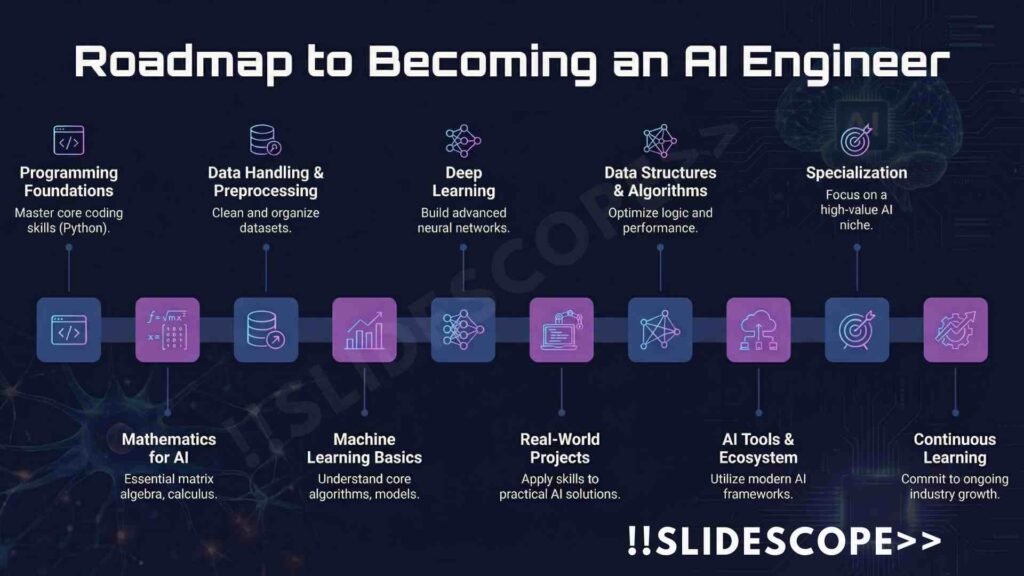
1. Build Strong Programming Foundations
Programming is the backbone of AI engineering. Start with mastering languages like Python, which is widely used due to its simplicity and extensive AI libraries. Focus on understanding core concepts such as variables, loops, functions, data structures, and object-oriented programming.
Beyond basics, learn how to write clean, efficient, and reusable code. Practice solving problems on platforms like LeetCode or HackerRank to strengthen your logic-building skills.
You should also get familiar with libraries such as NumPy, Pandas, and Matplotlib. These tools are essential for data manipulation and visualization, which are critical in AI workflows.
Consistency is key here—code daily, build small projects, and gradually increase complexity. Strong programming skills will make learning advanced AI concepts much easier and more practical.
2. Master Mathematics for AI
Mathematics is the core engine behind AI models. You don’t need to be a mathematician, but you must understand key concepts like linear algebra, probability, statistics, and calculus.
Linear algebra helps you understand vectors, matrices, and transformations used in machine learning models. Probability and statistics are crucial for making predictions and understanding data distributions.
Calculus plays a role in optimization techniques such as gradient descent, which is used in training models.
Instead of just theory, focus on applying math concepts in real scenarios. For example, understand how matrices are used in neural networks or how probability impacts classification models.
This foundation will give you confidence when working with complex algorithms and help you understand why models behave the way they do.
3. Learn Data Handling and Preprocessing
AI models depend heavily on data. Learning how to collect, clean, and preprocess data is a crucial skill. Raw data is often messy, incomplete, and inconsistent, so transforming it into usable form is essential.
You should understand techniques like handling missing values, normalization, encoding categorical variables, and feature scaling. Tools like Pandas and SQL are very helpful for managing datasets efficiently.
Data visualization is equally important. It helps you understand patterns, trends, and anomalies before building models. Use tools like Matplotlib or Seaborn for this purpose.
Remember, even the best AI model won’t perform well if the data is poor. Strong data handling skills often make the biggest difference in real-world AI projects.
4. Understand Machine Learning Fundamentals
Machine Learning is the core of AI engineering. Start by understanding supervised and unsupervised learning. Learn algorithms like linear regression, logistic regression, decision trees, and clustering techniques.
Focus on how models are trained, evaluated, and improved. Learn concepts like overfitting, underfitting, bias-variance tradeoff, and model evaluation metrics such as accuracy, precision, recall, and F1-score.
Use libraries like Scikit-learn to implement models and experiment with datasets. Build small projects like spam detection, price prediction, or recommendation systems.
The goal is not just to use models but to understand how they work and when to use them. This knowledge forms the foundation for more advanced AI techniques.
5. Dive into Deep Learning
Deep Learning is a subset of AI that focuses on neural networks. Start with understanding how artificial neural networks (ANNs) work, including layers, neurons, weights, and activation functions.
Gradually move to advanced architectures like Convolutional Neural Networks (CNNs) for image processing and Recurrent Neural Networks (RNNs) for sequential data.
Learn frameworks like TensorFlow and PyTorch, which are widely used in industry. Practice building models for tasks like image classification, text analysis, or speech recognition.
Deep learning requires experimentation and patience. You’ll often need to tweak parameters and architectures to get better results. Over time, you’ll develop intuition for designing effective models.
6. Work on Real-World Projects
Theory alone is not enough—you must apply what you learn. Start building real-world projects to gain practical experience.
Projects could include chatbots, recommendation systems, fraud detection models, or image recognition systems. These projects help you understand the end-to-end workflow of AI development.
Focus on solving real problems rather than just following tutorials. Try to deploy your models and make them usable in real scenarios.
Create a portfolio showcasing your work on platforms like GitHub. Employers value practical experience, and a strong portfolio can significantly boost your chances of landing a job.
7. Learn Data Structures and Algorithms
While AI is data-focused, strong problem-solving skills are still essential. Data Structures and Algorithms (DSA) help you write efficient code and optimize performance.
Learn about arrays, linked lists, stacks, queues, trees, and graphs. Understand sorting and searching algorithms, as well as time and space complexity.
Many AI roles involve handling large datasets, so efficiency matters. DSA also plays a crucial role in technical interviews.
Practice regularly and try to solve problems that challenge your thinking. This will improve your coding speed, logic, and confidence.
8. Understand AI Tools and Ecosystem
AI engineering is not just about models—it involves a complete ecosystem of tools and technologies. Learn about version control using Git, cloud platforms like AWS or Google Cloud, and containerization tools like Docker.
Understand how APIs work and how to integrate AI models into applications. Learn about MLOps, which focuses on deploying, monitoring, and maintaining models in production.
Familiarize yourself with tools like Jupyter Notebook, VS Code, and model deployment platforms.
Having knowledge of the ecosystem makes you industry-ready and helps you move beyond just building models to actually deploying and scaling them.
9. Specialize in a Domain
AI is a vast field, so specialization is important. Choose a domain based on your interest and career goals.
You can specialize in areas like Natural Language Processing (NLP), Computer Vision, Robotics, or AI in Healthcare/Finance.
Once you choose a domain, go deeper into its concepts, tools, and use cases. For example, if you choose NLP, focus on text processing, transformers, and language models.
Specialization helps you stand out and makes your skillset more valuable in the job market.
10. Stay Updated and Keep Learning
AI is one of the fastest-evolving fields. New models, tools, and techniques are constantly emerging. Staying updated is essential for long-term success.
Follow AI blogs, research papers, and industry leaders. Platforms like arXiv, Medium, and YouTube are great for learning new trends.
Participate in communities, attend webinars, and contribute to open-source projects. Continuous learning will keep your skills relevant and competitive.
Remember, becoming an AI Engineer is not a one-time achievement—it’s a continuous journey of learning, experimenting, and evolving.
Real-World Work of an AI Engineer
1. Building a Recommendation System for E-Commerce Platforms
One of the most common real-world applications of AI engineering is developing recommendation systems. Platforms like Amazon and Netflix rely heavily on AI engineers to personalize user experiences.
An AI engineer collects user behavior data such as browsing history, clicks, purchase patterns, and watch time. This data is then preprocessed and fed into machine learning models like collaborative filtering or content-based filtering systems.
The engineer designs algorithms that predict what a user is most likely to engage with next. These models are continuously improved using feedback loops and real-time data.
The final system is deployed into production, where it dynamically updates recommendations for millions of users. This directly impacts user engagement, retention, and revenue, making it a high-impact AI application in the real world.
2. Developing Fraud Detection Systems in Banking
AI engineers play a critical role in financial security by building fraud detection systems. Banks and fintech companies use AI to detect suspicious transactions in real time.
The process starts with collecting transaction data such as location, amount, frequency, and device information. AI engineers then build classification models using algorithms like decision trees or neural networks to identify unusual patterns.
For example, if a user suddenly makes a high-value transaction in a different country, the model flags it as potentially fraudulent. These systems use anomaly detection and predictive analytics to reduce financial risks.
AI engineers also focus on minimizing false positives, ensuring genuine transactions are not blocked unnecessarily. These systems operate at scale and must be highly accurate, reliable, and fast, making them a complex yet critical real-world AI application.
3. Creating AI-Powered Chatbots and Virtual Assistants
AI engineers design intelligent chatbots and virtual assistants used in customer support, healthcare, and business automation. Companies like Google and Microsoft invest heavily in conversational AI systems.
The engineer works on Natural Language Processing (NLP) models that understand user queries and generate meaningful responses. These systems are trained on large datasets of conversations to improve accuracy and context understanding.
AI engineers integrate chatbots into websites, mobile apps, and messaging platforms. They also ensure the system can handle multiple languages, intents, and user behaviors.
Advanced chatbots use deep learning models and transformers to provide human-like interactions. These systems improve customer experience, reduce operational costs, and automate repetitive tasks, making them highly valuable in modern businesses.
To become an AI Engineer Contact us.