Introduction
Hello learners, I am Ankit. Over the years, while working in data analytics, AI-driven marketing, and IT training, I have seen how Natural Language Processing (NLP) is transforming industries—from chatbots to recommendation systems and even legal tech. NLP is one of the most exciting domains because it allows machines to understand human language, which is at the core of communication.
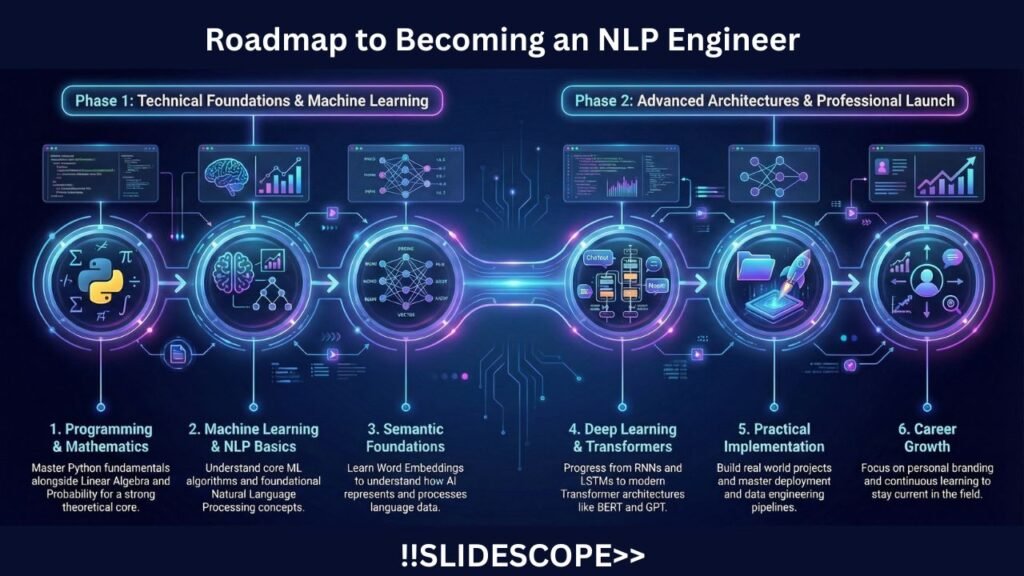
If you want to build a strong career in AI, becoming an NLP Engineer is a powerful path. But the journey is not just about learning a few tools—it requires a structured roadmap covering programming, mathematics, machine learning, and real-world application.
In this roadmap, I will break down the exact steps you need to follow—from beginner to advanced level—so you can systematically build your NLP expertise and become industry-ready.
1. Build Strong Programming Fundamentals
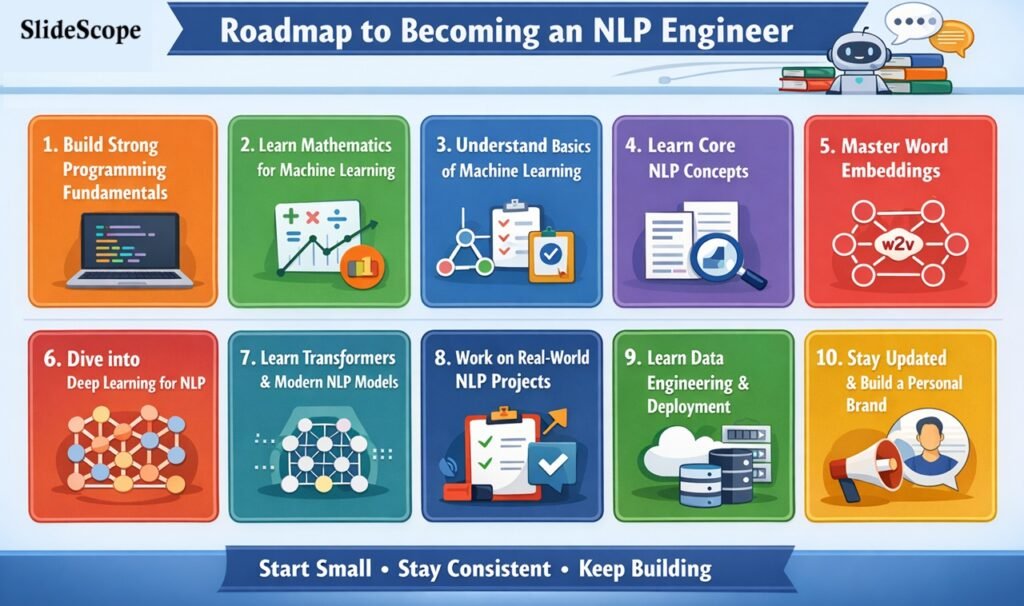
The first step is to master programming, especially Python. NLP heavily relies on Python due to its rich ecosystem of libraries and frameworks. You should be comfortable with data structures, loops, functions, and object-oriented programming.
Focus on writing clean and efficient code. Learn how to manipulate strings, handle files, and work with APIs since text data is the core of NLP. Practice solving problems on platforms like LeetCode or HackerRank.
Also, understand basic scripting and automation, as many NLP tasks involve preprocessing large volumes of text data. Git and version control are equally important for managing your projects.
Without strong programming skills, you will struggle in later stages like model building and deployment. So spend enough time here and build a solid base before moving forward.
2. Learn Mathematics for Machine Learning
Mathematics is the backbone of NLP. You don’t need to become a mathematician, but you must understand key concepts like linear algebra, probability, and statistics.
Linear algebra helps in understanding vectors and matrices, which are used in word embeddings. Probability and statistics are essential for understanding model predictions and evaluation.
Learn concepts like mean, variance, distributions, and Bayes theorem. These are widely used in NLP algorithms such as Naive Bayes.
Understanding these concepts will help you not only use models but also optimize and debug them effectively. Many engineers skip this step, but this is what differentiates a beginner from an expert.
3. Understand Basics of Machine Learning
Before jumping into NLP, you must understand core machine learning concepts. Learn supervised and unsupervised learning, classification, regression, and clustering.
Study algorithms like Logistic Regression, Decision Trees, Random Forest, and Naive Bayes. These are foundational and often used in NLP tasks like sentiment analysis.
Also, learn model evaluation techniques such as accuracy, precision, recall, and F1-score. Understanding bias and variance is critical to avoid overfitting.
Use libraries like scikit-learn to implement models. Practice on datasets to gain hands-on experience.
This stage prepares you for applying ML concepts specifically to text data in NLP.
4. Learn Core NLP Concepts
Now you move into the heart of NLP. Start with basic concepts like tokenization, stemming, lemmatization, stopword removal, and text normalization.
Understand how raw text is converted into structured data that machines can process. Learn techniques like Bag of Words (BoW) and TF-IDF.
Also, study n-grams and how context is captured in text data. These foundational concepts are used in almost every NLP project.
Use libraries like NLTK and spaCy for implementation.
This stage is crucial because it teaches you how to transform unstructured text into meaningful data for machine learning models.
5. Master Word Embeddings
Word embeddings are a major breakthrough in NLP. They convert words into numerical vectors while preserving semantic meaning.
Learn models like Word2Vec, GloVe, and FastText. These models help capture relationships between words (e.g., king – man + woman = queen).
Understand how embeddings improve model performance compared to traditional methods like BoW.
Practice using pre-trained embeddings and also try training your own on custom datasets.
Word embeddings are widely used in advanced NLP applications, including chatbots and recommendation systems.
6. Dive into Deep Learning for NLP
To become a true NLP Engineer, you must learn deep learning. Start with neural networks and then move to advanced architectures.
Understand RNNs (Recurrent Neural Networks), LSTMs, and GRUs, which are specifically designed for sequential data like text.
Learn how these models handle context and long-term dependencies in language.
Use frameworks like TensorFlow and PyTorch for implementation.
Deep learning is essential for building modern NLP systems like language translation and text generation.
7. Learn Transformers and Modern NLP Models
Transformers have revolutionized NLP. Models like BERT, GPT, and T5 are based on this architecture.
Understand concepts like attention mechanism and self-attention. These allow models to focus on relevant parts of a sentence.
Learn how pre-trained models can be fine-tuned for tasks like sentiment analysis, question answering, and summarization.
Use libraries like Hugging Face Transformers to work with these models easily.
This is one of the most important steps because most industry-level NLP solutions use transformer-based models.
8. Work on Real-World NLP Projects
Theory alone is not enough. You must build projects to gain practical experience.
Start with simple projects like:
- Sentiment analysis
- Spam detection
- Chatbots
Then move to advanced ones like:
- Resume parser
- Recommendation systems
- AI-powered search engines
Deploy your projects using APIs or web apps. This will make your portfolio strong and job-ready.
Employers value hands-on experience more than theoretical knowledge.
9. Learn Data Engineering and Deployment
An NLP Engineer is not just about building models—you must also deploy them.
Learn how to handle large datasets, clean data pipelines, and optimize performance.
Understand APIs, Docker, and cloud platforms like AWS or GCP. Learn how to serve models using REST APIs.
Also, learn tools like FastAPI or Flask for deployment.
This step is crucial for transitioning from a learner to a professional NLP Engineer.
10. Stay Updated and Build a Personal Brand
NLP is a rapidly evolving field. New models and techniques are introduced frequently.
Follow research papers, blogs, and platforms like arXiv. Stay updated with trends like generative AI and LLMs.
Start sharing your knowledge on LinkedIn, GitHub, or YouTube. Build a personal brand by showcasing your projects and learnings.
Networking and visibility can open doors to opportunities faster than just applying for jobs.
Consistency in learning and sharing is what will set you apart in this competitive field.
Real-World Work of an AI Engineer
1. Building Intelligent Chatbots for Customer Support
One of the most common real-world applications of AI engineering is developing intelligent chatbots that can handle customer queries automatically. Companies across industries—eCommerce, banking, education—use chatbots to provide 24/7 support.
An AI Engineer designs these systems using Natural Language Processing techniques to understand user queries and generate meaningful responses. Tools like Hugging Face Transformers and frameworks such as TensorFlow are often used to train conversational models.
The work involves collecting and cleaning conversational data, training intent classification models, and integrating them into platforms like websites or WhatsApp APIs. Engineers also improve chatbots over time by analyzing user interactions and retraining models.
This reduces operational costs for companies and improves user experience by providing instant responses without human intervention.
2. Developing Recommendation Systems for Platforms
AI Engineers play a major role in building recommendation systems—the engines behind platforms like Netflix, Amazon, and YouTube.
These systems analyze user behavior, preferences, and historical data to suggest relevant content or products. An AI Engineer works on data pipelines, feature engineering, and machine learning models such as collaborative filtering and deep learning-based recommenders.
Libraries like scikit-learn and PyTorch are commonly used to build and optimize these systems.
The goal is to increase user engagement, retention, and sales. For example, showing the right product at the right time can significantly boost conversion rates.
This is a high-impact domain because even small improvements in recommendation accuracy can lead to massive revenue growth.
3. Automating Document Processing and Analysis
Another powerful real-world application is automating document processing, especially in industries like legal, finance, and healthcare.
AI Engineers build systems that can read, extract, and analyze information from documents such as invoices, contracts, resumes, and reports. This involves using OCR (Optical Character Recognition) combined with NLP models.
For example, an AI system can automatically extract key clauses from legal contracts or identify important fields from invoices. Engineers use tools like spaCy along with deep learning frameworks such as TensorFlow.
The work includes preprocessing scanned documents, training named entity recognition (NER) models, and building pipelines for structured output.
This automation saves time, reduces human error, and increases efficiency, making it extremely valuable for businesses handling large volumes of documents.
Conclusion
Becoming an NLP Engineer is a structured journey that combines programming, mathematics, machine learning, and real-world application. If you follow this roadmap step by step and focus on practical implementation, you can build a strong career in this field.
Start small, stay consistent, and keep building. NLP is not just a skill—it’s a future-proof career.