Introduction
Hello, I am Ankit Srivastava, a Data Analytics Professional. If you are someone who enjoys solving complex problems using data, logic, and mathematical thinking, then a career as an Operations Research (OR) Analyst can be highly rewarding. In today’s data-driven world, organizations rely heavily on optimization, forecasting, and decision science to stay competitive. OR Analysts play a crucial role in improving efficiency, reducing costs, and enhancing decision-making processes. This roadmap will guide you step-by-step on how to build the right skills, tools, and mindset required to enter and grow in this high-demand analytical field.
1. Build a Strong Foundation in Mathematics
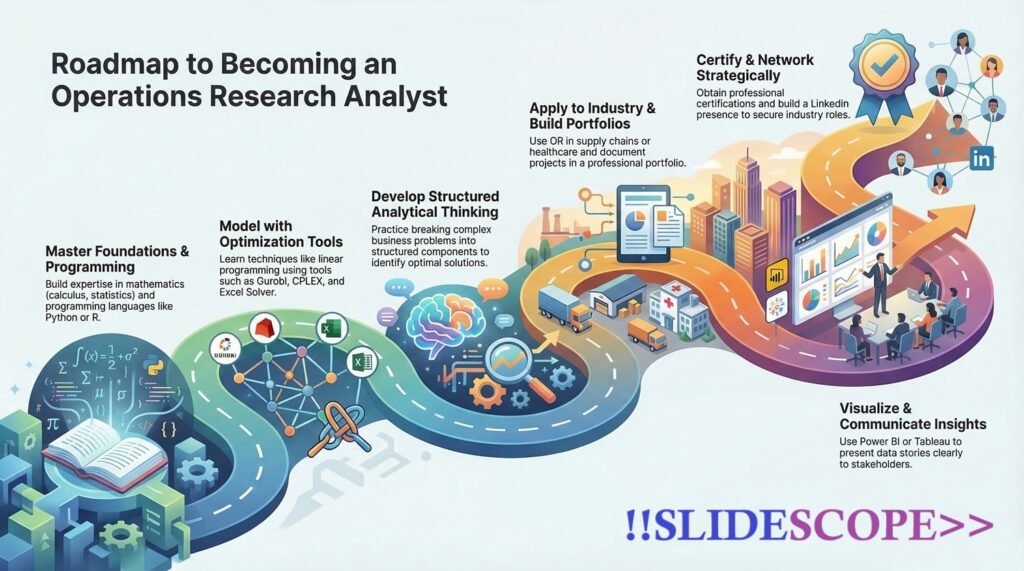
Operations Research is deeply rooted in mathematics, so your first step should be mastering core mathematical concepts. Focus on linear algebra, probability, statistics, and calculus, as these are essential for modeling real-world problems. Topics like matrices, vectors, derivatives, and probability distributions form the backbone of optimization techniques. You don’t need to become a mathematician, but conceptual clarity is critical. Many OR problems involve translating business challenges into mathematical equations, so comfort with numbers is a must. Practice regularly and use real-world examples to strengthen understanding. This foundation will later help you grasp advanced topics like linear programming, simulation models, and stochastic processes with much greater ease and confidence.
2. Learn Programming Languages for Data Analysis
Programming is a non-negotiable skill for an OR Analyst. Start with Python, as it offers powerful libraries like NumPy, Pandas, SciPy, and PuLP for optimization and data handling. R is also useful for statistical modeling and simulations. You should learn how to manipulate data, build models, and automate analysis workflows. Focus on writing clean, efficient, and scalable code. Understanding loops, functions, and data structures will help you solve complex problems effectively. Additionally, learn how to visualize data using libraries like Matplotlib or Seaborn. Programming bridges the gap between theory and practical implementation, enabling you to turn mathematical models into real-world solutions used by organizations.
3. Understand Core Operations Research Techniques
To become an OR Analyst, you must deeply understand core methodologies like linear programming, integer programming, dynamic programming, and network optimization. These techniques help solve problems such as resource allocation, scheduling, and logistics optimization. Learn how to formulate problems mathematically and identify constraints and objectives. Simulation modeling and queuing theory are also crucial for analyzing uncertain systems. Start with basic examples and gradually move toward complex case studies. Understanding when and how to apply each technique is more important than memorizing formulas. These tools form the core of your problem-solving arsenal and will be used across industries like supply chain, finance, healthcare, and manufacturing.
4. Master Optimization Tools and Software
Beyond theory, you need hands-on experience with optimization tools. Learn software like Excel Solver for beginners and then move to advanced tools like IBM CPLEX, Gurobi, or open-source libraries like PuLP and Pyomo. These tools allow you to build and solve optimization models efficiently. Familiarize yourself with modeling environments and understand how to input constraints and objectives. Practice solving real-life problems such as transportation models or workforce scheduling. Employers value candidates who can implement solutions, not just understand concepts. Mastering these tools will significantly improve your job readiness and allow you to handle industry-level optimization challenges with confidence.
5. Develop Strong Analytical and Problem-Solving Skills
An OR Analyst is essentially a problem solver. You need to develop the ability to break down complex problems into smaller, manageable components. Analytical thinking involves identifying patterns, evaluating multiple scenarios, and making data-driven decisions. Practice case studies and real-world business problems to enhance your thinking process. Learn how to ask the right questions and define clear objectives. Critical thinking and logical reasoning will help you choose the best possible solution among multiple alternatives. This skill is what differentiates an average analyst from a high-impact professional who can drive business results through intelligent decision-making.
6. Gain Knowledge of Business and Industry Applications
Operations Research is not just about mathematics—it’s about solving business problems. You should understand how OR is applied in industries like supply chain, logistics, healthcare, finance, and manufacturing. Learn concepts like inventory management, demand forecasting, production planning, and route optimization. Understanding business context helps you create practical and relevant models. For example, optimizing delivery routes requires knowledge of logistics constraints and customer expectations. The more you understand real-world applications, the better your solutions will be. This combination of technical and business knowledge makes you highly valuable in the job market.
7. Work on Real-World Projects and Case Studies
The best way to learn OR is by doing. Work on projects such as optimizing delivery routes, minimizing costs in supply chains, or simulating queue systems. Use publicly available datasets or create your own scenarios. Build a portfolio showcasing your problem-solving approach, models, and results. Document your projects clearly, explaining the problem, methodology, and impact of your solution. This practical experience is crucial for interviews and job applications. Recruiters prefer candidates who can demonstrate their skills through real work rather than just theoretical knowledge. Projects help you gain confidence and improve your ability to handle real-world challenges.
8. Learn Data Visualization and Communication Skills
An OR Analyst must communicate complex findings in a simple and understandable way. Learn data visualization tools like Power BI, Tableau, or Python libraries. Create dashboards and reports that clearly present your insights and recommendations. Communication skills are equally important—stakeholders may not understand mathematical models, so you must translate your results into business language. Practice storytelling with data, focusing on clarity and impact. The ability to present insights effectively ensures that your solutions are implemented and appreciated. Strong communication bridges the gap between technical analysis and business decision-making.
9. Pursue Relevant Certifications and Courses
Certifications can boost your credibility and structured learning. Consider courses in Operations Research, Data Analytics, or Optimization from platforms like Coursera, edX, or Udemy. Certifications in tools like Python, Power BI, or advanced Excel can also add value. If possible, pursue a degree or specialization in fields like Industrial Engineering, Mathematics, or Data Science. Continuous learning is essential, as the field evolves with new tools and techniques. Certifications not only validate your skills but also demonstrate your commitment to professional growth, making you more attractive to employers.
10. Build a Strong Professional Network and Apply Strategically
Networking plays a key role in career growth. Connect with professionals in the field through LinkedIn, attend webinars, and participate in data science or OR communities. Engage in discussions, share your projects, and learn from others. Stay updated with industry trends and job opportunities. When applying for jobs, tailor your resume to highlight relevant skills, tools, and projects. Prepare for interviews by practicing case studies and explaining your problem-solving approach. A strong network can open doors to opportunities, mentorship, and collaborations, helping you accelerate your career as an Operations Research Analyst.
Conclusion
If you have gone through this roadmap carefully, you would have realized that becoming an Operations Research Analyst is not just about learning a few tools or formulas—it is about developing a structured way of thinking. It is about approaching problems with clarity, breaking them down logically, and using data-driven techniques to arrive at the best possible decisions. In today’s competitive and fast-moving business environment, organizations are constantly looking for professionals who can optimize processes, reduce costs, and improve efficiency. This is exactly where Operations Research Analysts create massive value.
The journey may seem challenging in the beginning, especially when you start dealing with mathematical models, programming, and optimization techniques. However, if you follow a step-by-step approach—starting from fundamentals and gradually moving toward advanced concepts—you will notice a significant transformation in your analytical thinking. The key is consistency. Even dedicating a few hours daily to learning and practicing can take you a long way in just a few months.
One important thing I always tell my students is this: do not just learn concepts—apply them. Theoretical knowledge alone will not make you job-ready. When you start working on real-world problems, you begin to understand the practical challenges that businesses face. You learn how to deal with incomplete data, changing constraints, and multiple objectives. This is where your true learning happens. Projects, case studies, and hands-on implementation will always give you an edge over others.
Another crucial aspect is adaptability. The field of Operations Research is evolving rapidly with the integration of AI, Machine Learning, and advanced analytics. As an aspiring OR Analyst, you should stay updated with new tools, technologies, and industry trends. The more you evolve, the more relevant you remain in the job market. Remember, learning in this field never stops—and that’s actually what makes it exciting.
Let’s also talk about career opportunities. Operations Research Analysts are in demand across industries like logistics, e-commerce, healthcare, banking, consulting, and manufacturing. Companies like Amazon, Flipkart, Deloitte, and many others actively hire professionals who can solve complex optimization problems. The salary packages are also quite attractive, especially as you gain experience and expertise. But more than money, this career gives you the satisfaction of solving real-world problems that directly impact businesses and people.
Now comes the most important question—how do you actually start?
This is where proper guidance makes a huge difference. Many students struggle because they try to learn everything randomly from different sources without a clear structure. This leads to confusion and lack of confidence. A well-designed learning path, mentorship, and practical exposure can accelerate your journey significantly.
If you want to become an Operations Research Analyst, don’t try to figure everything out alone—join our classes.
In our training programs, we focus not just on theory but on practical, industry-oriented learning. You will learn mathematics, Python, optimization techniques, and real-world applications in a structured way. We provide hands-on projects, case studies, and personalized guidance to ensure that you are not just learning—but actually building skills that companies are looking for.
We also help you with portfolio building, interview preparation, and career guidance so that you can confidently step into the job market. Whether you are a student, working professional, or someone looking to switch careers, our programs are designed to take you from beginner to job-ready level.
The difference between someone who only learns and someone who succeeds is action. If you are serious about building a career in Operations Research and data-driven decision-making, now is the time to take that step.