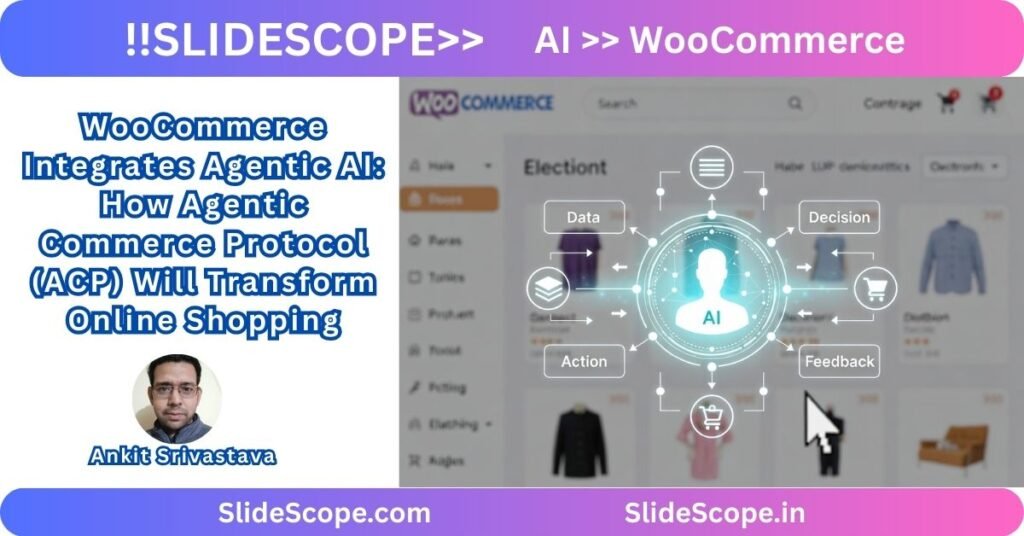
By Ankit Srivastava
What Is Agentic AI?
Agentic AI represents the next major evolution in artificial intelligence, moving beyond passive assistants and rule-based automation into systems that can reason, plan, act, and learn autonomously to achieve defined goals. Unlike traditional AI, which waits for explicit user commands, agentic AI systems can independently decide what actions to take, when to take them, and how to optimize outcomes—all within defined constraints.
In simple terms, agentic AI behaves like a digital agent rather than a tool.
From Reactive AI to Proactive AI
Most AI systems we’ve used so far—chatbots, recommendation engines, or analytics models—are reactive. They respond to inputs:
- You search → AI suggests products
- You ask → AI answers
- You click → AI tracks behavior
Agentic AI flips this model.
Instead of waiting, it:
- Observes user context
- Sets intermediate goals
- Takes actions autonomously
- Evaluates results
- Adjusts strategies in real time
For example, an agentic AI shopping assistant doesn’t just recommend a product. It can:
- Monitor price changes
- Compare vendors
- Check availability
- Apply coupons
- Schedule purchases
- Optimize delivery time
All without repeated user prompts.
Core Characteristics of Agentic AI
Agentic AI systems share a few defining traits:
- Autonomy – They operate independently once goals are defined
- Goal-Oriented Reasoning – They break high-level goals into smaller tasks
- Context Awareness – They understand user preferences, constraints, and history
- Decision-Making – They choose actions based on probability and reward
- Tool Usage – They can interact with APIs, websites, databases, and services
- Feedback Loops – They learn from outcomes and improve over time
This makes them closer to digital employees than digital assistants.
Agentic AI in Commerce
In eCommerce, agentic AI unlocks powerful capabilities:
- Personalized shopping journeys
- Autonomous product research
- Smart cart optimization
- Predictive restocking
- Dynamic pricing negotiation
- Automated customer support escalation
For store owners, this means:
- Higher conversion rates
- Lower customer acquisition cost
- Reduced operational overhead
- Better lifetime value per customer
For shoppers, it means:
- Less friction
- Faster decisions
- Better deals
- Smarter recommendations
Why Agentic AI Is a Turning Point for WooCommerce
WooCommerce powers millions of stores globally. Until now, AI integrations in WooCommerce were largely plugin-based and reactive—recommendation widgets, chatbots, or analytics tools.
Agentic AI changes the architecture completely.
Instead of embedding AI inside the store UI, agentic AI can operate:
- Outside the website
- Across multiple stores
- Across channels (web, voice, apps, assistants)
This allows WooCommerce stores to participate in agent-driven shopping experiences, where AI agents act on behalf of users across the open web.
This is not just a feature update—it’s a paradigm shift.
What Is the Agentic Commerce Protocol (ACP)?
The Agentic Commerce Protocol (ACP) is an open protocol designed to enable AI agents to discover, interact with, and transact across commerce platforms in a standardized, secure, and interoperable way.
In short:
ACP is the language that allows AI agents to shop, compare, negotiate, and purchase across online stores.
Why ACP Is Needed
Today’s eCommerce systems are built for humans using browsers:
- Click-based navigation
- Visual interfaces
- Form submissions
- Session-based carts
AI agents don’t operate this way.
They need:
- Machine-readable product data
- Structured pricing and inventory access
- Standardized checkout flows
- Secure authorization mechanisms
- Clear policies and constraints
Without a protocol like ACP, each AI agent would need custom integrations for every store—impossible at scale.
ACP solves this by creating a universal commerce interaction layer.
How ACP Works (Conceptually)
ACP defines how:
- AI agents discover stores and products
- Stores expose product catalogs in agent-readable formats
- Pricing, availability, and policies are communicated
- Orders are placed programmatically
- Payments and confirmations are handled securely
Instead of scraping websites, AI agents interact through structured endpoints and schemas.
Think of ACP as:
- For commerce: what HTTP is for the web
- For AI agents: what APIs are for developers
Key Capabilities Enabled by ACP
With ACP support, WooCommerce stores can:
- Allow AI agents to browse products
- Enable automated price comparison
- Support intent-based purchasing
- Participate in agent-driven marketplaces
- Remain discoverable in an AI-first internet
This is especially important as:
- Voice assistants evolve
- Personal AI agents become mainstream
- Shopping shifts from browsing to delegation
In the future, users won’t “visit” stores—they’ll send agents to shop for them.
How WooCommerce Is Integrating the Agentic Commerce Protocol (ACP)
The world of eCommerce is entering a new paradigm — where AI conversational agents not only recommend products but can shop and buy on behalf of users. At the center of this shift is the Agentic Commerce Protocol (ACP), a standardized way for businesses to expose products, checkout, and payment flows to AI agents such as ChatGPT. WooCommerce — the world’s most popular open-source eCommerce platform — is actively building support for ACP so its millions of merchants can participate in this next generation of shopping experiences. WooCommerce
This isn’t about a plugin or a gadget. It’s a fundamental change to how WooCommerce stores will be discoverable, interactive, and transactable inside AI ecosystems — without users ever visiting a traditional website. Let’s break down exactly how WooCommerce is making this a reality.
1. Official Support Through the Stripe Agentic Commerce Suite
WooCommerce is integrating ACP through partnership with Stripe, which has launched the Agentic Commerce Suite with built-in support for WooCommerce stores. This isn’t a third-party extension — it’s an official extension of the WooCommerce ecosystem that leverages Stripe’s checkout and payment capabilities for AI transactions. WooCommerce
Stripe has deep existing integration with WooCommerce payments, so this integration builds on the familiar workflow merchants already use:
- Stripe processes payments securely
- WooCommerce manages inventory and orders
- ACP enables AI agents to initiate checkout and manage transactions programmatically
This collaboration ensures that WooCommerce merchants don’t need to overhaul their payment setup to participate in ACP-powered commerce. WooCommerce
In essence:
👉 WooCommerce + Stripe + ACP = your store becomes AI-ready without external systems.
2. ACP Feed Endpoints for Product Catalog & Inventory
To let AI agents like ChatGPT discover and recommend products, WooCommerce must serve product data in a structured, machine-readable format that aligns with the ACP specification. This includes:
- Product titles and descriptions
- Pricing
- Inventory availability
- Media (images, videos)
- Attributes (size, color, variants)
- Metadata such as SKU and categories
ACP defines how this product feed should be structured — typically in JSON, CSV, TSV, or XML formats — so AI agents can reliably read and interpret store content. Plugins or built-in endpoints automatically generate and sync these feeds with the store’s data, often in near-real time. AgenticCart
For WooCommerce merchants, this means:
✔ Their inventory becomes AI discoverable
✔ Prices and stock levels remain current in ACP feeds
✔ No manual export of product data is needed
Real-time syncing is critical so AI agents don’t recommend products that are out of stock or incorrectly priced — something AgenticCart and similar ACP extensions already provide today. AgenticCart
3. Checkout Integration With ACP APIs
ACP doesn’t stop at product discovery — it enables complete checkout flows within conversational AI platforms. This transition requires WooCommerce to expose API endpoints that:
- Create checkout sessions
- Update cart contents
- Apply taxes and shipping
- Handle payment delegation through ACP
- Process webhook events for order status
WooCommerce’s ACP integration layers these agent-reachable endpoints on top of its existing REST API, preserving compatibility with the core WooCommerce order and payment flows. Merchant orders placed via ACP still appear in the WooCommerce dashboard, and existing fulfillment processes remain unchanged. ACP Woo
This API integration opens up:
➡ Shopping directly inside ChatGPT or other AI agents
➡ No redirects to the store frontend
➡ A unified experience between voice, chat, and web interfaces
4. Secure Payment Delegation
One of the biggest questions with AI shopping is payment security. AI cannot store or directly process card data. Instead, ACP uses a delegated payment model. In practical terms:
- The user approves the purchase inside the AI interface
- The payment is tokenized via payment service providers (PSPs) like Stripe
- WooCommerce receives the order and payment confirmation
ACP defines how these shared payment tokens are securely passed from the AI agent to the merchant without exposing sensitive payment information. This ensures compliance with PCI DSS standards while enabling AI-initiated purchases. Agentic Commerce
For WooCommerce merchants:
✔ Existing PSPs (like Stripe) continue handling payments
✔ Customers’ card details remain secure
✔ AI checkout behaves with the same trust model as web checkout
5. Two-Way Synchronization and Webhooks
AI agents must know when orders are placed, fulfilled, or canceled, and merchants must get updates back in real time. ACP integration adds:
- Webhook listeners for order status changes
- Inventory update push notifications
- Payment confirmation events
- Shipping and delivery updates
This ensures:
- CPC (cart/purchase communications) flow smoothly
- AI agents reflect accurate fulfillment status
- Merchants can automate follow-ups, email receipts, and tracking updates
Tools built into ACP plugins or native WooCommerce integrations allow merchants to monitor logs and webhook events directly in the WooCommerce admin. ACP Woo
6. Merchant Controls & Product Policy Settings
ACP integration isn’t a “fire and forget” feature. WooCommerce gives merchants control over:
- Which products are available for agentic commerce
- Whether AI sales should be accepted automatically
- Pricing adjustments or AI-specific offers
- Product exclusion lists
- How inventory sync behaves
This control layer is essential so merchants can choose the level of AI participation suited to their strategy and avoid unintended sales or overselling. Many ACP plugins expose these controls in the WooCommerce dashboard. AgenticCart
7. Built-In Compatibility With WordPress & WooCommerce Standards
One technical challenge with emerging protocols is integration complexity. Thankfully, ACP support is being engineered in a way that is WooCommerce-friendly:
- No core code rewrites or theme hacks are required
- ACP endpoints respect WordPress REST best practices
- High-Performance Order Storage (HPOS) compatibility is maintained
- Plugin ecosystems continue to function normally
- Webhooks and API keys are manageable from the admin panel
This means developers and merchants don’t have to rebuild everything from scratch — ACP becomes a natural extension of WooCommerce’s architecture. ACP Woo
For developers who have built headless WordPress and WooCommerce systems, this architecture is especially welcoming because ACP endpoints can be consumed by any frontend or middleware without breaking existing workflows.
8. Early Rollout and Phased Deployment
As with any major integration, the WooCommerce ACP adoption is phased and iterative:
- Early support through plugins and beta features
- Stripe-supported suites launching first
- Merchant onboarding and approval processes (e.g., ChatGPT merchant applications)
- Broader platform adoption over time
The official announcements indicate that WooCommerce is committed to supporting ACP broadly, while plugins like AgenticCart or ACP Connector already give merchants head starts on integration. AgenticCart+1
What this phased rollout means:
✔ Merchants can prepare now
✔ Developers can start experimenting
✔ Early adopters gain advantage in AI-driven shopping
✔ Feedback will shape future standards
9. New Discovery Channels for WooCommerce Stores
ACP integration effectively exposes WooCommerce catalogs to entirely new traffic sources:
💡 AI agent discovery systems (ChatGPT, Perplexity, Claude, etc.)
💡 Intent-based shopping queries (natural language searches)
💡 Voice commerce
💡 Embedded AI apps
This is an expansion beyond SEO and marketplace channels — AI agents now act as discovery and transaction interfaces. According to integration partners and examples of early integrations like AgenticCart, merchants are already seeing increased visibility and conversion opportunities from AI referrals. AgenticCart
10. Unified Merchant Experience
Behind the scenes, WooCommerce ensures that:
- Orders placed via AI or traditional checkout end up in the same order dashboard
- Inventory adjustments affect all sales channels
- Reporting and analytics reflect all transactions (including agentic)
- Customer data remains centralized
- Refunds, disputes, and returns use standard WooCommerce workflows
This means merchants don’t have to learn new systems — the ACP layer is just another channel for sales, similar to social commerce or marketplace integrations.
ACP and WooCommerce: Why This Matters
WooCommerce supporting ACP is a strategic move.
It ensures that:
- WooCommerce stores remain relevant in an AI-native web
- Merchants don’t get locked into closed ecosystems
- Open commerce survives against centralized marketplaces
For developers like me—who have built 120+ WooCommerce websites and headless WordPress architectures—this is a game changer.
ACP aligns perfectly with:
- Headless commerce
- API-first design
- Decoupled frontends
- Multi-channel selling
WooCommerce becomes not just a CMS-based store, but a commerce endpoint in an AI-driven ecosystem.
Security, Control, and Merchant Autonomy
One common concern: Do AI agents take control away from merchants?
ACP is designed with safeguards:
- Merchants define what agents can access
- Policies govern pricing, discounts, and availability
- Authentication and authorization remain mandatory
- Transactions are auditable and reversible
This ensures AI participation without loss of control.
The Bigger Picture
ACP signals the beginning of:
- Agent-to-agent commerce
- AI-negotiated pricing
- Autonomous B2B procurement
- Personalized micro-marketplaces
WooCommerce embracing ACP means:
- Open-source commerce stays competitive
- Independent stores remain discoverable
- Merchants participate in the next web evolution
Final Thought (Ankit’s Perspective)
Agentic AI and ACP together represent Commerce 3.0.
Just as mobile transformed eCommerce in the 2010s, AI agents will redefine shopping in the 2020s. WooCommerce’s early adoption of ACP positions it—and its merchants—on the right side of history.
For store owners, developers, and digital strategists, the message is clear:
Prepare your WooCommerce stack for an agent-driven future—because shopping is no longer just human.
Reference: https://woocommerce.com/
Learn Woocommerce / WordPress Development at Slidescope