In 2026, the role of a Big Data Architect is no longer limited to handling large datasets—it’s about designing intelligent, scalable, and real-time data ecosystems that power business decisions. As organizations become increasingly data-driven, the demand for skilled professionals who can architect robust data solutions is skyrocketing. If you’re aiming to step into this high-impact role, you need a clear, structured roadmap that blends technical expertise, strategic thinking, and hands-on experience. Let’s break it down into 10 actionable steps.
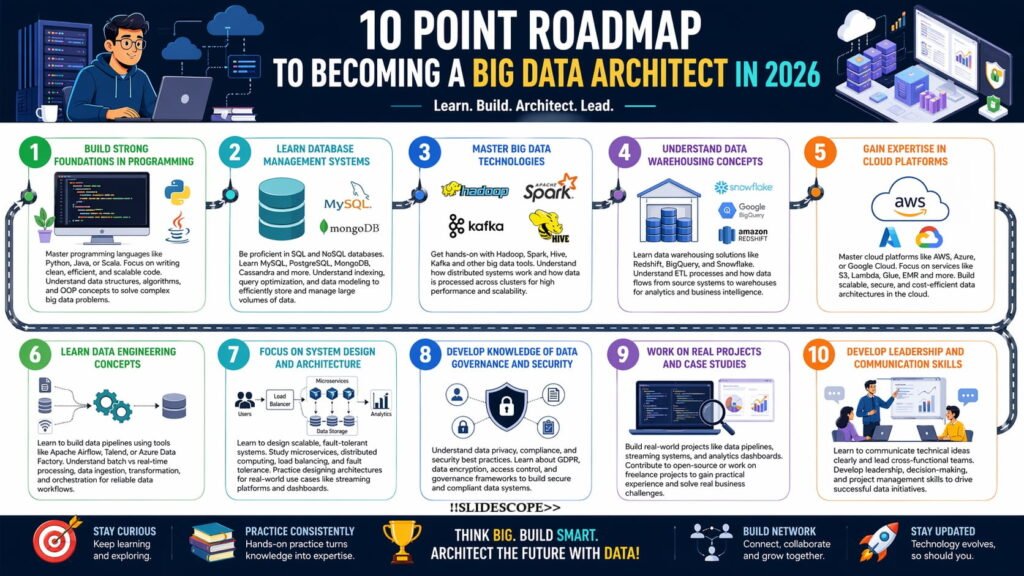
1. Build Strong Foundations in Programming
Start with mastering programming languages like Python, Java, or Scala. These are essential for handling large-scale data processing and building data pipelines. Focus on writing clean, efficient, and scalable code. Understanding data structures, algorithms, and object-oriented programming will give you a strong base for solving complex big data problems in real-world scenarios.
2. Learn Database Management Systems
A Big Data Architect must be proficient in both SQL and NoSQL databases. Learn relational databases like MySQL and PostgreSQL, and explore NoSQL systems like MongoDB and Cassandra. Understand indexing, query optimization, and data modeling. This knowledge helps you design systems that efficiently store, retrieve, and manage massive volumes of structured and unstructured data.
3. Master Big Data Technologies
Get hands-on experience with tools like Hadoop, Spark, Hive, and Kafka. Apache Spark is especially crucial for real-time data processing. Learn how distributed systems work and how data is processed across clusters. This step is critical because Big Data Architects design architectures that rely heavily on these technologies to process petabytes of data efficiently.
4. Understand Data Warehousing Concepts
Learn about data warehousing solutions like Amazon Redshift, Google BigQuery, and Snowflake. Understand ETL (Extract, Transform, Load) processes and how data flows from source systems to warehouses. This helps in designing centralized data systems that support analytics, reporting, and business intelligence across organizations.
5. Gain Expertise in Cloud Platforms
Cloud platforms are the backbone of modern data architectures. Learn AWS, Azure, or Google Cloud in depth. Focus on services like AWS S3, Lambda, Glue, and EMR. Understand how to build scalable and cost-efficient architectures in the cloud. Most companies now rely on cloud-native solutions for big data processing and storage.
6. Learn Data Engineering Concepts
Big Data Architects must understand how data pipelines are built. Learn tools like Apache Airflow, Talend, or Azure Data Factory. Understand batch vs real-time processing, data ingestion, transformation, and orchestration. This helps you design end-to-end data workflows that are reliable, scalable, and efficient.
7. Focus on System Design and Architecture
This is where you transition from developer to architect. Learn how to design scalable, fault-tolerant systems. Study concepts like microservices, distributed computing, load balancing, and fault tolerance. Practice designing architectures for real-world use cases like streaming platforms, recommendation systems, and analytics dashboards.
8. Develop Knowledge of Data Governance and Security
Understand how to manage data privacy, compliance, and security. Learn about GDPR, data encryption, access control, and governance frameworks. As an architect, you are responsible for ensuring that data systems are secure and compliant with regulations, especially when dealing with sensitive or enterprise-level data.
9. Work on Real Projects and Case Studies
Theory alone won’t make you an architect. Build real-world projects like data pipelines, streaming systems, or analytics dashboards. Contribute to open-source projects or work on freelance assignments. Practical experience helps you understand challenges like scalability, performance, and system failures.
10. Develop Leadership and Communication Skills
A Big Data Architect doesn’t just build systems—they lead teams and communicate with stakeholders. Learn how to present technical ideas to non-technical audiences. Develop leadership, decision-making, and project management skills. This will help you transition into senior roles where strategy and vision matter as much as technical expertise.
Conclusion
Becoming a Big Data Architect in 2026 is not just a technical journey—it’s a transformation into a strategic thinker who understands both technology and business impact. The role demands a deep understanding of data ecosystems, cloud infrastructure, distributed systems, and modern data tools. However, what truly sets a Big Data Architect apart is the ability to design solutions that are scalable, efficient, and aligned with business goals.
The roadmap we discussed is not something you complete overnight. It requires consistent effort, curiosity, and hands-on practice. Start with programming and database fundamentals, then gradually move into big data tools and cloud platforms. As you gain confidence, shift your focus towards system design, architecture, and real-world implementations. Each stage builds on the previous one, shaping you into a well-rounded professional.
One of the biggest mistakes aspirants make is focusing only on tools. Remember, tools will change, but concepts remain constant. Focus on understanding how distributed systems work, how data flows through pipelines, and how architectures are designed for scalability and fault tolerance. This conceptual clarity will help you adapt to any new technology that emerges in the future.
Another critical aspect is real-world exposure. Try to work on projects that simulate real business problems. Build data pipelines, design streaming architectures, and optimize data storage solutions. These experiences will not only strengthen your technical skills but also prepare you for real challenges in the industry.
Networking and continuous learning also play a vital role. Follow industry leaders, participate in tech communities, attend webinars, and stay updated with the latest trends in big data and cloud computing. The field is evolving rapidly, and staying relevant requires a proactive approach to learning.
Equally important is developing soft skills. As you move towards an architect role, your responsibilities will expand beyond coding. You will need to communicate with stakeholders, lead teams, and make critical decisions. Your ability to explain complex systems in simple terms will be a key differentiator.
In 2026, businesses are not just looking for engineers—they are looking for visionaries who can turn data into a strategic asset. As a Big Data Architect, you will be at the center of this transformation. You will design systems that power analytics, enable AI, and drive innovation.
If you follow this roadmap with discipline and consistency, you can position yourself as a highly valuable professional in the data ecosystem. The journey may be challenging, but the rewards—both in terms of career growth and impact—are immense.
Start today, stay consistent, and think like an architect from day one.
Learn More about our Data Analyst Course

Ankit Srivastava is an IT trainer, technology educator, and digital skills mentor with expertise in programming, data analytics, AI, and software development. He has successfully trained thousands of learners, with more than 10,000 student enrollments on Udemy. His practical teaching approach empowers students and professionals to build in-demand technical skills. Colorstech channel where Ankit posts video tutorials has more than 8000 Subscribers.