Last Updated: July 2026
Somewhere around my fourth or fifth big data project — I genuinely lost exact count somewhere past a dozen — I stopped explaining “big data” to clients using the textbook definition and started explaining it through a much simpler question: “What’s currently happening in your business that you can’t actually see, because the data describing it exists, but nobody can practically access, process, or make sense of it?”
That question tends to land better than any formal definition, because it captures the actual problem big data technology solves. And in nearly every project I’ve managed over the years — whether it involved e-commerce transaction logs, IoT sensor streams, or years of accumulated customer interaction data — AWS has been the platform doing the heavy lifting behind the scenes.
I’m Ankit Srivastava, and having managed enough of these projects to know where the theory and the reality diverge, I want to walk you through what AWS big data actually is, why it matters, and how the pieces fit together — grounded in real project experience, not just a services catalog.
What “Big Data” Actually Means
Before getting into AWS specifically, it’s worth being precise about the term itself, because it gets thrown around loosely. According to AWS’s own definition, big data is best understood through three characteristics, commonly called the three V’s: volume (data ranging from terabytes to petabytes), variety (data coming from many different sources and formats — web logs, transactions, social interactions, sensor data), and velocity (how quickly data needs to move from being generated to being turned into an actionable insight, which increasingly means near real-time, not just daily batch processing).
Here’s the practical version I give clients: if your existing databases and applications start struggling — slowing down, becoming expensive to scale, or simply unable to handle the volume, variety, or speed of data you’re now generating — you likely have a big data problem, whether or not anyone in the organization has explicitly labeled it that way yet. I’ve walked into more than one project where leadership hadn’t framed their issue as “big data” at all; they just knew their reporting was too slow, their systems kept timing out, or they were making decisions on data that was weeks out of date by the time anyone looked at it.
Why AWS Specifically Became the Default Platform for This
When I started managing big data projects, one of the first lessons that became obvious fast was this: traditional big data infrastructure — the kind involving physical server clusters, manual provisioning, and long setup cycles — creates a genuine bottleneck before a project even gets to the interesting part. AWS’s core value proposition for big data work is removing that bottleneck almost entirely.
With AWS, there’s no hardware to procure and no infrastructure to physically maintain and scale, which means project teams can focus their time on actually uncovering insights rather than managing servers. In my own project experience, this difference isn’t theoretical — it’s the difference between a data pipeline going from concept to working prototype in days versus a traditional on-premises approach that could easily eat weeks just on procurement and setup before any real data engineering work even begins.
AWS also offers a genuinely broad and deep set of tools — more than 50 services relevant to data work, with new capabilities added constantly — meaning a project team can build virtually any big data application regardless of the volume, variety, or velocity involved, without needing to commit to a rigid, long-term architecture decision upfront.
The Core AWS Big Data Workflow (And Where Projects Actually Get Complicated)
Most AWS big data projects I’ve managed follow a similar underlying flow, even when the specific services chosen differ significantly project to project.
Collect
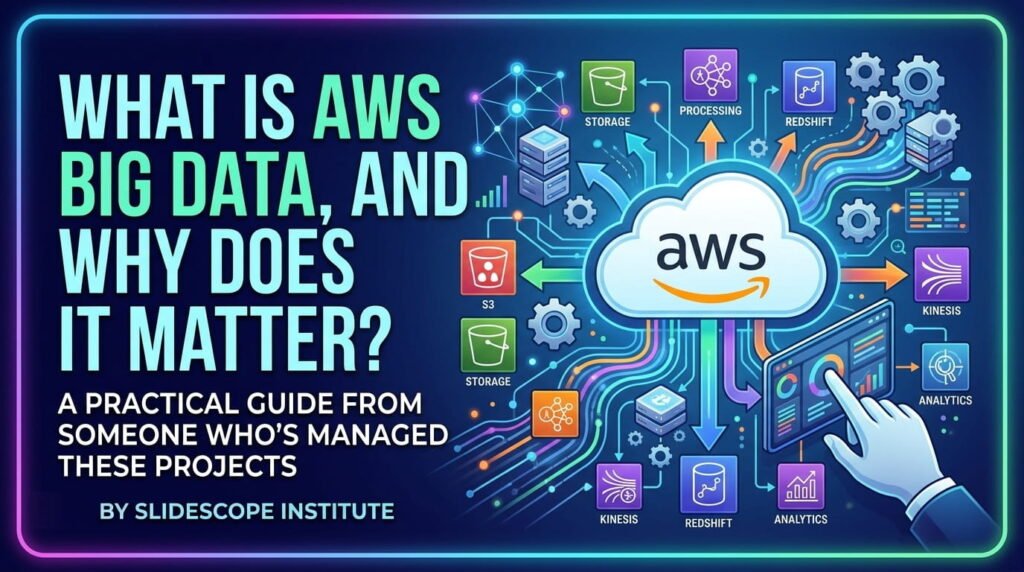
This is where raw data — transactions, logs, mobile app events, IoT sensor readings — first enters the system. For real-time and streaming data specifically, Amazon Kinesis is the service I’ve reached for most often, since it’s purpose-built to ingest fast-moving data continuously rather than in scheduled batches. For less time-sensitive data, batch ingestion tools handle the job more cost-effectively.
Store
Every big data project needs a secure, scalable, durable place to put data, both before and after processing. Amazon S3 (Simple Storage Service) is almost always the foundation here — I don’t think I’ve managed a single AWS big data project that didn’t have S3 sitting at the center of the storage architecture in some form, precisely because of how reliably it scales and how naturally it integrates with nearly every other AWS analytics service.
Process and Analyze
This is where raw data actually gets transformed into something usable — sorting, aggregating, joining, and running more advanced analytical functions. Amazon EMR (Elastic MapReduce) has been central to several of my larger projects, since it makes it genuinely straightforward to spin up managed clusters running open-source tools like Apache Spark and Hadoop without needing to hand-configure that infrastructure yourself. For SQL-based, serverless querying directly against data sitting in S3, Amazon Athena has increasingly become my go-to for teams that don’t want to manage a persistent cluster at all.
Consume and Visualize
None of the previous steps matter if the resulting insights don’t actually reach the people who need to act on them. Amazon Redshift handles data warehousing at scale for teams running complex SQL analytics across large datasets, while Amazon QuickSight is what I’ve most often used to put the resulting insights in front of business stakeholders through dashboards, without requiring them to write a single query themselves.
Where Most Big Data Projects Actually Struggle (In My Experience)
I want to be honest about something the marketing material around big data tools rarely addresses directly: the technology has never been the primary bottleneck in most of the projects I’ve managed. The real difficulty consistently shows up in a few specific places.
Data quality and governance get underestimated. Teams get excited about analytics capability and underinvest in the unglamorous work of ensuring data is clean, consistent, and properly cataloged before it reaches an analytics layer. AWS Glue, AWS’s managed data cataloging and ETL (extract, transform, load) service, has been the tool I’ve relied on most to bring order to this specific mess, particularly on projects with data flowing in from many disconnected source systems.
Security and access control need real planning, not an afterthought. Big data, almost by definition, tends to be sensitive data — customer records, financial transactions, operational details. AWS provides strong underlying security capabilities, with environments continuously audited against certifications like ISO 27001 and standards including HIPAA and PCI DSS, but that infrastructure-level security doesn’t automatically translate into properly configured access permissions inside your specific project. I’ve seen more project delays caused by teams needing to retroactively fix overly broad data access than by any actual technical limitation of the AWS services themselves.
The skills gap is real, and it’s often the actual constraint. AWS’s own big data ecosystem is genuinely deep enough that even experienced teams can feel overwhelmed navigating which combination of 50-plus relevant services actually fits their specific use case. This is honestly the single biggest reason I now spend as much time training teams as I do managing projects directly — the technology capability has consistently outpaced how quickly most organizations can build internal expertise to use it well.
The Significance: Why This Actually Matters for Businesses
Having managed enough of these projects to see the pattern repeat, here’s where I’ve consistently seen AWS big data capability translate into genuine business value, not just technical accomplishment.
Decisions move from delayed and reactive to near real-time. Projects that shift from batch reporting (data reviewed days or weeks after the fact) to streaming, near real-time analytics fundamentally change what kind of decisions a business can make — catching a fraud pattern as it happens rather than in next month’s audit, for instance.
Cost structures shift from large capital investment to elastic, pay-as-you-go spending. This matters enormously for mid-sized businesses specifically, since it removes the traditional barrier where meaningful big data capability required an enterprise-level upfront infrastructure investment before you could even test whether the approach would pay off.
New categories of insight become accessible. I’ve seen projects surface genuinely surprising findings — customer segments nobody had identified, operational inefficiencies hidden across systems that had never been analyzed together — simply because the underlying infrastructure finally made it practical to combine and analyze datasets that had previously been too large or too fragmented to examine jointly.
AI and machine learning become a natural next step, not a separate initiative. With a solid big data foundation already in place, layering in predictive analytics or machine learning models becomes a far more achievable extension of existing infrastructure rather than a completely separate, high-risk project — a pattern I expect to keep accelerating given how tightly AWS’s analytics and AI tooling are increasingly integrated.
Where I’d Suggest Starting
If you’re evaluating whether your organization has a genuine big data need, I’d suggest starting with AWS’s own foundational explainer on the topic, which covers these core concepts in more technical depth, along with AWS’s broader analytics and data lake portfolio, which gives a useful overview of how these services fit together. For teams ready to start hands-on, AWS’s free tier for analytics services is a genuinely practical, low-risk way to begin experimenting before committing to a larger architecture decision.
Final Thoughts
Managing big data projects for as long as I have taught me that the technology question — which AWS service does what — is almost always the easier half of the problem. The harder half is organizational: getting genuinely clean data flowing in, setting up sensible governance and access control, and building enough internal skill that a team can actually operate and extend what gets built rather than depending entirely on outside consultants indefinitely. AWS provides an extraordinarily capable platform for solving the technical half of that equation — but the businesses that get real, lasting value from it are consistently the ones that invest just as seriously in the people and process side alongside it.
If you’re looking to build genuine, hands-on skills in AWS big data services — not just theoretical knowledge, but the practical, project-tested understanding of how these tools actually fit together — that’s exactly what we focus on in our AWS and data engineering training programs at SlideScope.com.
Helpful AWS Resources Referenced in This Article:
- AWS Big Data, Data Lakes & Analytics Portfolio
- Amazon S3
- Amazon EMR
- Amazon Redshift
- Amazon Kinesis
- Amazon Athena
- AWS Glue
- Amazon QuickSight
- AWS Free Tier for Analytics
- AWS Training and Certification

Ankit Srivastava is an IT trainer, technology educator, and digital skills mentor with expertise in programming, data analytics, AI, and software development. He has successfully trained thousands of learners, with more than 10,000 student enrollments on Udemy. His practical teaching approach empowers students and professionals to build in-demand technical skills. Colorstech channel where Ankit posts video tutorials has more than 8000 Subscribers.