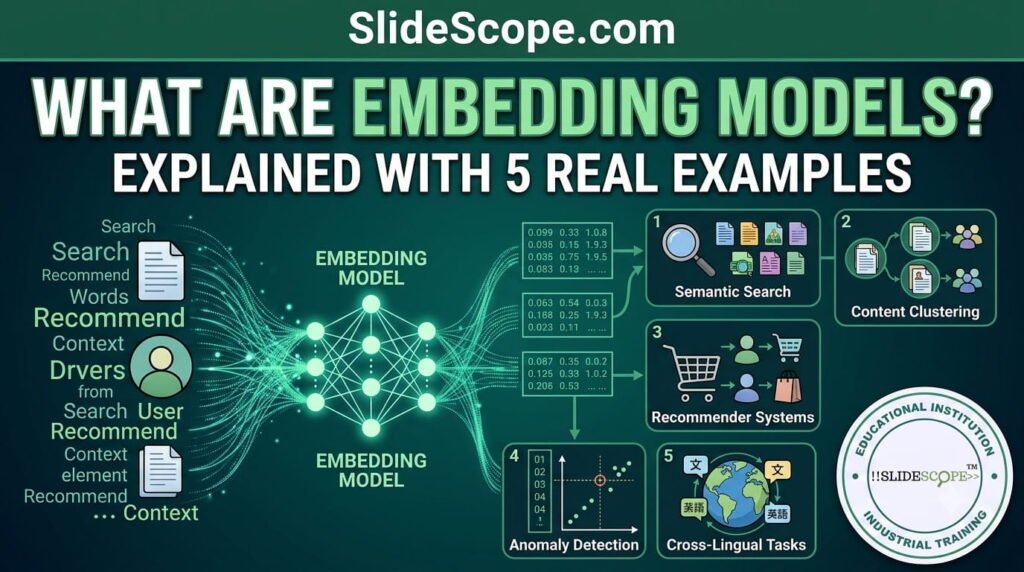
I remember the first time I tried explaining embeddings to a group of marketing professionals in one of my AI training sessions, and watching their eyes glaze over the moment I started with the math. So I stopped, and instead asked them a simpler question: “If I said the words ‘king’ and ‘queen,’ would you agree they’re more similar to each other than ‘king’ and ‘bicycle’?” Everyone nodded immediately. Then I told them: that’s essentially what an embedding model does — it turns that intuitive sense of “similar meaning” into actual numbers a computer can work with, compare, and search through.
That’s the whole concept, really, once you strip away the intimidating terminology. And if you’ve read my earlier article on Retrieval-Augmented Generation, you already know embedding models sit right at the center of how RAG systems find relevant information. But embeddings are useful for a lot more than just RAG, and I think they deserve their own clear explanation — including which specific models are actually worth knowing in 2026.
I’m Ankit Srivastava, and I want to walk through what embedding models actually are, how they work under the hood without drowning you in math, and then get concrete with five real embedding models you’re likely to encounter or choose between in actual projects.
What an Embedding Actually Is
An embedding is a numerical representation of a piece of content — a word, a sentence, a paragraph, even an image — expressed as a list of numbers, called a vector. Instead of storing “the cat sat on the mat” as literal text, an embedding model converts that sentence into something like a list of 768 or 1536 numbers, positioned in a mathematical space where meaning determines location.
Here’s the part that makes this genuinely useful: content with similar meaning ends up positioned close together in that mathematical space, while unrelated content ends up far apart. “The cat sat on the mat” and “A feline rested on the rug” would land close together, even though they don’t share many actual words, because an embedding model captures meaning, not just literal text matching. This is a fundamentally different approach from older keyword-based search, which would completely miss that these two sentences are saying almost the same thing.
How Embedding Models Actually Work (Without the Heavy Math)
Embedding models are trained on massive amounts of text, learning patterns in how words and concepts relate to each other based on the contexts they appear in. Over the course of training, the model gradually learns to position semantically related concepts near each other in this high-dimensional vector space, and unrelated concepts farther apart.
Once trained, using the model is straightforward from a developer’s perspective: you feed in a piece of text, and the model outputs a fixed-length vector representing that text’s meaning. You can then measure the “distance” or similarity between any two vectors using mathematical measures like cosine similarity — a smaller distance means more similar meaning. This is exactly the mechanism that powers semantic search, recommendation systems, duplicate detection, and the retrieval step in RAG pipelines.
Why This Matters Beyond the Technical Novelty
The practical value here is enormous once you see it applied. A customer searching your support documentation for “how do I get my money back” should reasonably find your “refund policy” article, even though the search terms share almost no exact words. Traditional keyword search often fails at exactly this kind of query. Embedding-based semantic search handles it naturally, because it’s matching on meaning rather than literal word overlap.
I’ve seen this play out directly in projects — an e-commerce client’s internal search was returning poor results because it relied entirely on keyword matching, missing a large share of genuinely relevant products every time a customer phrased their search slightly differently than the product listing’s exact wording. Switching to embedding-based semantic search meaningfully improved search relevance without requiring the product catalog itself to be rewritten.
Five Real Embedding Models Worth Knowing
Theory aside, let’s get concrete. Here are five embedding models that actually show up in real projects, each with different strengths worth understanding before you pick one.
1. OpenAI’s text-embedding-3 Series
OpenAI’s text-embedding-3 models (available in “small” and “large” variants) are among the most widely used embedding models in production RAG systems and semantic search applications today, largely because they’re easy to access through a simple API call, well-documented, and deliver strong general-purpose performance across a wide range of languages and content types. The “large” variant produces higher-dimensional, more precise embeddings at a higher cost per call, while the “small” variant trades a bit of precision for significantly lower cost and latency — a genuinely practical option when you’re embedding large volumes of content and cost adds up quickly. I typically recommend this as a starting point for teams building their first RAG or semantic search prototype, simply because the barrier to getting started is so low.
2. Google’s Gemini Embedding Models
Google’s embedding models, accessible through Vertex AI and the Gemini API, are a strong choice particularly for teams already building within the Google Cloud ecosystem, or working with multilingual content, since Google’s embedding models have generally shown strong cross-language performance. They integrate naturally with Google’s broader AI and data infrastructure, which matters if your RAG pipeline or search system is already living inside Google Cloud, BigQuery, or Vertex AI Search — avoiding unnecessary friction from stitching together services across multiple cloud providers.
3. Cohere’s Embed Models
Cohere has built a strong reputation specifically around enterprise search and retrieval use cases, and their Embed model family reflects that focus directly — with dedicated support for multilingual embeddings across over 100 languages, and specific optimization for retrieval-augmented generation and semantic search workflows rather than being a general-purpose model adapted after the fact. For enterprise clients with genuinely global, multilingual document repositories, I’ve found Cohere’s embedding models to be a particularly strong fit, since multilingual retrieval quality varies more between providers than people often expect.
4. BGE (BAAI General Embedding)
BGE, developed by the Beijing Academy of Artificial Intelligence, is one of the strongest open-source embedding model families available, and it’s become a genuine favorite in projects where cost control, self-hosting, or data privacy requirements rule out sending content to a third-party API for embedding. Because it’s open-weight, you can run BGE entirely on your own infrastructure, which matters significantly for clients in regulated industries who can’t have sensitive document content leaving their own servers, even just for the embedding step. BGE consistently performs competitively against several proprietary options on standard retrieval benchmarks, which is genuinely impressive for a freely available, self-hostable model.
5. Sentence-BERT (SBERT)
Sentence-BERT deserves mention as something of a foundational model in this space — it was one of the first widely adopted models specifically designed to produce high-quality sentence-level embeddings efficiently, built by fine-tuning BERT specifically for semantic similarity tasks. While newer models have generally surpassed it on raw benchmark performance, SBERT and its many fine-tuned variants remain widely used in production today, particularly for lighter-weight applications, edge deployment scenarios, or teams needing a well-understood, extensively documented model with a large ecosystem of pre-trained variants for specific domains (legal text, medical text, and so on).
How to Actually Choose Between These
I get asked this constantly, so here’s my honest, practical guidance. If you’re building a first prototype and want the lowest-friction path, start with OpenAI’s text-embedding-3-small — you’ll be up and running fastest. If your content spans many languages, seriously evaluate Cohere or Google’s embedding models before committing, since multilingual quality genuinely varies between providers more than most general-purpose benchmarks reveal. If data privacy, cost at scale, or self-hosting are hard requirements, BGE is currently the strongest open-source option worth building around. And if you’re working in a resource-constrained environment — edge devices, lightweight applications — Sentence-BERT variants remain a practical, well-supported choice.
One practical tip from real project experience: don’t assume the most expensive or most benchmark-topping model is automatically the right choice for your specific use case. I’ve seen teams over-invest in a premium embedding model when their actual retrieval quality problem was really coming from poor document chunking, not an insufficiently powerful embedding model — always diagnose where the real weak point in your pipeline is before assuming a bigger model is the fix.
Final Thoughts
Embedding models are one of those pieces of AI infrastructure that quietly power an enormous share of the tools people use every day — semantic search, recommendation engines, chatbots grounded in real documentation — without most users ever knowing the term exists. Understanding what they actually do, even at a conceptual level, makes it significantly easier to reason about why a RAG system or search tool is or isn’t performing well, and to make an informed choice between the many options now available rather than defaulting to whichever one happens to be trending.
If you want to move from understanding embedding models conceptually to actually building and evaluating them in real projects — comparing retrieval quality, setting up vector search, and integrating embeddings into working applications — that’s exactly the kind of hands-on skill we cover in our AI and data engineering training programs at SlideScope.com.
Learn AI Development & Machine Learning at SlideScope : Contact Us to Learn More

Ankit Srivastava is an IT trainer, technology educator, and digital skills mentor with expertise in programming, data analytics, AI, and software development. He has successfully trained thousands of learners, with more than 10,000 student enrollments on Udemy. His practical teaching approach empowers students and professionals to build in-demand technical skills. Colorstech channel where Ankit posts video tutorials has more than 8000 Subscribers.