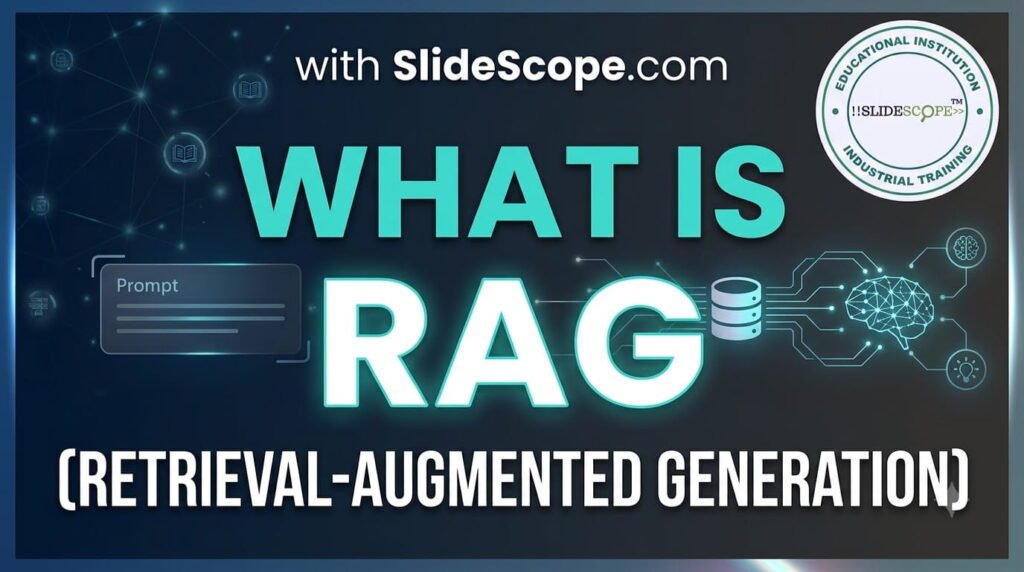
Retrieval-Augmented Generation (RAG) is an advanced AI technique that combines information retrieval with text generation to improve the accuracy and relevance of AI-generated responses. It is particularly useful for tasks requiring up-to-date, factual, or context-aware answers.
How RAG Works
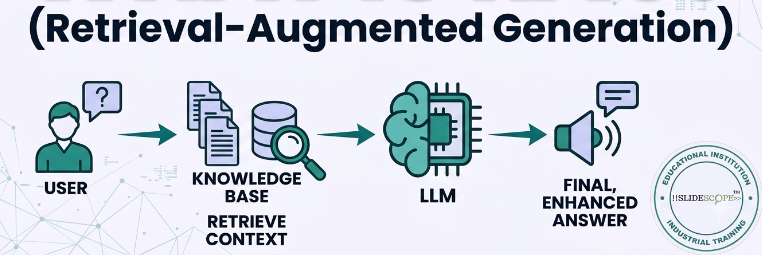
- Retrieval: Instead of relying solely on pre-trained knowledge, the model retrieves relevant documents or data from an external knowledge base (such as a database, vector store, or search engine).
- Augmentation: The retrieved information is then incorporated into the model’s input to provide additional context.
- Generation: The model generates a response based on both its learned knowledge and the retrieved data, ensuring a more factually accurate and context-aware output.
Benefits of RAG
- Improved Accuracy: Reduces hallucinations by grounding responses in real-world data.
- Up-to-date Information: Can fetch recent data, unlike static language models.
- Domain-Specific Knowledge: Useful for specialized fields like legal, medical, or financial applications.
- Efficient Use of Storage: The base model remains compact while accessing external data when needed.
Use Cases
- Chatbots & Virtual Assistants: Enhancing customer support with accurate, updated information.
- Enterprise AI: Querying internal documentation for precise answers.
- Search & Recommendation Systems: Providing contextualized search results.
- Content Generation: Writing informed articles, reports, or summaries with real-time data.
RAG vs. Fine-Tuning: What’s the Actual Difference
One question I get constantly in training sessions is whether RAG and fine-tuning solve the same problem. They don’t, and mixing them up leads to a lot of wasted engineering effort.
Fine-tuning changes the model itself — you’re retraining (or partially retraining) the model’s weights on a specific dataset so it internalizes new patterns, tone, or domain knowledge permanently. It’s expensive to update, requires real ML infrastructure, and the model’s knowledge is still frozen at whatever point you last trained it.
RAG leaves the model’s weights untouched entirely. Instead, it changes what the model sees at the moment it generates a response, by feeding it relevant, current information pulled from an external source. Updating a RAG system usually just means updating the documents in your knowledge base — no retraining required.
In practice, I tell clients: use fine-tuning when you need the model to reliably adopt a specific writing style, tone, or specialized reasoning pattern. Use RAG when you need the model to know things — facts, policies, current data — that change over time or are too specific and proprietary to have ever been part of its training data in the first place. Many production systems I’ve worked on actually use both together: a lightly fine-tuned model for tone and behavior, paired with RAG for factual grounding.
A Concrete Example: How RAG Actually Plays Out Step by Step
Abstract explanations only go so far, so let’s walk through a real scenario. Imagine an HR chatbot deployed inside a mid-sized company, and an employee asks: “How many paid sick days do I get if I’ve been here for three years?”
Without RAG, a general-purpose language model has no idea — it was never trained on this specific company’s internal HR policy, and even if it guesses at a plausible-sounding answer, that answer is essentially fabricated. This is exactly the kind of confident-but-wrong hallucination that makes standalone LLMs risky for internal enterprise use.
With RAG in place, the process looks like this: the employee’s question first gets converted into a vector embedding — a numerical representation of its meaning. That embedding gets compared against a vector database containing embeddings of the company’s actual HR policy documents, benefits handbook, and internal wiki pages. The system retrieves the most relevant chunks — in this case, likely the specific paragraph covering tenure-based sick leave accrual. That retrieved text gets inserted into the prompt sent to the language model, along with the original question. The model then generates a response grounded specifically in that retrieved policy text, rather than guessing.
The employee gets an accurate, current answer, and critically, if HR updates the sick leave policy next quarter, the chatbot’s answer updates automatically the moment the underlying document is updated — no retraining, no waiting on an engineering team to ship a model update.
The Technical Building Blocks Behind a RAG System
If you’re planning to actually build one of these systems rather than just understand the concept, it helps to know the standard components involved.
Embedding models convert text into vector representations that capture semantic meaning — models like OpenAI’s text-embedding series, Google’s embedding models, or open-source options like BGE and E5 are common choices, and the right pick depends on your language coverage, cost constraints, and how domain-specific your content is.
Vector databases store those embeddings and handle fast similarity search at scale. Pinecone, Weaviate, Chroma, and Qdrant are popular managed or self-hostable options, while FAISS remains a common choice for teams wanting a lightweight, self-managed library rather than a full database service.
Chunking strategy determines how source documents get split before embedding — too large, and retrieval pulls in irrelevant noise alongside the useful content; too small, and you lose important surrounding context. This is genuinely one of the most underrated levers in RAG system quality, and I’ve seen more RAG implementations fail because of poor chunking decisions than because of a weak underlying language model.
Orchestration frameworks like LangChain and LlamaIndex handle the plumbing — connecting your retrieval step, your prompt construction, and your language model call into a coherent pipeline, without you needing to hand-build every integration from scratch.
Re-ranking layers, increasingly common in more mature RAG implementations, take the initial batch of retrieved documents and re-score them with a more precise (though more computationally expensive) model before final selection, improving relevance beyond what a single-pass vector similarity search alone typically achieves.
Common Challenges I’ve Seen in Real RAG Implementations
RAG sounds conceptually simple, but production implementations run into a consistent set of real-world problems.
Retrieval quality is everything, and it’s harder to get right than it looks. If the retrieval step pulls the wrong documents, the generation step will confidently produce a wrong answer grounded in irrelevant context — which can actually be more dangerous than an obvious hallucination, because it looks well-sourced and credible.
Stale or poorly maintained knowledge bases quietly undermine the whole system. RAG is only as current and accurate as the documents feeding it — I’ve seen enterprise deployments where nobody owned the responsibility of keeping the underlying document repository updated, and the chatbot kept confidently citing a policy that had been superseded months earlier.
Latency adds up. Every RAG query now involves an embedding step, a vector search, and often a re-ranking step, all before the actual language model generation even begins. For latency-sensitive applications, this pipeline needs real engineering attention, not just a default off-the-shelf setup.
Context window management gets tricky at scale. Retrieving too many documents to “be safe” can flood the model’s context window with irrelevant information, actually degrading answer quality rather than improving it — more retrieved content isn’t automatically better.
Security and access control are frequently overlooked. In enterprise RAG systems, especially ones pulling from internal documentation, you need to ensure a user can’t retrieve or receive answers grounded in documents they shouldn’t have access to in the first place — this requires permission-aware retrieval, which a lot of early RAG implementations don’t account for until it becomes a real problem.
Best Practices Worth Following From Day One
Based on implementations I’ve been involved with, a few practices consistently separate RAG systems that work well from ones that quietly disappoint users.
Invest real time in chunking strategy and test it against realistic queries, rather than defaulting to a generic fixed-size split. Maintain clear ownership over your knowledge base so documents actually get updated when the underlying information changes. Add a re-ranking step once you move past a basic prototype, since it consistently improves answer relevance for a relatively modest added cost. Log and review real user queries regularly to catch cases where retrieval is quietly failing, since these failures often don’t look like obvious errors to an end user. And build in permission-aware retrieval from the start if your knowledge base includes any access-restricted content, since retrofitting this later is significantly harder than designing for it upfront.
Frequently Asked Questions
Is RAG the same as giving a chatbot internet search access? They’re related but not identical. Web search retrieval is one specific form of RAG, pulling from the open internet. Most enterprise RAG systems instead retrieve from a private, curated knowledge base — internal documents, product catalogs, or proprietary data — which gives far more control over accuracy and relevance than open web search alone.
Does RAG completely eliminate hallucinations? No, and it’s important to be honest about this. RAG significantly reduces hallucinations by grounding responses in retrieved facts, but a model can still misinterpret or poorly synthesize the retrieved content. Good RAG implementations reduce hallucination risk substantially; they don’t eliminate it entirely.
Do I need a data science team to implement RAG? Not necessarily for a solid initial implementation. Frameworks like LangChain and LlamaIndex, combined with managed vector databases, have significantly lowered the technical barrier — a capable software developer can build a functional RAG prototype without deep machine learning expertise, though scaling and optimizing it for production use does benefit from more specialized knowledge over time.
How is RAG different from just pasting documents into a chat prompt manually? Conceptually similar, but RAG automates and scales that process — instead of a human manually finding and pasting the relevant document every time, the system automatically retrieves the most relevant content from a much larger knowledge base for every single query, which becomes essential the moment your knowledge base grows beyond what fits in a single prompt.
Final Thoughts
RAG has become one of the most practical, widely adopted techniques in applied AI precisely because it solves a real, common problem — language models that sound confident but don’t actually know your specific, current, or proprietary information. Getting real value from it depends less on the underlying language model you choose and more on the quality of your retrieval pipeline: good chunking, a well-maintained knowledge base, and thoughtful attention to relevance and access control.
If you want to move beyond understanding RAG conceptually and actually build a working implementation — vector databases, embedding strategies, and real retrieval pipelines — that’s exactly the kind of hands-on skill we cover in our AI and data engineering training programs at SlideScope.com.

Ankit Srivastava is an IT trainer, technology educator, and digital skills mentor with expertise in programming, data analytics, AI, and software development. He has successfully trained thousands of learners, with more than 10,000 student enrollments on Udemy. His practical teaching approach empowers students and professionals to build in-demand technical skills. Colorstech channel where Ankit posts video tutorials has more than 8000 Subscribers.