Paid marketing campaigns are rarely static.
You may complete a detailed PPC audit today, fix the obvious problems, review the account structure, check tracking, adjust budgets, and feel confident that everything is in good shape. But tomorrow, something can change.
A campaign can suddenly spend more than expected. A conversion tag can stop sending data. A landing page can become unavailable. Someone on the marketing team can change a campaign setting. Or performance can drop without any obvious explanation.
This is where Digital Marketing Analytics becomes important.
A PPC audit gives you a detailed picture of an advertising account at a particular point in time. Monitoring helps you understand what is happening after that audit. You do not necessarily need to perform a complete audit every day. Instead, you need a practical monitoring process that helps you identify meaningful changes early.
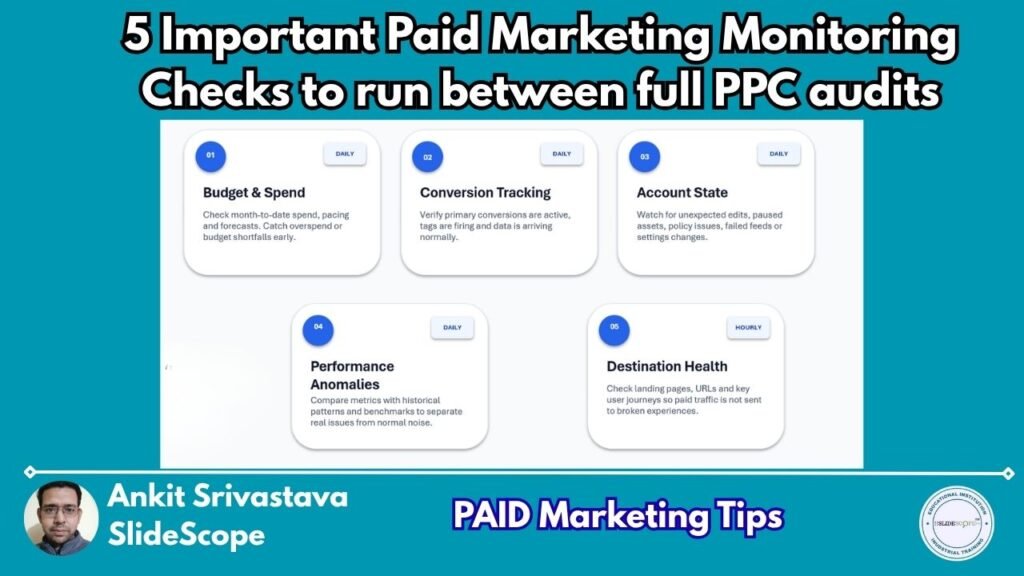
In this article, I am going to cover five important paid marketing monitoring checks that marketers should run between full PPC audits.
1. Monitor Budget and Ad Spend
The first thing I recommend monitoring is simple: where is the money going?
Budget management is one of the most important parts of paid advertising. Even a well-optimized campaign can create problems if spending moves away from the expected plan.
Start by checking your month-to-date spending against your planned budget.
For example, suppose your monthly Google Ads budget is ₹3,00,000. If you are halfway through the month, you would normally expect your spending to be somewhere around the planned pacing level, depending on your campaign strategy.
The exact number will not always be 50 percent. Some businesses intentionally spend more during certain days, weekends, promotions, or seasonal periods. That is why simple percentage comparisons are not enough.
Look at:
- Month-to-date spend
- Daily average spend
- Budget utilization
- Campaign-level spending
- Sudden increases in daily spend
- Campaigns consuming more budget than expected
- Changes in cost per conversion
- Forecasted month-end spend
The goal is not to stop campaigns whenever spending changes.
The goal is to understand why the spending changed.
For example, increased spending may be completely normal because a campaign entered a promotional period. On the other hand, an unexpected budget change or sudden increase in traffic could require investigation.
This is where analytics gives context to the numbers.
2. Check Conversion Tracking and Data Quality
A paid marketing campaign can appear to be performing well while the tracking is actually broken.
This is one of the most dangerous problems because the advertising platform may continue spending money even when your reporting no longer represents reality.
Conversion tracking should therefore be part of your regular monitoring process.
Check whether your important conversion actions are still receiving data. Depending on the business, these could include:
- Form submissions
- Phone calls
- Purchases
- Sign-ups
- Demo requests
- App downloads
- Lead generation
- Newsletter registrations
Do not only look at the number of conversions. Look for unusual changes in the data.
For example, imagine a website normally generates 20 to 30 leads from paid search every day. Suddenly, the account reports zero conversions.
That does not automatically mean the campaign has failed.
The tracking may have stopped working.
A website developer may have changed the form. A tag could have been removed. A consent configuration may have changed. A thank-you page could have been modified. An analytics or tag-management implementation may have broken.
This is why conversion data should be compared with other business signals whenever possible.
If Google Ads reports zero leads but the sales team says they received 25 enquiries, something clearly needs investigation.
Good Digital Marketing Analytics is not just about collecting numbers. It is about checking whether those numbers make sense.
3. Monitor Important Account and Campaign Changes
Paid advertising accounts are often managed by multiple people.
A performance marketer may make changes. A business owner may update a budget. An agency team member may modify targeting. A developer may change a landing page. Automated bidding systems may also adjust campaign behavior.
Small changes can sometimes produce large differences in performance.
That is why account-state monitoring is important between audits.
Keep an eye on changes such as:
- Campaigns being paused
- Ad groups being paused
- Ads being disapproved
- Budget changes
- Bid strategy changes
- Targeting changes
- Location changes
- Keyword changes
- Conversion action changes
- Feed errors
- Tracking changes
- Policy-related issues
Change history can be particularly useful here.
Suppose conversions dropped significantly on Monday. Before assuming that the market suddenly changed, check whether something was changed in the account around the same time.
Perhaps a campaign budget was reduced.
Maybe a location was removed.
Perhaps a conversion action was changed.
Or a landing page URL was replaced.
Finding that connection can save hours of unnecessary analysis.
For larger advertising accounts, it is also useful to establish clear ownership. Teams should know who is allowed to make major changes and how important changes should be documented.
The purpose is not to prevent experimentation.
The purpose is to make changes easier to understand.
4. Watch for Performance Anomalies
The fourth check is where Digital Marketing Analytics becomes especially useful.
Do not wait for a complete PPC audit to discover that campaign performance has changed.
Monitor important metrics and look for unusual patterns.
Depending on your campaign objectives, these may include:
- Impressions
- Clicks
- Click-through rate
- Cost per click
- Conversion rate
- Cost per conversion
- Conversion volume
- Revenue
- Return on ad spend
- Search impression share
However, there is an important point here.
Not every change is a problem.
Advertising performance naturally moves up and down.
A 10 percent change in clicks might be completely normal. A sudden 70 percent drop in conversions could deserve immediate attention.
This is why it helps to understand historical patterns.
Compare current performance with:
- Previous days
- Previous weeks
- Previous months
- Similar campaigns
- Similar products
- Seasonal periods
- Business benchmarks
For example, if conversions normally fluctuate between 18 and 25 per day and suddenly fall to two, that is worth investigating.
Analytics tools can make this process easier by creating alerts around unusual movements.
The best monitoring system does not simply tell you that a number changed. It helps you identify changes that are unusual enough to deserve attention.
That distinction matters because marketers can quickly become overwhelmed by unnecessary alerts.
If every small movement triggers an alert, people eventually stop paying attention.
Good monitoring should help marketers focus on meaningful problems.
5. Check Landing Pages and Destination Health
There is another part of the PPC journey that is sometimes forgotten: what happens after the user clicks the advertisement?
Your ad can be perfectly written. Your targeting can be accurate. Your bidding strategy can be working properly.
But if the landing page is broken, the campaign can still waste money.
That is why destination health should be part of regular paid marketing monitoring.
Check important landing pages and URLs for issues such as:
- Pages returning errors
- Broken links
- Slow-loading pages
- Incorrect redirects
- Missing forms
- Forms not submitting
- Incorrect product pages
- Expired offers
- Mobile usability problems
- Tracking failures
This becomes particularly important when campaigns use promotional landing pages.
Imagine a company running a campaign for a limited-time offer. The ads are receiving clicks and the campaign is spending normally, but the promotional page has accidentally been removed.
The advertising account itself may look perfectly healthy.
The real problem is happening after the click.
That is why PPC monitoring should not stop at the advertising platform.
The complete customer journey matters.
A useful way to think about this is:
Ad → Click → Landing Page → Action → Conversion → Business Result
If any important step breaks, campaign performance can suffer.
How Often Should You Run These Checks?
There is no single monitoring schedule that works for every business.
The right frequency depends on advertising spend, campaign complexity, business importance, and how quickly problems need to be identified.
High-spend accounts may require more frequent automated monitoring. Smaller campaigns may only need daily or several-times-a-week checks.
A practical approach could look like this:
Daily:
Check major spend changes, conversion problems, campaign status, and serious performance anomalies.
Several times per week:
Review important metrics, landing pages, tracking signals, and account changes.
Weekly:
Review trends, unusual movements, budget pacing, and significant campaign changes.
Monthly or periodically:
Conduct a deeper PPC audit covering account structure, targeting, keywords, ads, bidding, tracking, landing pages, and overall strategy.
The important distinction is that monitoring and auditing are not the same thing.
Monitoring is about staying aware of what is changing.
An audit is about taking a deeper look at the overall health and strategy of the account.
Build a Monitoring System Instead of Relying on Memory
One of the biggest mistakes I see in digital marketing is relying completely on manual checking.
A marketer may remember to check spending today, conversion tracking tomorrow, and landing pages next week.
Eventually, something gets missed.
Instead, create a simple monitoring checklist.
Document:
- What needs to be monitored
- How often it should be checked
- Who owns the check
- What counts as an unusual change
- Who should receive an alert
- What action should be taken
Automation can also help.
For example, dashboards can bring important KPIs together in one place. Analytics platforms can identify unusual changes. Advertising platforms can provide alerts. Website monitoring tools can check whether important pages remain accessible.
The technology does not have to be complicated.
Even a well-designed spreadsheet or dashboard can provide a useful starting point.
The important thing is consistency.
Final Thoughts
A PPC audit is valuable, but an audit alone cannot tell you what happens between two audit dates.
Paid marketing accounts are constantly changing. Budgets move, campaigns are edited, conversion tracking can break, landing pages can change, and customer behavior can shift.
That is why ongoing monitoring should be part of every serious paid marketing process.
The five checks discussed in this article provide a practical starting point:
- Budget and Spend
- Conversion Tracking
- Account and Campaign Changes
- Performance Anomalies
- Landing Page and Destination Health
The objective is not to watch every metric every minute.
It is to build a system that helps you notice important problems early.
For marketers, this is one of the practical applications of Digital Marketing Analytics: turning campaign data into useful signals, identifying changes, and making better-informed decisions.
At SlideScope, we believe digital marketing becomes much more useful when learners understand not only how to launch campaigns, but also how to measure, monitor, analyze, and improve them.
A campaign should not simply be launched and forgotten.
Monitor continuously. Analyze intelligently. Audit periodically.

Ankit Srivastava is an IT trainer, technology educator, and digital skills mentor with expertise in programming, data analytics, AI, and software development. He has successfully trained thousands of learners, with more than 10,000 student enrollments on Udemy. His practical teaching approach empowers students and professionals to build in-demand technical skills. Colorstech channel where Ankit posts video tutorials has more than 8000 Subscribers.