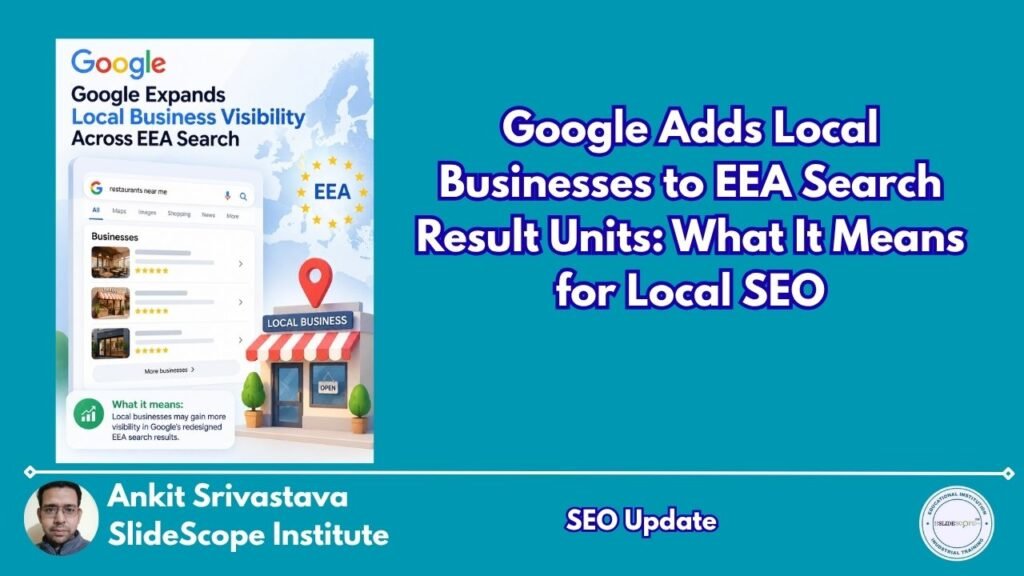
Google has expanded its redesigned EEA Search experience to include local business queries. The September 18, 2026 update allows eligible aggregators and local businesses to appear in new Search result units, creating additional visibility opportunities for businesses serving customers across the European Economic Area.
1. Google Expands Its Redesigned EEA Search Results to Local Businesses
Google has expanded its redesigned Search experience in the European Economic Area (EEA) to include local business queries. The change was documented on September 18, 2026, when Google updated its Search Central documentation for both the aggregator unit and the supplier unit. These result formats were introduced earlier in September as part of Google’s changing Search experience for certain commercial queries in the EEA. Local businesses are now officially included alongside categories such as hotels, flights, long-distance transportation, and products.
The update is important because local searches can now participate in a Search format that creates space for two different types of participants: aggregators and direct suppliers. An aggregator can be a directory, comparison service, metasearch engine, or another qualifying vertical search service. A direct supplier, meanwhile, can be the business that actually provides the product or service being searched for. Google describes the aggregator unit as a multi-provider feature designed to connect users with eligible vertical search services.
For example, imagine someone in the EEA searches for a local service such as a beauty salon, restaurant, attraction, plumber, or another type of business. Under the newly documented support, qualifying local-business searches can potentially trigger an aggregator unit containing listings supplied by an approved directory or vertical search service. A supplier unit can then appear alongside it, providing visibility for the businesses themselves.
This does not mean every local search will automatically receive these units. Google describes the features as being available for particular queries and says that the Search experience depends on factors including the relevance of the feature to the query. The change therefore represents an expansion of eligibility rather than a guarantee that every local business will receive a new Search placement.
The geographical limitation is also important. This update concerns users in the European Economic Area, rather than representing a global change to Google’s local Search results. Google’s regional Search documentation specifically lists local businesses among the query types supported by the EEA aggregator and supplier units.
For marketers, agencies, directories, and local businesses operating in Europe, the update adds another Search surface worth understanding. It also shows how Google’s EEA Search experience continues to evolve, particularly around how Google presents third-party services and direct providers within commercial searches.
2. How the New Local Business Aggregator and Supplier Units Work
The two units serve different roles, and understanding that distinction is essential for businesses and SEO professionals. The aggregator unit is intended for approved Vertical Search Services, or VSSs. Google says these can include online travel agencies, comparison shopping services, metasearch engines, and directories. For local-business queries, qualifying aggregators can submit information through a dedicated data feed to populate their listings in the Search unit.
When the aggregator unit appears, Google can display results from an eligible provider that are relevant to the user’s query. The top-ranked provider’s results are expanded by default, according to Google’s documentation. Users may also be able to select another participating provider when alternatives are available. Google states that only one aggregator unit appears at a time. Clicks within the unit lead users directly to the participating aggregator’s website.
For local searches, this means directories and other qualifying services have a new opportunity to participate in Google’s EEA Search ecosystem. However, participation is not automatic. Google says businesses seeking to participate as aggregators need to be approved as a Vertical Search Service, have relevant content, provide the necessary data, and meet Google’s quality and Search content requirements.
The data requirement is particularly significant. Google points local-business participants toward its Local Point of Interest Feed documentation. A local business data feed can contain information such as the business name, address, category, telephone number, images, and ratings. Google’s documentation also recommends providing comprehensive entity details and maintaining accurate information.
The supplier unit works differently. Rather than representing a directory or comparison service, it provides a Search presence for direct suppliers. Google says direct suppliers serving users in the EEA do not need to provide additional data beyond what Google can crawl, although feeds can enhance their results. Importantly, the supplier unit appears only when an aggregator unit is also present.
This creates a two-sided structure. One side can represent third-party directories or vertical search services, while the other can represent the businesses themselves. For local Search, this could mean users see both an intermediary source and direct business options within the redesigned Search experience.
Google’s documentation does not state that this replaces every existing local Search feature. It specifically describes the new units and their eligibility requirements. Therefore, businesses should view this as an additional regional Search development rather than assuming that traditional local SEO elements such as Business Profiles, organic listings, or other Search features have been replaced.
3. What the Update Means for Local Businesses and SEO Professionals
For local businesses serving customers in the EEA, one of the most notable aspects of this update is that businesses themselves do not necessarily need to submit a new feed simply to appear in the supplier unit. Google says direct providers can qualify based on information it can crawl, while feeds may be used to enhance results.
That makes the quality and accessibility of a business’s existing web presence increasingly relevant. Business information should be clear, consistent, and easy for search engines to understand. Important details such as the business name, address, category, contact information, services, images, operating hours, and other relevant attributes should be accurately represented across the website and other legitimate business sources.
For SEO teams, this development also highlights the importance of separating traditional local SEO from participation in Google’s new regional Search ecosystems. A local business does not become an aggregator simply because it has a website or appears in local Search. Aggregator participation has additional requirements, including approval as a Vertical Search Service and the submission of appropriate data.
Directories may therefore have more technical work to do than individual local businesses. A directory or vertical search platform interested in appearing in the aggregator unit needs to investigate Google’s eligibility process, submit an expression of interest where appropriate, prepare its local point-of-interest data, and maintain the quality of that information.
The quality of the feed can also matter operationally. Google’s recommendations include providing detailed entity information, accurate titles, high-quality imagery, verified user ratings and review counts where available, appropriate categories, and accurate operating information. Google also recommends keeping information such as pricing and availability current where those attributes apply.
This reinforces a broader SEO principle: structured and reliable business data can help search engines understand entities more effectively. Local businesses should not interpret the update as a reason to abandon existing SEO strategies. Instead, it is another reason to make sure their digital information is accurate and consistent.
Search monitoring will also become important. Because this feature is specifically regional, SEO professionals tracking rankings in Europe should pay attention to the actual Search experience users encounter in different EEA markets. Google itself maintains regional documentation because Search features can differ depending on geography and query type.
For agencies managing multiple local businesses, this means documenting which clients serve EEA customers, which directories operate in the region, and which sites could potentially qualify as vertical search services. The practical impact will vary considerably depending on whether a company is an individual local provider, a multi-location business, a directory, or another type of Search ecosystem participant.
4. Why Google’s EEA Local Search Update Matters for the Future of Search
Google’s decision to add local business queries to the aggregator and supplier units is another development in the company’s redesigned EEA Search experience. The broader system was introduced earlier in September for commercial searches involving areas such as hotels, flights, long-distance transportation, and products. Google has now expanded that framework to local businesses.
The significance goes beyond a single new Search box. It demonstrates that Google’s regional Search architecture is being adapted to accommodate different participants within commercial ecosystems. Instead of treating every commercial query as a standard collection of organic results, the redesigned experience creates dedicated spaces for eligible aggregators and direct suppliers.
For local businesses, the supplier component provides a potential additional visibility opportunity in qualifying EEA searches. Google says businesses serving users in the EEA can participate without submitting additional information beyond what Google can crawl, although feeds can enhance their results.
For directories, the situation is different. Their participation requires a more formal process, including approval, relevant content, and the appropriate local business data feed. This could make high-quality business data an important operational consideration for directories seeking to participate in Google’s aggregator ecosystem.
There is also an important limitation: Google has not said that this update applies globally. Its regional Search documentation identifies the aggregator and supplier units as EEA features and lists local businesses among the supported query categories there.
That means SEO professionals should avoid immediately treating the development as a worldwide Google local ranking change. The immediate documented impact is regional. Businesses outside the EEA may see different Search experiences, while businesses serving European audiences should monitor how these units develop.
The update also does not eliminate the need for conventional local SEO fundamentals. A strong website, accurate business information, useful service pages, accessible content, legitimate reviews, appropriate structured data, and a well-maintained local presence remain relevant components of search visibility. The new units add another layer to that environment rather than replacing everything that existed previously.
For now, the clearest takeaway is that Google has officially extended its EEA aggregator and supplier framework to local business queries. Approved aggregators can compete to populate the aggregator unit using the required data, while local businesses can potentially appear in the accompanying supplier unit without submitting additional data solely for that purpose.
As Google’s regional Search features continue to evolve, local SEO strategies in Europe will need to account not only for traditional organic and local results but also for these newer ecosystem-based Search experiences. The September 18 documentation update is therefore worth watching closely for local businesses, directories, agencies, and marketers targeting customers across the European Economic Area.
Conclusion
Google’s latest EEA update adds local businesses to its evolving Search result framework. For businesses and directories targeting European users, accurate business data, crawlable websites, and strong local SEO fundamentals remain important as these new Search experiences develop.

Ankit Srivastava is an IT trainer, technology educator, and digital skills mentor with expertise in programming, data analytics, AI, and software development. He has successfully trained thousands of learners, with more than 10,000 student enrollments on Udemy. His practical teaching approach empowers students and professionals to build in-demand technical skills. Colorstech channel where Ankit posts video tutorials has more than 8000 Subscribers.