Last Update: 18 September 2026
1. What Is Cloudflare Wallets?
Cloudflare Wallets is a new programmable wallet infrastructure designed for the next generation of the internet, where AI agents can do more than answer questions. They can use tools, access APIs, purchase digital content and complete tasks on behalf of users. Cloudflare is building Wallets to give these agents a stable identity and a controlled way to make payments using digital currencies such as stablecoins.
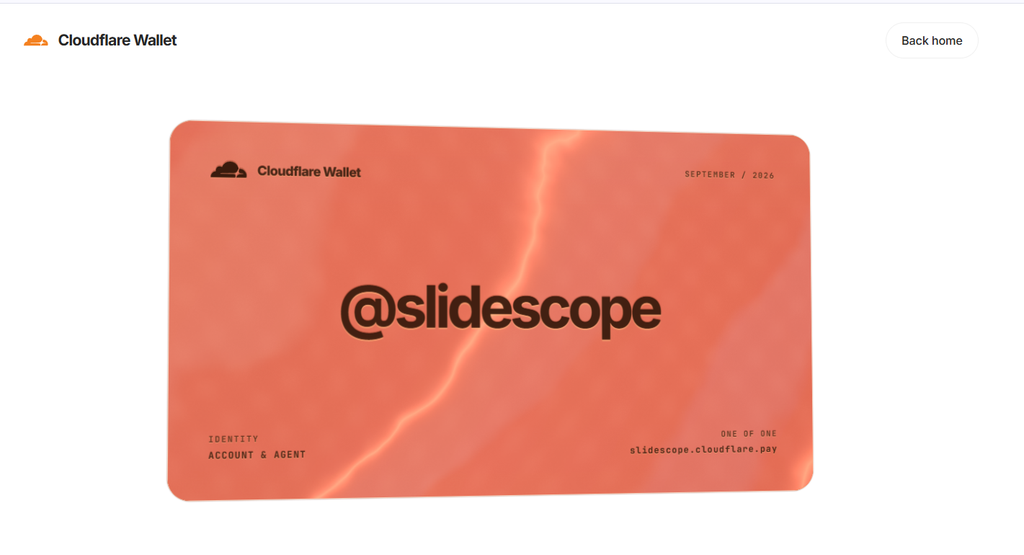
We reserved : https://cloudflare.pay/claimed?tag=slidescope
The easiest way to understand Cloudflare Wallets is to first understand the problem it is trying to solve. Today, an AI agent can search information, call an API, process a document, use an MCP tool or perform a sequence of automated tasks. But when one of those services requires payment, the agent normally reaches a wall. A human has to provide payment details, approve the transaction, purchase credits or maintain a subscription.
That model works when a human is directly using the internet. It becomes less convenient when software is operating independently.
Imagine that you create an AI research agent. You ask it to collect information about a particular industry. During the process, it discovers that one useful database charges for API access. Another service charges for premium content. A third service charges according to the number of requests.
The agent can technically use these services, but how does it pay?
This is where the idea behind Cloudflare Wallets becomes interesting.
Cloudflare describes Wallets as a programmable wallet that gives eligible Cloudflare accounts and AI agents a stable identity and a way to pay for APIs and content. The company says the initial wallet functionality will be designed to send, receive and hold stablecoins.
The system is planned around two different types of wallets.
The first is an Account Wallet. This is designed for humans who own and use Cloudflare accounts. The Account Wallet is intended to be the main source of funds and control. According to Cloudflare, account owners will be able to add funds, delegate spending to Virtual Wallets and remove funds when required.
The second is a Virtual Wallet, which is designed for AI agents.
A Virtual Wallet can operate through API keys, allowing an agent to spend funds according to permissions assigned to it. Cloudflare says the maximum amount an agent can spend will be capped by a limit established by the Account Wallet owner.
That spending-limit concept is particularly important.
You probably would not want an AI agent to have unlimited access to your company’s financial resources. Instead, you could eventually give the agent a defined budget.
For example, a research agent might have a $20 spending limit. A marketing agent might have a $100 limit. A data-processing agent could have a different allowance.
The goal is therefore not simply to give AI access to money.
It is to create controlled financial autonomy.
Cloudflare Wallets is part of a broader Cloudflare ecosystem around AI agents and agentic payments. Cloudflare’s documentation also points developers toward its Agents and Agentic Payments products, including systems designed around agents paying for services and using the x402 protocol.
This is why I see Cloudflare Wallets as more than another cryptocurrency wallet.
The bigger idea is an internet where software agents can have identity, permissions, tools and eventually the ability to pay for the resources they need.
2. How Does Cloudflare Wallets Work?
Cloudflare Wallets is designed around a simple but important relationship between the person or organization controlling the money and the AI agents that are allowed to spend it. The Account Wallet provides the ownership and funding layer, while Virtual Wallets are intended to give individual agents controlled spending capabilities. This separation can make autonomous payments more manageable for developers and businesses.
Let’s understand this with a practical example.
Suppose a company creates an AI agent responsible for market research. The agent has access to search tools, data APIs and several business intelligence services. Some resources are free, while others charge per request.
The company does not want to give the agent access to its main corporate payment credentials.
Instead, the planned Cloudflare Wallet architecture provides a different approach.
The company would have an Account Wallet, while the AI agent would operate through a Virtual Wallet. The Account Wallet owner can determine how much the agent is permitted to spend. Cloudflare says the Virtual Wallet’s maximum spending will be capped by the limit established by the Account Wallet owner.
This creates an important layer between access to money and permission to spend money.
Think about it like an employee expense account.
A company might have millions of dollars available, but an employee may have a $500 expense limit. The employee can perform their job without requesting approval for every small purchase, but they cannot simply spend the entire company’s balance.
Cloudflare is applying a similar concept to autonomous software.
The agent can potentially operate independently while remaining within financial boundaries established by its owner.
The planned wallet system also uses stablecoins.
Cloudflare says its initial Wallets functionality will be able to send, receive and hold stablecoins.
Stablecoins are particularly relevant to this model because they are digital assets designed to maintain a stable value relative to a reference currency. For automated digital transactions, this can provide a more predictable payment mechanism than highly volatile cryptocurrencies.
However, there is an important distinction regarding what is available today.
As of September 18, 2026, Cloudflare’s documentation says that Wallet handle reservations are available, but the actual wallet itself is not yet available for sending, receiving or holding funds.
Users can reserve one wallet handle for each Cloudflare account. The handle is associated with the Cloudflare account and creates a page using the corresponding HANDLE.cloudflare.pay address. The reservation also registers the account for notification when Cloudflare Wallets becomes available.
Cloudflare’s FAQ says the reservation is free and that anyone with a Cloudflare account can reserve one handle. It also says handles are allocated on a first-come, first-served basis.
So, if you reserve a handle today, you should understand what you are actually getting.
You are reserving the identity associated with the future wallet system.
You are not yet receiving a functioning crypto wallet.
This is an important difference for developers.
Cloudflare has published the architecture and intended functionality, but the full wallet capability is still being introduced. Therefore, developers should treat the current reservation system and the planned programmable wallet system as two different stages of the product.
The direction is nevertheless clear.
Cloudflare wants AI agents to be able to operate with identity, tools and controlled payment capabilities.
That could eventually allow a workflow such as:
Agent receives task → discovers required service → checks price → verifies spending permission → makes payment → receives service → completes task.
That is the foundation of agentic commerce.
3. What Are the Benefits of Cloudflare Wallets?
The biggest potential benefit of Cloudflare Wallets is that it could allow AI agents to participate in digital transactions without requiring humans to manually approve every small purchase. Combined with spending limits, stablecoins and programmable permissions, the system is designed to make autonomous software more useful while maintaining control over how much an agent can spend and which financial resources it can access.
The first major benefit is AI-agent autonomy.
AI agents are becoming capable of completing multi-step workflows. They can research topics, interact with APIs, call tools, process information and make decisions based on instructions.
But an agent that cannot pay for anything still depends heavily on humans.
Consider an AI travel agent.
You ask it to find flights, compare hotels, check airport transfers and build an itinerary. Most of the research can be automated, but when a paid data source is required, the agent may need human intervention.
A programmable payment system could eventually allow the agent to pay for permitted resources automatically.
The second benefit is spending control.
This is arguably one of the most important parts of Cloudflare’s proposed architecture.
Giving an AI agent unrestricted access to money would introduce obvious risks. A software system could make mistakes, misunderstand instructions or repeatedly call an expensive service.
Cloudflare’s Virtual Wallet model is designed around spending limits. The owner of the Account Wallet can set the maximum spending capability of the Virtual Wallet.
That means developers can think about AI payments in terms of permissions rather than simply credentials.
For example:
Research Agent → $25 limit
Marketing Agent → $100 limit
Data Agent → $50 limit
The exact controls available when the full product launches will determine how sophisticated this becomes, but the architecture already communicates the basic idea.
The third benefit is machine-to-machine payments.
Traditional online payment systems were primarily designed around people. A person selects a service, enters payment information and confirms the transaction.
AI agents work at a different speed.
An agent could potentially interact with dozens of services within a single workflow. Requiring a human to approve every small transaction would reduce much of the value of autonomous systems.
Programmable wallets could provide the financial layer needed for these interactions.
The fourth benefit is stablecoin support.
Cloudflare says Wallets will initially be able to send, receive and hold stablecoins.
This makes the system naturally compatible with digital commerce where the buyer and seller are software systems rather than people.
The fifth benefit is separation between different AI agents.
A company might operate multiple agents.
One could handle research.
Another could manage advertising.
Another could access data.
Another could purchase digital services.
Instead of giving all of them the same payment credentials, a wallet architecture based on individual Virtual Wallets could provide separate financial boundaries.
This is useful from a security and management perspective.
It also makes accounting potentially easier because businesses could associate particular spending with particular agents or workflows.
Another important area is APIs and digital content.
Cloudflare explicitly says its Wallets are designed to allow AI agents to purchase necessary APIs and content.
That matters because the AI economy is increasingly becoming an ecosystem of specialized services.
An agent may not need to perform everything itself. It may use one API for translation, another for search, another for data analysis and another for image processing.
If each service has a price, the agent needs a way to handle those transactions.
This creates a potential economic layer for AI.
The final benefit is the connection with Cloudflare’s broader agentic payments work. Cloudflare describes Agentic Payments as a way to charge for HTTP content and MCP tools or pay for them from an agent using the x402 protocol.
Put all of this together and the bigger picture becomes easier to understand.
Cloudflare Wallets is not simply trying to make cryptocurrency easier for humans.
It is exploring how software agents can safely participate in digital commerce.
That is the part developers should pay attention to.
4. Why Cloudflare Wallets Matters for the Future of AI
Cloudflare Wallets represents an important development in the evolution of AI agents because today’s agents are moving beyond conversations and toward autonomous task execution. Once an agent can use tools, access information and make decisions, payments become the next practical requirement. Cloudflare’s wallet approach combines identity, stablecoins and spending limits to create a financial layer for this emerging agent-based internet.
Think about how the internet has evolved.
The early web was primarily about humans visiting websites.
Then APIs became common, allowing software applications to communicate with other applications.
Now AI agents are becoming another layer of interaction.
Instead of a human visiting ten websites and comparing information manually, an AI agent can perform that process.
Instead of a developer manually checking several APIs, an agent can potentially select and use the appropriate service.
Instead of a person opening multiple applications, an agent can coordinate several tools.
But there is one major piece missing from many autonomous workflows:
money.
An agent can discover a service, but if the service requires payment, the agent needs a financial mechanism.
That is where Cloudflare Wallets becomes relevant.
Cloudflare’s proposed Account Wallet and Virtual Wallet architecture creates a model where humans remain in control while agents receive limited financial authority. Account Wallets are intended for Cloudflare account owners, while Virtual Wallets are intended for agents and operate through API keys with spending controlled by the Account Wallet owner.
This could eventually support a new type of digital worker.
Imagine telling an AI agent:
“Research the Australian travel market and prepare a report.”
The agent could search the web, access permitted APIs, purchase relevant data, process the information and deliver the final report.
The human would provide the objective.
The agent would execute the workflow.
The wallet would potentially provide the financial permissions required to complete it.
That is the fundamental idea behind agentic commerce.
However, as of September 18, 2026, Cloudflare Wallets should be described accurately as an announced programmable-wallet system with wallet-handle reservations currently available, rather than a fully released wallet service. Cloudflare’s own documentation states that reserved handles do not yet allow users to send, receive or hold funds.
This does not make the project irrelevant.
In fact, it makes the current stage important for developers who want to understand where the technology is heading.
Cloudflare has already published documentation explaining Account Wallets, Virtual Wallets, stablecoin functionality and the relationship between Wallets, AI agents and Agentic Payments.
For developers, the practical lesson is to understand the architecture rather than immediately treating it as another consumer crypto wallet.
Cloudflare Wallets is being designed around programmability.
That word matters.
A traditional wallet primarily answers:
“Where are my digital assets?”
A programmable wallet can potentially answer a much larger question:
“What is this software allowed to spend, where can it spend it, and how much can it spend?”
That becomes especially important when the software is an AI agent.
The future of AI will not necessarily be about one giant model doing everything itself. It could involve networks of specialized agents and services working together.
One agent might research.
Another might analyze.
Another might purchase data.
Another might call an API.
Another might complete the final transaction.
For this ecosystem to work efficiently, these agents need identity, permissions, communication and payment mechanisms.
Cloudflare Wallets is aimed at that financial component.
For businesses, the potential applications are broad. AI-powered research platforms could pay for data. Automated software could purchase API access. Content platforms could charge agents for access. MCP tools could potentially operate within paid workflows. Cloudflare’s Agentic Payments documentation specifically connects its infrastructure with payments for HTTP content and MCP tools through x402.
There will still be important questions around security, financial controls, compliance, user permissions and adoption. Those factors will influence how quickly programmable agent payments become mainstream.
But the underlying direction is clear.
The internet is moving toward a model where software does more work on behalf of people.
If software is going to perform meaningful economic tasks independently, it will eventually need controlled ways to transact.
That is why Cloudflare Wallets is worth watching.
As of September 18, 2026, you can reserve a Cloudflare Wallet handle, but the full wallet functionality is still forthcoming.
The larger idea, however, is already easy to understand:
Cloudflare wants to give AI agents a controlled financial identity so they can eventually pay for the APIs, content and digital services they need to complete tasks.
That could become an important piece of the infrastructure behind the next generation of the internet.
Disclaimer: Cloudflare Wallets is an evolving technology. Features, availability, supported assets, payment capabilities and other functionality may change as Cloudflare develops and releases the service. This article is for informational and educational purposes only and should not be considered financial, investment, legal or technical advice. Refer to Cloudflare’s official documentation for the latest product information.

Ankit Srivastava is an IT trainer, technology educator, and digital skills mentor with expertise in programming, data analytics, AI, and software development. He has successfully trained thousands of learners, with more than 10,000 student enrollments on Udemy. His practical teaching approach empowers students and professionals to build in-demand technical skills. Colorstech channel where Ankit posts video tutorials has more than 8000 Subscribers.