Hello Friends, welcome once again to another article related to coding and development, if there’s one question I’ve been asked more than any other in my training sessions over the past few months, it’s some version of “which AI model should I actually be coding with right now?” And honestly, I get why people are confused — this space has moved faster in the last six months than in the two years before it combined. New models drop, benchmarks shift, pricing gets restructured, and last month’s “best” pick quietly becomes this month’s budget option.
So instead of writing another generic “top AI tools” listicle, I want to give you a genuinely useful, current snapshot — where things actually stand as of July 2026, based on the latest benchmark data, pricing, and how these models are actually performing for developers doing real work, not toy demos.
One honest caveat before we dive in: this field moves on a weekly cadence right now. Treat this as a solid, current decision framework — not a permanent verdict carved in stone. I’d recommend rechecking rankings every couple of months if coding tool selection matters to your work or your team.
How I’m Ranking These
Rather than picking one arbitrary benchmark, I’m weighing a combination of factors that actually matter in practice: raw coding capability (SWE-bench and Terminal-Bench style results), agentic performance (how well a model handles multi-step, autonomous coding tasks — not just single-shot code generation), cost per million tokens, and real developer usage and sentiment across tools like Claude Code, Cursor, and Codex.
With that framework, here’s how the top 10 stack up right now.
The Top 10 AI Coding Models — July 2026
1. Claude Fable 5 — The Frontier Peak
Claude Fable 5 currently holds the top spot for raw coding capability, posting around 95% on SWE-bench Verified — the highest of any model currently available. It retook the coding crown at 80.3% on SWE-bench Pro after returning to general availability on July 1, following a brief suspension tied to U.S. export-control requirements earlier in the quarter.Pricing sits at $10/$50 per million tokens, positioning it as a Mythos-class flagship purpose-built for long-horizon, autonomous agentic coding runs.
If your work involves complex, multi-file refactors or long autonomous coding sessions where reliability matters more than cost, this is currently the model to reach for — with the tradeoff being that most teams won’t run it for everyday, high-volume work given the price point.
2. Claude Opus 4.8 — The Everyday-Value Flagship
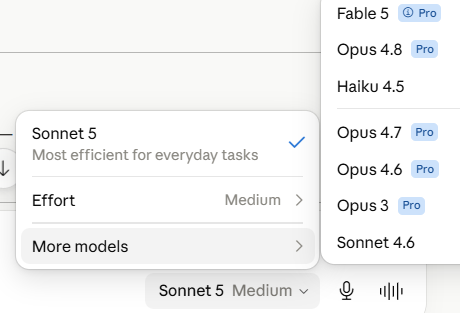
Claude Opus 4.8 sits right behind Fable 5 as the everyday-value pick, priced at $5/$25 per million tokens, and leads Anthropic’s SWE-bench Verified rankings while being the favorite model inside both Cursor and Claude Code. This is the model I personally recommend to most professional developers who want frontier-level reasoning without the premium Fable 5 price tag — it consistently punches above its price point on real-world coding tasks.
3. Claude Sonnet 5 — Best Value in Premium Coding
For most developers in July 2026, Claude Sonnet 5 is a strong choice as your primary coding model, with introductory pricing that makes it the best value currently available in the premium coding tier. If you’re a freelancer or small team trying to balance quality against a monthly API budget, Sonnet 5 is where I’d point you first — it holds its own against much pricier flagships for the vast majority of day-to-day coding tasks.
4. GPT-5.6 Sol — OpenAI’s Reasoning Powerhouse
GPT-5.6 Sol currently leads the Coding Agent Index at a score of 80, with Sol specifically winning on raw quality with a score of 59 on broader intelligence benchmarks. On Terminal-Bench Hard specifically, GPT-5.6 Sol posts around 66%, edging out several competitors on complex, real-terminal coding tasks. If your workflow leans heavily on agentic, multi-step terminal operations, Sol is genuinely one of the strongest options on the market right now.
5. GPT-5.6 Luna — The Budget OpenAI Option
GPT-5.6 Luna fills OpenAI’s budget slot at $1/$6 per million tokens, with a Coding Agent Index score of 75 — remarkably close to much pricier flagship models.For students, hobbyists, or teams running high-volume, lower-stakes coding tasks (boilerplate generation, simple scripts, test writing), Luna offers a genuinely strong capability-to-cost ratio.
6. Gemini 3.1 Pro — Google’s Reasoning Contender
Google’s flagship reasoning model remains a strong pick for developers already embedded in the Google Cloud and Vertex AI ecosystem, particularly for tasks that benefit from strong multimodal understanding alongside code generation — useful when you’re working from screenshots, diagrams, or design mockups alongside your codebase. It’s commonly grouped among the top-tier planning and architecture models, alongside Claude Fable 5, Opus 4.8, and GPT-5.6 Sol, for teams running a “large model plans, smaller model executes” workflow.
7. Grok 4.5 — xAI’s Raw Performance Play
Grok 4.5 from xAI holds a strong position in the current coding model landscape, particularly noted for raw benchmark scores.Worth watching here: Cursor’s parent company Anysphere is in the process of being acquired by SpaceX in a deal expected to close in Q3 2026, with a jointly developed Grok-integrated model reportedly on the roadmap — meaning xAI’s coding presence inside popular developer tools is likely to grow significantly in the coming months.
8. Kimi K3 — The Open-Weight Frontend Specialist
Moonshot AI’s Kimi K3, launched July 16, debuted at #1 on Arena.ai’s Frontend Code Arena with a 1679 Elo rating and a score of 57 on the Intelligence Index — making it the first open-weight model to directly challenge Fable 5 and Sol on real-world coding tasks. If your work is heavily frontend-focused — React components, UI generation, visual layouts — this is currently the strongest open-weight option specifically for that use case.
9. GLM-5.2 — The Open-Weight Daily Driver
GLM-5.2 has emerged as the new open-weight daily driver — MIT-licensed, strong on Terminal-Bench 2.1, and it slots directly into Claude Code as a drop-in alternative model. For teams that want open-weight flexibility (self-hosting, fine-tuning, data control) without sacrificing too much day-to-day coding quality, GLM-5.2 is currently the most practical choice in that category.
10. DeepSeek V4-Pro — The Budget Frontier Option
DeepSeek V4-Pro is currently the cheapest frontier-class coding model available, priced at $0.435/$0.87 per million tokens — a fraction of what the premium flagships charge. It won’t match Fable 5 or Sol on the hardest, most complex coding challenges, but for the overwhelming majority of everyday development tasks, it delivers a genuinely strong result at a price that makes high-volume usage financially painless.
Honorable mentions worth knowing about: MiniMax M3 is currently the outright budget king at $0.30/$1.20 per million tokens with a full 1M token context window, and Qwen3-Coder remains a solid open-weight pick if you’re running models locally on consumer-grade hardware.
Quick-Reference Comparison Table
For those who just want the numbers side by side before reading further:
| Rank | Model | Developer | Pricing (per 1M tokens, input/output) | Best For | Key Benchmark |
|---|---|---|---|---|---|
| 1 | Claude Fable 5 | Anthropic | $10 / $50 | Hardest problems, long-horizon agentic runs | ~95% SWE-bench Verified |
| 2 | Claude Opus 4.8 | Anthropic | $5 / $25 | Everyday frontier-level coding | Leads SWE-bench Verified rankings |
| 3 | Claude Sonnet 5 | Anthropic | Intro pricing (best value premium tier) | Freelancers, small teams, daily driver | Strong across day-to-day tasks |
| 4 | GPT-5.6 Sol | OpenAI | Premium tier | Complex agentic/terminal workflows | 80 Coding Agent Index, 66% Terminal-Bench Hard |
| 5 | GPT-5.6 Luna | OpenAI | $1 / $6 | Students, high-volume simple tasks | 75 Coding Agent Index |
| 6 | Gemini 3.1 Pro | Mid-premium | Multimodal coding (screenshots, diagrams) | Top-tier planning/architecture model | |
| 7 | Grok 4.5 | xAI | Mid-premium | Raw benchmark performance, Cursor integration incoming | Strong on raw scores |
| 8 | Kimi K3 | Moonshot AI | Open-weight | Frontend/UI code generation | #1 Frontend Code Arena, 1679 Elo |
| 9 | GLM-5.2 | Zhipu AI | Open-weight (MIT license) | Self-hosting, data privacy, Claude Code drop-in | Strong on Terminal-Bench 2.1 |
| 10 | DeepSeek V4-Pro | DeepSeek | $0.435 / $0.87 | Budget-friendly frontier-class quality | Cheapest frontier-class option |
Honorable mentions: MiniMax M3 ($0.30 / $1.20, 1M context — outright budget king) and Qwen3-Coder (best for local, consumer-hardware deployment).
Note: Pricing and benchmark data are current as of July 2026 and may change without notice. Always verify current specs and pricing on the official provider website before making a decision.
How to Actually Choose Between These
I know a ranked list is useful, but the real question my students ask is “okay, but which one should I actually use?” Here’s how I’d break it down.
If you’re a professional developer or a small agency
The strongest practitioners I see aren’t picking just one model — they’re running a system: a large reasoning model like Claude Fable 5, Opus 4.8, or GPT-5.6 Sol to plan and architect the work, a cheaper, faster model like Claude Sonnet 5, GPT-5 Mini, or GLM-5.2 to actually execute the plan, and often a separate, independent model to review the output before it ships. This layered approach consistently produces better, more reliable results than relying on a single model for everything, and it keeps your overall API costs manageable since the expensive model only handles the parts that genuinely need deep reasoning.
If you’re a student or learning to code
Start with a budget-friendly option like GPT-5.6 Luna, DeepSeek V4-Pro, or GLM-5.2. At this stage, you genuinely benefit more from writing a large volume of code and getting frequent feedback than from having access to the absolute frontier model — and keeping costs low means you can practice without worrying about your API bill.
If your work is heavily frontend or UI-focused
Kimi K3’s strong Frontend Arena performance makes it worth specifically testing against your usual model for component generation, layout work, and visual UI tasks — this is a case where a specialized open-weight model may genuinely outperform a more expensive generalist.
If data privacy or self-hosting is a hard requirement
GLM-5.2 and Qwen3-Coder are your strongest current options — both are open-weight, meaning you can self-host and keep your codebase entirely off third-party servers, which matters significantly for regulated industries or companies with strict IP policies.
If you’re choosing between a subscription and API access
For interactive, daily coding work, a subscription (like Claude Max or Cursor) tends to make more financial sense. For programmatic agents, CI pipelines, and bursty automated workloads, paying through the API directly is usually more cost-effective — and increasingly, serious development setups run both simultaneously rather than choosing one exclusively.
A Quick Word on Tooling, Not Just Models
Which model you pick matters, but so does where that model actually lives day-to-day — Claude Code offers terminal-native autonomy, OpenAI Codex works well for cloud-based, asynchronous batch tasks, and Cursor remains the strongest AI-native IDE experience for many developers. Increasingly, I see experienced engineers using more than one tool depending on the specific task at hand, rather than committing entirely to a single ecosystem.
My Honest Take, 10 Years Into This Industry
Here’s what I’d tell any of my students directly: don’t chase the “best” model as if it’s a permanent title. The broader shape of the market right now is fairly stable even as individual benchmark numbers shift weekly — Anthropic currently leads the top of the coding stack, OpenAI and Google are close behind on reasoning capability, xAI is competitive on raw scores, and open-weight coding models have closed most of the capability gap at a fraction of the price.
What actually separates developers who get consistently great results from AI coding tools isn’t which specific model logo they’re using — it’s whether they write clear, spec-driven prompts, review AI-generated code carefully rather than blindly trusting it, and pick the right model for the specific task rather than defaulting to whatever’s currently trending. I’ve written about this discipline in more depth in my earlier article on the Do’s and Don’ts of vibe coding, and honestly, that discipline matters more than this month’s benchmark leaderboard.
Final Thoughts
The AI coding landscape in July 2026 offers more genuinely strong options than at any point I’ve seen in this industry — from frontier models like Claude Fable 5 and GPT-5.6 Sol for the hardest problems, down to remarkably capable budget options like DeepSeek V4-Pro and MiniMax M3 for high-volume, everyday work. The right choice depends far more on your specific use case, budget, and workflow than on chasing whichever model tops this month’s leaderboard.
If you want to genuinely understand how to work effectively with these tools — not just which one to pick, but how to prompt them properly, review their output critically, and build them into a reliable development workflow — that’s exactly what we cover hands-on in our AI-assisted development training programs at SlideScope.com.

Ankit Srivastava is an IT trainer, technology educator, and digital skills mentor with expertise in programming, data analytics, AI, and software development. He has successfully trained thousands of learners, with more than 10,000 student enrollments on Udemy. His practical teaching approach empowers students and professionals to build in-demand technical skills. Colorstech channel where Ankit posts video tutorials has more than 8000 Subscribers.