Search engine optimization has evolved far beyond simple keyword research and backlink building. Today’s SEO professionals must combine customer research, search intent analysis, topical authority, competitor intelligence, AI search optimization, and revenue-focused content planning. In this guide, you’ll discover nine powerful ChatGPT or Claude prompts designed to help marketers, business owners, consultants, and SEO specialists create a complete 12-month SEO strategy. These prompts can help you identify ideal customers, uncover profitable keywords, build content clusters, analyze competitors, create content calendars, optimize service pages, and improve visibility in AI-powered search engines such as ChatGPT, Google AI Overviews, Gemini, Claude, and Perplexity.
Prompt 1 – Ideal Customer Profile & Search Intent Research
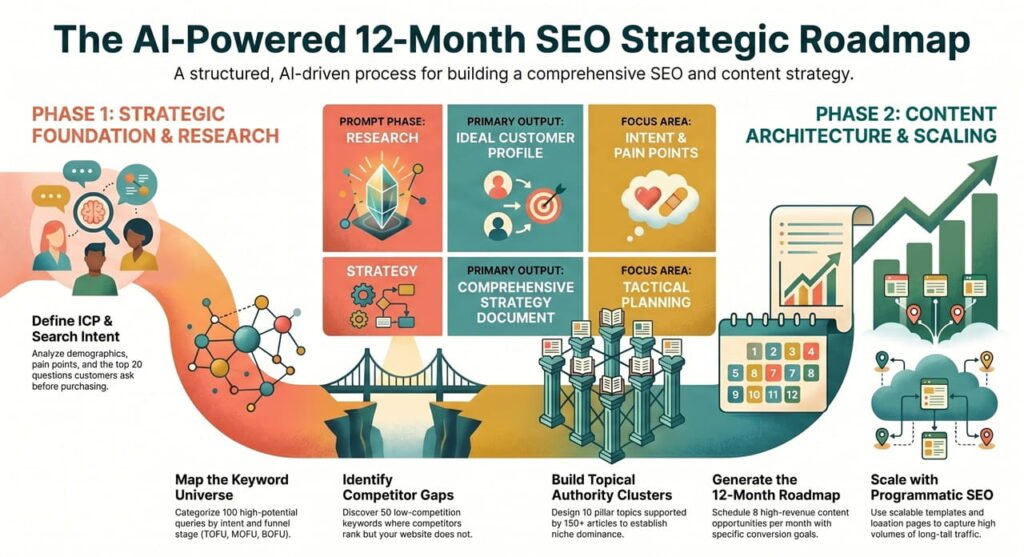
You are a senior SEO and market research consultant. Create a comprehensive Ideal Customer Profile (ICP) for a business in the [INDUSTRY] niche targeting [LOCATION]. Include demographics, job roles, business size, pain points, goals, objections, buying triggers, customer journey stages, search behavior, preferred content formats, and the top 20 questions they are likely to search on Google before purchasing.
Prompt 2 – Keyword Universe & Search Intent Mapping
Using the ICP above, generate 100 high-potential keywords and search queries. Categorize them into topic clusters and classify each keyword by search intent (Informational, Commercial, Transactional, Navigational) and funnel stage (TOFU, MOFU, BOFU). Include estimated keyword difficulty, content type recommendation, and AI-search visibility potential.
Prompt 3 – Competitor Gap Analysis
Analyze the following competitors: [Competitor URLs]. Identify keyword gaps, content gaps, backlink opportunities, and under-served topics. Generate a list of 50 keywords that competitors rank for but my website does not. Prioritize opportunities based on low competition, commercial intent, and ranking potential for a website with a Domain Rating of [DR].
Prompt 4 – Topical Authority Content Clusters
Build a complete topical authority SEO framework for [BUSINESS TYPE]. Create 10 pillar topics, each containing 10-15 supporting articles. For every content piece provide:
- Primary keyword
- Secondary keywords
- Search intent
- Recommended URL slug
- Internal linking opportunities
- Funnel stage
- AI Overview optimization suggestions
Prompt 5 – 12-Month SEO Content Roadmap
Create a detailed 12-month content marketing calendar. Generate 8 content opportunities per month prioritized by revenue potential. Include:
- Content title
- Target keyword
- Search volume potential
- Funnel stage
- Content format
- Publishing month
- Internal linking recommendations
- Conversion goal
- CTA recommendation
Prompt 6 – High-Converting Service Page Framework
Create SEO-optimized outlines for 20 service pages targeting commercial and transactional keywords. For each page provide:
- SEO Title
- Meta Description
- H1
- H2 Structure
- FAQ Schema Questions
- Internal Linking Strategy
- Entity Suggestions
- Trust Signals
- Conversion Elements
- Strong CTA Sections
- AI Search Optimization Recommendations
Prompt 7 – Programmatic SEO Opportunities
Identify 50 programmatic SEO opportunities for [BUSINESS NAME]. Suggest scalable page templates, location pages, industry pages, comparison pages, statistics pages, and calculator/tools that can generate long-tail organic traffic at scale.
Prompt 8 – AI Search & ChatGPT Citation Strategy
Create a complete GEO (Generative Engine Optimization) strategy to increase visibility in ChatGPT, Google AI Overviews, Gemini, Claude, and Perplexity. Identify content types, citation-worthy assets, data studies, expert insights, statistics pages, and schema opportunities that increase the likelihood of being referenced by AI systems.
Prompt 9 – SEO Revenue Growth Plan
Act as a Fractional SEO Director. Create a 12-month SEO growth strategy for [BUSINESS NAME] with the goal of generating qualified leads and revenue. Include monthly priorities, KPIs, content targets, link-building strategy, technical SEO improvements, CRO recommendations, expected outcomes, and reporting metrics.
These versions are more aligned with how SEO agencies in 2026 are planning campaigns around topical authority, AI search visibility, entity SEO, GEO (Generative Engine Optimization), and revenue-focused SEO, rather than just keyword rankings.
Conclusion
Building a successful SEO strategy in today’s digital landscape requires much more than publishing a few blog posts and hoping they rank. Search engines have become smarter, competition has increased across nearly every industry, and AI-powered search experiences are changing how users discover information online. Businesses that want sustainable organic growth must adopt a more strategic, data-driven, and customer-focused approach to SEO.
The nine prompts shared in this guide are designed to help marketers, business owners, consultants, agencies, and content creators develop a complete SEO framework that aligns with modern search behavior. Instead of focusing solely on keywords, these prompts encourage a deeper understanding of your target audience, their pain points, their buying journey, and the questions they ask before making a purchasing decision.
Everything begins with understanding your Ideal Customer Profile (ICP). Without knowing exactly who you are trying to reach, even the most technically optimized website can struggle to generate meaningful results. By identifying customer needs, search habits, objections, and motivations, you can create content that resonates with the right audience and attracts visitors who are more likely to convert into leads and customers.
Keyword research remains one of the foundations of SEO, but successful keyword strategies now extend beyond search volume. Search intent, content relevance, and topical coverage play a significant role in determining whether a page earns visibility. Organizing keywords into topic clusters and funnel stages allows you to create content that supports users throughout their entire decision-making process. This approach helps search engines better understand your expertise while creating a smoother experience for potential customers.
Competitor analysis is another critical component of a modern SEO strategy. Rather than attempting to outrank every competitor on every keyword, smart businesses identify gaps and opportunities where they can realistically compete and win. Understanding which keywords competitors rank for, where their content is weak, and which topics remain underserved can reveal valuable opportunities for growth. Often, the quickest SEO wins come from targeting gaps that competitors have overlooked.
Creating topical authority has become increasingly important as search engines prioritize expertise and comprehensive coverage of subjects. The hub-and-spoke model outlined in these prompts helps businesses organize content in a logical structure that demonstrates depth of knowledge. By connecting pillar pages with supporting content, websites can improve internal linking, strengthen contextual relevance, and increase their chances of ranking for a broader range of search queries.
Consistency is another factor that separates successful SEO campaigns from unsuccessful ones. A well-planned content calendar ensures that content production remains aligned with business goals throughout the year. Publishing strategically across TOFU, MOFU, and BOFU stages allows businesses to attract new audiences, nurture prospects, and convert visitors into customers. Without a structured publishing plan, many organizations struggle with inconsistent content efforts that fail to build momentum over time.
Service pages remain some of the most valuable assets on a business website because they target users with high commercial intent. Optimizing these pages with clear messaging, strong calls-to-action, frequently asked questions, internal links, and trust-building elements can significantly improve conversion rates. Effective service pages do more than rank—they persuade visitors to take action and become customers.
One of the most exciting opportunities in SEO today is the rise of programmatic SEO. Businesses that can create scalable content systems around locations, industries, comparisons, tools, statistics, and resource pages can unlock significant growth opportunities. When implemented correctly, programmatic SEO allows websites to capture large amounts of long-tail traffic while maintaining quality and relevance.
At the same time, the growth of AI-powered search experiences is reshaping how information is discovered online. Platforms such as ChatGPT, Google AI Overviews, Gemini, Claude, and Perplexity increasingly summarize and recommend information directly to users. As a result, businesses must think beyond traditional rankings and focus on becoming trusted sources that AI systems reference and cite. Creating authoritative content, publishing original insights, using structured data, and demonstrating expertise can improve visibility across both traditional search engines and emerging AI-driven platforms.
Perhaps the most important takeaway from these prompts is that SEO should always be connected to business outcomes. Rankings and traffic are valuable, but they are not the ultimate goal. The true purpose of SEO is to attract qualified visitors, generate leads, increase sales, and support long-term business growth. Every keyword targeted, every article published, and every optimization implemented should contribute toward measurable business objectives.
The combination of AI tools and human expertise creates an unprecedented opportunity for businesses willing to invest in strategic SEO. AI can accelerate research, generate ideas, identify opportunities, and streamline workflows, while human creativity, industry knowledge, and critical thinking ensure that content remains valuable and differentiated. Organizations that successfully combine these strengths will be well-positioned to outperform competitors in the years ahead.
Whether you are launching a new website, managing SEO for clients, growing an agency, or scaling an established business, these nine prompts provide a practical framework for building a comprehensive 12-month SEO strategy. Use them as a starting point, customize them for your industry, and continuously refine your approach based on data and results.
SEO is not a one-time project but an ongoing process of learning, testing, improving, and adapting to changes in search behavior and technology. Businesses that commit to this long-term mindset will be better equipped to build authority, increase visibility, attract qualified traffic, and achieve sustainable growth in both traditional search engines and the rapidly evolving world of AI-powered search.

Ankit Srivastava is an IT trainer, technology educator, and digital skills mentor with expertise in programming, data analytics, AI, and software development. He has successfully trained thousands of learners, with more than 10,000 student enrollments on Udemy. His practical teaching approach empowers students and professionals to build in-demand technical skills. Colorstech channel where Ankit posts video tutorials has more than 8000 Subscribers.