The Changing Relationship Between Search Visibility and Website Traffic
For years, businesses have measured their online visibility through familiar metrics: organic rankings, website clicks, impressions, referral traffic, and conversions. If a product appeared on Google’s first page and attracted clicks, marketers considered that a successful SEO outcome. However, the growing influence of artificial intelligence in search is challenging this traditional understanding.
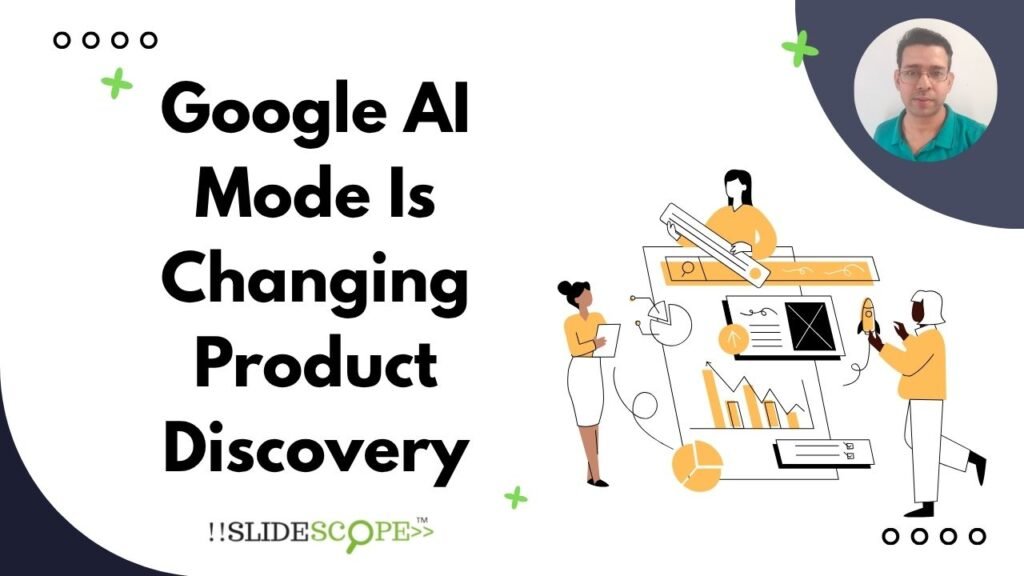
Google AI Mode is introducing a different way for consumers to discover products, compare prices, explore brands, and make purchasing decisions. Instead of presenting a conventional list of ten blue links, Google’s AI-powered search experience can generate product-focused answers using information from its shopping ecosystem.
A recent study by Findrix, which examined 55,198 AI-generated answers in the United States, highlights an important development. Google AI Mode linked exclusively to Google’s own pages in 46.5% of U.S. product answers. Furthermore, approximately 57% of all links appearing in AI Mode product answers directed users to Google Shopping product pages.
These findings deserve attention from e-commerce businesses, digital marketers, SEO professionals, and online retailers.
After reviewing these findings alongside broader developments in AI-powered search, I believe businesses need to reconsider how they measure search visibility. Website traffic remains important, but it may no longer provide a complete picture of how effectively a brand appears in AI-generated product recommendations.
Let’s understand what this research reveals and how businesses can prepare.
1. Google AI Mode Is Becoming a Product Discovery Platform
Google has spent years building its shopping ecosystem, including product listings, merchant information, prices, availability, customer ratings, and shopping-related search features.
AI Mode brings many of these capabilities together through conversational search.
For example, imagine someone searching for the best sunscreen for sensitive skin. Instead of opening multiple websites, the user may receive an AI-generated answer containing product recommendations, pricing information, ratings, and shopping links.
The user can compare several options without necessarily visiting individual retailer websites.
The Findrix study indicates that this behaviour is particularly relevant to product-related searches. With 57% of links in AI Mode product answers directing users to Google Shopping pages, Google’s shopping infrastructure appears to play a significant role in how products are presented.
For retailers, this creates an interesting situation.
A product can gain visibility within Google’s AI-generated recommendations even when the shopper does not immediately visit the retailer’s website.
This means product discovery and website traffic are becoming two different measurements of online visibility.
Businesses that depend entirely on organic website visits to evaluate their SEO performance could overlook an increasingly important part of their search presence.
2. Fashion and Beauty Categories Face Greater Dependence on Google’s Ecosystem
One of the most interesting findings concerns the differences between product categories.
According to Findrix, Google AI Mode linked exclusively to Google’s own pages in a significant proportion of answers involving fashion and beauty products.
The study reported the following figures:
| Product category | Answers linking only to Google pages |
|---|---|
| Swimwear | 60.4% |
| Women’s everyday fashion | 57.0% |
| Sun care | 54.1% |
| Activewear | 53.8% |
| Sports nutrition | 7.6% |
These differences suggest that AI search does not treat every product category in the same way.
Fashion and beauty products often have structured attributes that can be presented through shopping listings. These include product images, sizes, colours, prices, brands, customer ratings, and availability.
Google can use these attributes to help shoppers evaluate products without requiring them to visit multiple external websites.
Consider a consumer searching for women’s running leggings. The search experience may provide several products with images, prices, ratings, and shopping destinations.
From the consumer’s perspective, this is convenient. From a retailer’s perspective, however, it raises a visibility question: how often does the brand appear in the recommendation process, even if the shopper never visits its product page?
The sports nutrition category presents a different picture. Only 7.6% of answers linked exclusively to Google pages.
This difference may reflect variations in product discovery, available information, and the types of external resources consumers need when evaluating products.
The important lesson is that e-commerce businesses should not assume that AI search visibility behaves identically across industries.
SEO strategies must consider the search behaviour and information requirements of individual product categories.
3. Local Services and Software Businesses Experience a Different AI Search Pattern
The research becomes particularly interesting when we move beyond physical products.
According to the study, only 5.1% of AI Mode links for local service searches went to Google pages. These searches included businesses such as plumbers, lawyers, and dentists.
For software-related questions, the percentage was even lower, at just 1.1%.
Why is there such a significant difference?
Product searches can often be supported by structured shopping information. Google has access to a substantial product database containing information such as prices, ratings, and inventory.
However, evaluating a professional service or software solution requires different information.
Someone looking for a plumber may want to examine service areas, qualifications, customer reviews, previous projects, and contact information.
Similarly, someone researching project management software may want to explore detailed feature comparisons, integrations, pricing plans, documentation, customer experiences, and product demonstrations.
This information frequently exists on external business websites.
Consequently, service providers and software companies may continue to receive substantial opportunities for visibility through external website citations.
For these industries, investing in high-quality service pages, detailed product documentation, customer case studies, and informative resources remains important.
The opportunity is not simply to rank for a keyword. It is to become a credible source that AI-powered search experiences can reference when answering a user’s question.
4. Why Google’s Product Database Matters
Findrix co-founder Yosif Merman attributed Google’s product-heavy linking behaviour to its shopping database.
The explanation is logical.
Google’s shopping ecosystem contains structured information that helps the search engine understand products and their commercial attributes.
For example, a product listing may contain:
- Product name and brand.
- Current price and promotional pricing.
- Product images.
- Available sizes and colours.
- Customer ratings and reviews.
- Merchant information.
- Inventory and availability details.
When this information is available in a structured format, Google’s AI systems can potentially use it to construct useful product answers without relying on an external webpage for every recommendation.
This creates an important opportunity for online retailers.
Businesses should pay greater attention to the accuracy and completeness of their product information across Google’s shopping ecosystem.
Product titles should clearly describe what is being sold. Images should accurately represent the item. Prices and availability should remain updated, while product attributes should be consistent across listings and website pages.
Google Merchant Center and product feeds therefore deserve attention as part of a broader AI search visibility strategy.
Traditional SEO optimisation is not disappearing. Instead, product data management is becoming an increasingly important part of digital discoverability.
5. ChatGPT and Gemini Follow Different Linking Patterns
Another interesting part of the Findrix research is the comparison between Google’s AI Mode, ChatGPT, and Gemini.
The platforms appear to approach citations and external sources differently.
According to the study, ChatGPT included approximately 25 links per answer, compared with approximately three links for Google AI Mode.
Gemini’s measured links did not include google.com.
The study also identified differences in product-related recommendations.
| Platform | Notable research finding |
|---|---|
| Google AI Mode | Approximately 57% of product-answer links led to Google Shopping |
| ChatGPT | Approximately 25 links per answer |
| Gemini | No measured links directed to google.com |
The research also examined the presence of major shopping platforms in ChatGPT’s product answers.
Walmart appeared in 45.1% of the measured cases, while Amazon appeared in 6.1%.
These figures demonstrate why businesses should avoid treating AI search as a single marketing channel.
A website’s visibility in Google AI Mode may be very different from its visibility in ChatGPT or Gemini.
Each platform can use different information sources, retrieval approaches, product databases, and citation patterns.
For digital marketers, this means an SEO strategy focused exclusively on Google rankings may not adequately address the wider AI discovery landscape.
Businesses should understand where their audiences search and how different AI platforms present relevant brands and products.
6. Reddit Citations Reveal Another Important Difference
The study also examined Reddit citations across the three platforms.
ChatGPT cited Reddit in 35.6% of all measured U.S. answers. In comparison, Reddit appeared in 5.1% of Google AI Mode answers and 1.5% of Gemini answers.
This is an interesting finding because Reddit has become an important destination for consumers researching products, services, and purchasing decisions.
People often use discussion communities to understand real-world experiences.
For example, someone considering a particular laptop might search Reddit for discussions about battery performance, overheating, durability, and customer support.
Similarly, consumers researching skincare products may look for discussions about product suitability and personal experiences.
These conversations provide a different type of information compared with conventional product descriptions.
For businesses, the implication is that online reputation and community discussions can influence how their products are discovered and evaluated.
However, brands should approach community engagement carefully. Artificially promoting products or publishing misleading recommendations can damage credibility.
A better strategy is to provide genuine assistance, answer relevant questions, address customer concerns, and encourage authentic customer feedback.
Reddit visibility should be treated as one component of a wider reputation and content strategy rather than an opportunity for aggressive promotional posting.
7. What E-commerce Businesses Should Change in Their SEO Strategies
The research highlights a shift in how consumers may discover products through AI-powered search.
For e-commerce businesses, the objective should be to improve visibility across both traditional search results and AI-generated shopping experiences.
Here are several practical areas worth prioritising.
Improve product feed quality
Review product information submitted through Google Merchant Center. Ensure titles, descriptions, images, prices, availability, and product identifiers are accurate and consistent.
Use structured product data
Implement appropriate Product and Offer structured data on product pages. Where relevant, include ratings, reviews, price, currency, and availability information.
Structured data helps search engines understand product attributes and their relationships.
Create informative product pages
Do not rely entirely on short descriptions supplied by manufacturers. Explain product benefits, specifications, use cases, materials, compatibility, and limitations.
Useful content helps customers make informed decisions.
Build brand authority beyond Google
Develop a presence across relevant industry publications, review platforms, communities, and trusted third-party websites.
Different AI platforms may rely on different sources when generating answers.
Monitor AI search visibility
Track whether your products and brand appear in relevant AI-generated answers. Compare findings across Google AI Mode, ChatGPT, and Gemini.
Look beyond website sessions to understand product mentions, citations, recommendation frequency, and the quality of the surrounding context.
Strengthen customer reviews
Encourage genuine customer feedback and respond professionally to questions and complaints.
Reviews can provide valuable information for both prospective buyers and search experiences that incorporate customer sentiment.
8. Why Traditional SEO Metrics Are No Longer Enough
One of the biggest lessons from this research is that website traffic cannot independently measure the success of an AI search strategy.
Consider an online fashion retailer whose products appear regularly in Google AI Mode recommendations.
A customer might discover a product, compare its price, and visit a Google Shopping listing. The retailer gains product exposure, but its website analytics may not record a corresponding organic visit.
If the customer subsequently purchases through another route, conventional organic traffic reports may fail to capture the initial discovery process.
This creates a measurement challenge.
Marketing teams should continue monitoring organic clicks, impressions, rankings, conversions, and revenue. However, they should also explore additional indicators:
- Brand mentions in AI-generated answers.
- Product appearances in AI shopping recommendations.
- Frequency of citations across AI platforms.
- Product feed accuracy and approval status.
- Customer reviews and brand reputation.
- Referral traffic from AI platforms.
- Assisted conversions and overall sales performance.
Not every metric will be directly measurable through existing analytics tools. Nevertheless, developing a broader measurement framework will help businesses understand their position in an increasingly AI-driven search environment.
Conclusion: Visibility Is Becoming More Important Than Clicks Alone
The Findrix study of 55,198 AI-generated answers offers an interesting perspective on how Google AI Mode is changing product discovery.
With 46.5% of U.S. product answers linking exclusively to Google’s own pages and approximately 57% of product-answer links directing users to Google Shopping, the relationship between search visibility and external website traffic is clearly worth examining.
The differences between fashion, beauty, local services, and software also demonstrate that AI search behaviour varies significantly by industry.
Meanwhile, ChatGPT and Gemini show different citation patterns, reinforcing the importance of building visibility beyond a single search platform.
My recommendation is straightforward: businesses should stop evaluating their entire digital visibility strategy through website traffic alone.
Product data, structured information, brand authority, customer experiences, third-party mentions, and AI-generated recommendations are becoming important parts of the discovery journey.
Traditional SEO still matters, but the definition of successful SEO is expanding.
The businesses that prepare for this transition will be better positioned to attract attention, build trust, and influence purchasing decisions, even when the customer does not immediately click through to their website.
The future of search will not simply be about getting users to visit a webpage. It will increasingly be about ensuring that your brand, products, and expertise become part of the answers people receive.

Ankit Srivastava is an IT trainer, technology educator, and digital skills mentor with expertise in programming, data analytics, AI, and software development. He has successfully trained thousands of learners, with more than 10,000 student enrollments on Udemy. His practical teaching approach empowers students and professionals to build in-demand technical skills. Colorstech channel where Ankit posts video tutorials has more than 8000 Subscribers.